Showing posts sorted by relevance for query black-death. Sort by date Show all posts

Black Death

Black Death
Black Death

The Black Death (Black Plague, The Plague, Bubonic Plague) was so named because the skin on many of its victims turned black, a result of massive blood clots. Although there have been many plagues throughout history, the three most associated with the term Black Plague are pandemics (epidemics that affect huge geographic areas) that occurred in Justinian, began in Egypt, according to Procopius.

The disease spread from the coasts to inland areas, killing thousands of people each day. Allegedly, corpses were put on ships and sent out to sea to be abandoned. The power shift from south to north and from the Mediterranean to the British Isles is attributed to this devastation.

It was the second pandemic—a series of outbreaks that escalated from an early adegan in 1331 to the disastrous events in 1346—that is most frequently referred to as the Black Death. In 1346 a Mongol prince and his armies attempted to lay siege to Caffa, in the Crimea. However, the soldiers were stricken with this dreadful disease and withdrew, but not before catapulting infected corpses over the city wall.


The Christian defenders, who thought they were now safe from attack, left to return home but perished from the plague. The few who reached home spread the disease throughout Europe and as far north as Greenland. Within a year 80 percent of Marseille had died. According to various sources, the death rate varied from 12 to 50 percent. It is estimated that in Europe 20–25 million, and throughout the world 42 million people died.

There are three forms or types of the disease: bubonic, pneumonic, and septicemic. The most dramatic is the septicemic version. Immense numbers of bacteria cause DIC (disseminated intravascular coagulation), a condition where there is so much debris in the bloodstream, the blood hemorrhages under the skin and the afflicted person’s body, or parts of it, becomes black. These victims died almost immediately, within one to three days after they showed symptoms of the disease.

Plague doctor...the "beak" would contain herbs that would help to protect the Doctor from contracting the disease. It was basically useless...of course they didn't realize how disease was spread and the different methods of cross contamination, etc...
Plague doctor
Giovanni Boccaccio (1313–75), the author of characteristic symptoms after being exposed.

The most painful symptom was swelling of the lymph glands in the armpit, groin, and neck. These enlargements would become buboes, painful abscesses; skin infections filled with pus. When the bubo broke and drained, the purulent material inside was infectious and therefore spread to whomever touched the patient or the anything the patient’s clothing, bedding, or items that he handled.

Boccaccio wrote, “... in men and women alike there appeared, at the beginning of the malady, certain swellings, either on the groin or under the armpits, whereof some waxed of the bigness of a common apple, others like unto an egg, some more and some less, and these the vulgar named plagueboils ... to appear and come indifferently in every part of the body; wherefrom, after awhile, the fashion of the contagion began to change into black or livid blotches, which showed themselves in many, first on the arms and about the thighs and after spread to every other part of the person ... a very certain token of coming death ...”

Patients with the bubonic form spread the pneumonic form via fine droplets from a cough or sneeze. Although it was less lethal than the septicemic version, victims suffered from painful coughing episodes and eventually they coughed so much that the lining of their lungs became irritated and they coughed up blood.

People were so fearful of catching the plague that they abandoned their own family members, friends, homes, and public spaces in order to escape contact with anyone stricken with the disease. Doctors who were still willing to treat patients donned hoods with masks, beaks and hats in order to avoid breathing the air around a plague victim. They had no way of understanding the natural history or cause of this disease.

They blamed an unlucky conjunction of astrological influences, such as Saturn, Jupiter and Mars, and poison from the tails of comets, or blamed Jews for allegedly poisoned the wells. But even after the wells had been sealed, people continued to get the plague.

Some of the treatments such as cupping, purging and bleeding, although acceptable in the 14th century, did more harm than good and weakened anyone who remained alive after such insults to their feeble bodies. Amazingly some people survived and because of their illness, developed antibodies that provided immunity against a future attack.

The Spread of the Black Plague

The Black Death ripped through Europe

This second pandemic was facilitated by a number of factors. Populations had reached such high numbers in Europe that there was not enough food to feed everyone. Consequently those who could not afford the rising cost of food lacked adequate nutrition, and became easy targets for any new threat to health. There were trade routes connecting urban centers and increased travel in the form of caravans. Returning crusaders were spreading Christianity and, at the same time, the plague.

The causative organism Pasturella pestis (now called Yersinia pestis) was already present in the burrowing rodents of the Manchurian-Mongolian steppes but did not create a plague until the black rat (Rattus rattus) spread to Europe with a specific kind of flea. Rattus rattus originated in Asia but reached Europe during the early Middle Ages. They thrived in environments where people lived, near water, and traveled by ship.

The black rat’s flea Xenophylla cheopsis would bite the rat, but instead of being satisfied with its blood meal, its digestive tract would get plugged with plague bacteria, thus creating a constant hunger. It would voraciously bite anything in its path, including humans. When it found a human host, it spread the disease through repeated bites.

Europe had eradicated both the opportunity and the infection, but Asia suffered acutely. In the early 1890s an epidemic broke out in southern China, then in the city of Guangzhou in January of 1894, where 100,000 were reported dead. By May it had spread to the Tai Ping Shan area of Hong Kong.

As in any epidemic high population density, poor hygiene, inadequate health education, and the government’s inability to maintain a decent water supply and sewer treatment facility added to the poor defenses of the population. That year, 2,552 people died. Trade was affected and many Chinese left the colony. Plague continued to be a masalah in Asia for the next 30 years.

The causative organism of the plague was not isolated and described until the third pandemic in 1894. Shibasaburo Kitasato and Alexandre Yersin simultaneously discovered the bacteria responsible for the plague, soon after they arrived in Hong Kong to assist in the eradication of the plague there.

Originally named Pasturella pestis, the organism responsible for causing the Black Death was renamed Yersinia pestis after it was reclassified into a different genus on the basis of its similarities to other Enterobacteriaceae species.

Peasants’ Revolt

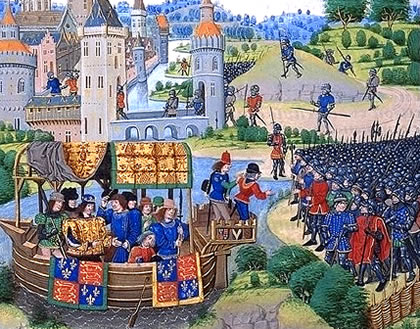
Richard II meets the rebels

In the early summer of 1381 a series of protests and revolts erupted across England. Peasants and townspeople rose against royal agents in opposition to a poll tax the royal government had levied upon them.

While the poll tax was the immediate cause of the rebellion, it was the focal point for a litany of complaints about the economic oppression the landholders and government had forced upon working people since the Black Death.

In the three decades following the Black Death landlords and peasants struggled over customary obligations and duties. The plague created a labor shortage and an increased availability of land, and many peasants saw an opportunity for economic gain, but the landholders saw the potential for their own economic ruin.


The lords attempted to solve the duduk perkara using legal means, establishing laws such as the Statute of Laborers (1351), which fixed all wages at the levels of 1346, before the plague. Peasants who profited from higher wages received fines.

Enforcement proved difficult since manorial lords, lesser gentry, wealthy peasants, and towns all competed for the smaller labor supply, but attempts to enforce the law nevertheless occurred, making lawyers and government officials the objects of resentment while driving rural village leaders and urban labor leaders into alliance. A collapse in grain prices in the mid-1370s intensified the economic tension.

To compound the commoners’ tax burden, the Crown’s extended military campaigns had proved extremely costly. To pay off debt from previous adventures, as well as to fund new military activity in France, in 1371 the Crown undertook a aktivitas of increasingly intense taxation.

Labor laws and landlords attempting to revive their manorial rights never provoked anything beyond local protest and passive resistance, but new taxes introduced in 1371 differed remarkably from traditional forms of taxation.

The taxes on parishes of 1371 and the poll taxes of 1377, 1379, and 1381 taxed people rather than possessions or land, and they hit hardest in the populous areas of East Anglia.

Peasant Leader
Peasant Leader


With taxation at an all-time high in 1381, the Crown levied a poll tax to raise £66,666 for the duke of Buckingham’s campaign in Brittany. The tax was three times what it had been in 1377. However the collectors’s preliminary returns indicated a nationwide shortfall in revenue. One-third of the people who paid the tax in 1377 were missing—nearly half a million taxpayers.

Faced with a potential shortfall of one-third of its poll tax revenue, the government ordered the tax assessors back into the field and appointed commissions composed of local landholders and lawyers to investigate instances of evasion and collect delinquent taxes.

On May 30 an angry group of men, insisting that they had already paid their taxes, attacked two tax commissioners at Brentwood. The commissioners fled, and villagers, fearing government retribution, banded together with men from nearby villages. On June 2 they gathered at Bocking, swearing to destroy the king’s agents, his laws, all forms of lordship, and to live only by their own laws.

The protestors sent word to Kent, where another rising had occurred, appealing for support. The rising spread to central Essex, where rebels murdered the escheator and destroyed the houses of Sir Robert Hales, the king’s treasurer, and Sir John Sewale, the sheriff.

Rebels burned the sheriff’s financial records in Chelmsford on June 11, and throughout the county peasants burned manorial records, destroying proof of their landlords’ claims over them. The peasants directed most of their violence against records rather than landholders, but some died, mostly sheriffs, justices, and tax collectors who represented the Crown and the magistracy.

The rebels vowed to destroy the institution of lordship yet fully supported their 14-year-old king, Richard II (1377–99), who nevertheless was wary. On June 11 he rode to the Tower of London with his bodyguard and the earls of Salisbury, Warwick, and Oxford.

His mother; his chancellor, Archbishop Sudbury; his treasurer, Hales; and William Walworth, mayor of London, also retreated to the Tower for protection. The next day the bands from Essex converged at Mile End and those from Kent met at Blackheath.

Several leaders emerged, including Wat Tyler and Jack Straw. Richard sailed down the Thames to Greenwich to meet the rebels but with no way to ensure the king’s safety, Richard’s party concluded that landing would be too hazardous.

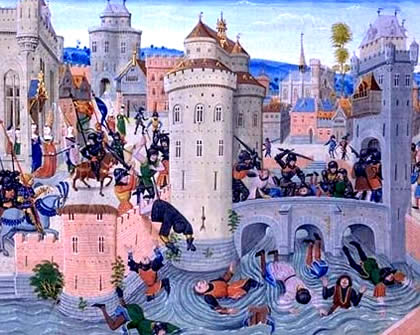
On Thursday morning, June 13, the mob arrived at the gates of London, and the city admitted them. The exact number of rebels that day is unknown. Once inside the gates, they released prisoners from the Fleet, Newgate, and the Marshalsea; burned the Savoy palace owned by the king’s uncle; and murdered foreigners, notably the Flemish and Italians.

The royal party soon realized it was trapped. Though safe in the impregnable Tower, they were too few in number to break out. Their only hope was negotiation. The king agreed to meet the rebels on June 14 at Mile End.

Friday morning Richard and his bodyguard of lords and knights rode out to talk with the mob. The king had to grant pardons and give charters of freedom to the rebels. Furthermore they demanded abolition of serfdom, rent of servile land of 4d. per acre, freedom to buy and sell in markets of their choice, and the right to enter service contracts of their own free will.

Finally the rebels made Richard promise to punish traitors. He conceded and the mob dragged Hales and Sudbury from the Tower and executed them summarily. By this point most of the rebels had grown tired and hungry from their long adventure, and many had received what they had wanted.

Revolt
Revolt

Charters in hand, they began to disperse homeward. However a large contingent of the most dedicated and radical remained, buoyed by the day’s successes. They wanted more from the young king, and Richard agreed to meet them again on Saturday.

While the king prayed at Westminster, his nobles and the mayor mustered the London militia. The next day the rebels stood defiant, bearing a royal standard and a banner of St. George. Richard and a small retinue rode out to meet Wat Tyler.

Tyler built on the rebels’ previous demands, including abolition of serfdom and all of lordship but the king’s, and disendowment of the church and dismantling of its hierarchy.

He also asked for the annulment of all law except the law of Winchester, which granted responsibility for peacekeeping to local authorities. As unrealistic as the demands were, Richard conceded everything except his regality and demanded that the rebels disperse.

The peasants seemed satisfied, but then someone in the king’s retinue provoked Tyler, who then attacked the armored man with his knife, not harming him. Walworth ordered his arrest and when Tyler resisted the mayor struck him twice with his sword, and then a member of the king’s household ran him through two or three times.

Tyler fell mortally wounded. The crowd became agitated and the young king rode toward the crowd to calm the rebels while his retinue sent for the militia. Sources suggest that the royal party had acted deliberately, but whatever the case the revolt collapsed and the rebels returned home under guard.

Tyler’s vision of a self-governing countryside died with him, but the peasants carried home their charters of freedom, which they would use to challenge lordship for years to come.

Widespread uprisings included attacks on abbeys and the magistracy, and the burning of manorial records after the rebellion in Essex during mid-June. The uprisings occurred in at least 240 places around England and participants included wealthier peasants, as well as laborers and craftsmen.

Often townspeople and peasants coordinated their efforts, but in some areas, such as York, Beverley, and Scarborough in Yorkshire, the protests drew little or no rural support; nor did they necessarily call for a reordering of society.

However all wished to reduce or remove the power that their lords held over their lands or property. The young king was not happy. Despite their ample willingness to recognize him as their only lord, Richard felt angry that his kingdom had come so close to destruction.

He rode with a strong force into Essex, executing a “bloody assize,” and brutally suppressed the revolts. He revoked the charters on July 2, warning the peasants that they remained in bondage, and that things were going to get worse.

The gentry and officials who ran the counties did not like these harsh tactics. In Kent and Hertfordshire, the gentry did not desire brutal punishment; nor did they appreciate royal justices whose visitations overrode their own authority. While the local administrators did not understand the peasants’ hatred of servitude, they were more humane in their treatment of protestors than royal officials.

In October the speaker from Essex told Parliament that the villains should be put in place, their charters revoked, and their leaders punished, but he said that followers should be handled leniently. Few could deny that the revolt showed a need for reform, and that justice and taxation had been handled unfairly. Some executions occurred, but most rebels received fines as punishment.

It is easy to blame the Peasants’ Revolt on the poll tax of 1381, but in his work on the period, Gerald Harriss notes the complex picture leading up to the revolt. The village was the center of the peasants’ economic and political world.

In the years following the Black Death, anger increased as peasants saw the institution of lordship blocking opportunity for economic gain and personal freedom. Commercial areas, such as East Anglia and Kent, felt anger toward the Statute of Laborers. Likewise the Black Death had changed the relationship between countryside and town and more interaction occurred than before 1348.

In the wake of the plague peasants moved into towns, townspeople acquired land in the countryside, and the two economies, always interdependent, became permanently intertwined.

Peasants and townspeople saw themselves as the true commons of the land, not the members of Parliament, and they saw no need for layers of lordship between themselves and the king. To villagers royal officials represented a false structure, imposed from the outside and unneeded.

Tension caused by these factors had not gone unnoticed prior to the revolt. The House of Commons had expressed its concern about conspiracies in the years leading up to the revolt. The poll tax dumped the government and the nobility military failures onto the backs of the lowest order of society.

The fact that the tax assessors were outsiders made matters worse, because it confirmed the ill will the peasants already bore toward the nobility and prevented wealthier peasants from charitably paying a larger share to relieve the burden on their poorer neighbors, as had happened in the past. The poll tax served as a spark to set off the explosive Peasants’ Revolt.

Norman and Plantagenet Kings of England

Norman Castle in England

The conquest of England in 1066 brought with it a completely new ruling dynasty. The Norman kings, beginning with William I, began a social and legal revolution in England. They also succeeded in unifying England and blurred the lines between Saxons and Normans.

The Plantagenet kings composed a long dynasty that included the related families of Anjou, Lancaster, and York. However, most historians seclude the Angevins from the Lancastrians and the Yorkists because of the historical development of the Wars of the Roses.

The Norman kings included the following rulers:
William I (the Conqueror): 1066–1087
William II (Rufus): 1087–1100
Henry I (Beauclerc): 1100–1135
Stephen: 1135–1154
Matilda (Maude): 1141


The Plantagenet rulers were
Henry II: 1154–1189
Richard I (Lionheart): 1189–1199
John: 1199–1216
Henry III: 1216–1272
Edward I (Longshanks): 1272–1307
Edward II: 1307–1327
Edward III: 1327–1377
Richard II: 1377–1399

William I, originally the duke of Normandy and the second cousin of Edward the Confessor, emerged victorious from the Norman Conquest of England and seized control of the English throne on Christmas Day, 1066. Within five years William I contained numerous rebellions and subdued the country.

His reign was highlighted with the creation of the Domesday Book, a survey of landownership used to collect taxes and the most comprehensive and detailed record of a country’s physical resources produced in Europe during the Middle Ages. William I died on September 9, 1087, from complications of a wound received in battle.

William II, or Rufus, was the second son of William I. He received England upon the death of his father. William I’s eldest son, Robert, received Normandy. William Rufus’s rule was categorized by heavy taxes and animosity between Crown and clergy.

On August 2, 1100 William II was shot in the eye with an arrow while on a hunting expedition and died childless and unmarried. Because of his unpopular reign, many historians believe his death was not an accident.

Henry I, brother of William Rufus and the youngest son of Edward I, ascended the throne of England upon the death of his brother. He was nicknamed Beauclerc (fine scholar) because of his educational background.

Through his skilled use of court politics, he established the exchequer, or the royal treasury, during his reign. Henry I had hoped to leave his throne to his only surviving daughter, Matilda, but upon his death the throne was offered to Stephen of Blois.

Stephen, Henry I’s nephew and grandson of William the Conqueror, was ill equipped to respond to the demands of the monarchy and his lack of authority over the quarreling and power hungry English barons erupted into civil war and strife during 1135–54.

The government that Henry I had constructed was in jeopardy of collapse, and the church and Crown continued their deepening animosity. He was briefly overthrown in 1141 when Matilda (known also as Maude) and her husband, Geoffrey of Anjou, entered London and claimed the throne.

She ruled briefly but was removed from the throne by Stephen’s rallying troops. Questions of succession continued until the Treaty of Wallingford was signed. Under this agreement, Stephen would rule unopposed until his death, at which time the throne would pass to Matilda’s son, Henry of Anjou.

Henry Plantagenet, count of Anjou, succeeded Stephen as Henry II in 1154. As the first of the Angevin kings, Henry II was a European ruler rather than an English king because of the size of his empire and the fact that he was the richest prince in Europe at the time of his ascension to the throne.

Henry II’s rule is often remembered as one of the most effective of English monarchs’. Most important at this time were the revival of royal justice and the foundation of English common law applicable to all of England.

Henry’s reign also included his quarrel regarding the power of church courts with Thomas Becket, Henry’s former chancellor and archbishop of Canterbury, which led to the latter’s martyrdom at Canterbury cathedral in 1170.

The latter years of Henry II’s reign included several rebellions ignited by his sons, backed by the kings of France and Scotland and encouraged by Eleanor of Aquitaine Henry’s vivacious wife.

Richard I ascended the throne in 1189 but only lived in England for less than a year of his entire reign. Instead, he fought in the Crusades, fell captive to the Holy Roman Emperor Henry VI in Germany, and continued to fight for lands lost in France. While he was away, the government built by Henry II continued to collect taxes and survive. He died from battle wounds in April 1199, leaving no heirs.

John, the fourth son of Henry II, ruled England in 1199 after many years of trying to steal the throne from his brother Richard. Nicknamed Lackland, John was the stereotypical wicked king; he taxed the English system in every possible manner.

During his reign England lost her French possessions, Pope Innocent III excommunicated John from the church for refusing to install Stephen Langton as the archbishop of Canterbury, and taxes consistently increased.

The barons, led by Langton, confronted John at Runnymede and forced him to accept the Magna Carta, or Great Charter, in 1215. The document confirmed popular liberties and restated the rights of the church and the English people.

When John died in 1216, his nine-year-old son, Henry, was accepted as king of England. He assumed the role of king in 1234 and confirmed the Magna Carta. However Henry III was an inept king who engaged in costly wars in an attempt to replenish his impoverished treasury, refused to defy papal decree, and provided appointments to foreigners rather than the English nobility.

This approach to government fueled antipapal sentiment and laid the foundation for the Reformation. It also provided opportunity for the rise of English nationalism. As English barons became more frustrated with Henry III’s choices and costly wars, they revolted and threw England into a period of civil war.

At one point Simon de Montfort briefly held power in 1264; however, he was killed in battle and power returned to Henry III and his son, Edward. There were some positive aspects of Henry III’s reign.

The population of London and the country rose substantially, the universities of Oxford and Cambridge were established, and the economy improved with the increase of agriculture. By the time Henry III died in 1272, he was monarch in name only, as the true power had already been transferred to Edward.

Edward I, known as Longshanks because of his height, was an accomplished soldier, statesman, and perhaps the most successful medieval monarch. Through his reign England recognized and retained many aspects of society, law, and government that survived centuries, civil war, and international conflict. Although Edward I could be considered ruthless and aggressive in many situations, he understood the delicate balance in which a monarch functioned.

He is credited with the creation of the modern-day Parliament. In 1295 Edward I summoned various representatives to his Model Parliament in order to raise more revenue. To this end parliament was used to conduct national business.

Edward I also supplied the courts of King’s Bench, Exchequer, and Common Pleas with judges; established a Court of Equity; and created a Chancery Court to provide redress in situations where other courts could not intervene. Edward accepted the Confirmation of Charters in 1297, which stated that taxes must have the assent of the realm.

Edward I also lived up to his ancestors’ attempts to expand the English empire. He conquered Wales in 1284 and chose to name his eldest son Prince of Wales in 1301, a title that has been bestowed upon the all firstborn male heirs to the present day.

Scotland proved to be a tougher conquest. Edward attempted to lay claim to Scottish lands by having his son marry Margaret, the legitimate heir to the Scottish Crown.

However she died en route to England, and Edward I invaded Scotland in 1296, defeated them, and was paid homage by the Scottish barons. William Wallace incited a riot against the English king in 1297, defeated the English army at Stirling, and continued to be a thorn in Edward I’s side until his capture and execution in 1304.

Robert Bruce, a distant claimant to the Scottish throne, continued to harass Edward I and his armies. The English were eventually defeated at Bannockburn under Edward II, but the animosity between the two nations continued for centuries.

Edward I’s biggest failure came in the form of his son, Edward II, who was feeble, lazy, and incompetent. Edward II also had a penchant for surrounding himself with foreigners, a trait that the English barons loathed. He carried on a homosexual affair with Piers Gaveston, which led to Gaveston’s exile and murder.

Eventually Edward II’s wife, Isabella, and her lover, Roger Mortimer, invaded England from France, forced Edward II to abdicate in favor of his son, and murdered him. Once his wife and her lover deposed Edward II, Edward III ascended the throne in 1327.

He quickly arrested and hanged Mortimer while imprisoning his mother for the last few decades of her life. Edward III was responsible for the beginning of the Hundred Years’ War with France in 1337 allegedly to support his claim to the French throne.

Initially England saw victories at Sluys (1340), Crécy (1346), and Calais (1347), giving them control of the Channel and the land. The bubonic plague, or Black Death, provided a short break from hostilities, but England resumed the fight with an invasion of France in 1355.

Edward, the “Black Prince” and eldest son of Edward III, found success at Poitiers (1356). The Treaty of Brétigny (1360) brought this phase of the Hundred Years’ War to a close. However, John of Gaunt, Edward’s third son, resumed the battle in 1369 when he invaded France again.

Under Edward III, English social life and economic history changed. He experienced relatively peaceful relations with the noble classes. Mercantilism began to replace feudalism. The taxation system was supported by commerce rather than land taxes.

Parliament found a bicameral cohesion as it divided into two houses representing the nobility and clergy, and the middle classes. In 1362 English replaced French as the national language of the realm. Treason was defined in 1352, and the office of justice of the peace was created (1361) to assist the sheriffs.

Unfortunately Edward III’s selesai years were marked by increasing senility, the death of the Black Prince, and disintegrating relations between the Crown and his subjects, due in part to Edward’s mistress, Alice Perrers.

Richard II, son of the Black Prince and grandson of Edward III, ascended the throne in 1377 at the age of 10. His rule was highlighted by his marriage to Isabella of Valois, daughter of Charles VI of France, in order to end further conflict with France.

He also subdued a Peasants’ Revolt in 1381 that resulted from the effects of the Black Plague’s strain on the economy. Rival factions continued to fight for governmental control, and in 1397, Richard II became embroiled in a struggle with some of the nobles for control.

First John of Gaunt, then his son, Henry Bolingbroke (Henry IV), attempted to take the throne. Richard was usurped in 1399, imprisoned, and murdered. The Wars of the Roses had claimed their first victim in the former king.

Valois Dynasty

Valois Dynasty
Valois Dynasty

The branch of the Capet family who ruled France from 1328 to 1589, the Valois, descended from 1285 when Philip III gave the county of Valois to his brother Charles. Charles’s son succeeded to the throne of France when the direct male line of the Capets failed in 1328.

The succession was challenged by the English king Edward III, who claimed a closer link to the Crown via his mother, the sister of the last king. This was one direct cause of the Hundred Years’ War.

There were three branches of Valois kings. The first was the direct line, reigning 1328–1498. The second was the Orleans branch, which reigned in the person of just one monarch, Charles V, noted poet Louis, was given the Duchy of Orleans. His descendant, Louis XII (1498–1515), succeeded in 1498.


The third branch, the House of Angoulême, which reigned from 1515 to 1589, also descended from Duke Charles of Orleans. When the male line of this family ended, it went to another branch of the royal family, the Bourbon dynasty, under Salic Law, which limited the royal succession to a paternal male relative.

The first king of the Valois family, Philip VI (1328–50), was unfortunate as he faced the great defeat of Crecy followed by the Black Death that took approximately one-third of France’s population. The second king, John the Good (1350–64), was captured at the Battle of Poitiers (1356) and spent the rest of his time as a prisoner of the English. This was a low point for France, as much of the country was occupied and facing civil unrest.

The later kings of the first branch proved more capable. Charles V (1364–80), often called the wisest of the Valois, was able to win back most of the English conquest but died young. His successor, Charles VI (1380–1422), succeeded as a child, gave promise of ability, but succumbed to insanity in 1392.

Thereafter, the French realm slid back into anarchy and eventual English invasion by Henry V, whose victory at Agincourt and intrigue by the House of Burgundy eventually led to a treaty in 1420 that made the English king, as the husband of Catherine of France, the heir. Perhaps half of France fell under English control.

The next king, Charles VII (1422–61), was not a great king but was called “the well-served” because of his advisers and aides. A series of events led to the eventual expulsion of the English from France during Charles VII’s reign. First, Joan of Arc inspired the French in her quest to rid her country of England.

Then Charles’s relatives persuaded him to establish the first standing army so as to reduce dependence on unreliable nobles. Additionally, the financier Jacques Coeur established a tax system to support the army. Together, these factors empowered the French to shake off English rule altogether.

Louis XI (1461–83), who along with Charles V, is considered the ablest of the Valois kings, faced a threat from Burgundy, which was an offshoot of the royal line of France. The duchy and county of Burgundy (Franche-Comté) together with much of the Netherlands were under the control of this family. Other nobles joined Charles to flout Louis XI’s authority.

Louis established a new civilian administration and gradually reduced the huge territories of the nobles. He was assisted by the defeat and death of his greatest rival, Charles of Burgundy, in 1477 so that with the exception of Brittany, the major fiefs of France had been annexed by his death. The marriage of his son Charles VIII (1483–98), who married the heiress of Brittany in 1498, completed the policy of consolidation.

On Charles’s death in 1498, the direct line ended, and Louis XII succeeded. He retained Brittany by marrying the widow of Charles VIII. He also continued the Italian Wars started by his predecessor. On his death in 1515, he was succeeded by his cousin and son-in-law Francis I.

A true Renaissance prince, Francis I spent the bulk of his reign struggling against the hegemony of the Habsburg dynasty as exemplified by charles v and I of Germany and Spain. His successor, Henry II, continued his policies. The French abandoned Italy at the end of his reign but gained the Lorraine territories of Metz, Toul, and Verdun.

The last kings of the Valois (Francis II, 1559–60; Charles IX, 1560–74; and Henry III, 1574–89) had their reigns overshadowed by the Wars of Religion between devout Catholics on the one hand and the Protestant Huguenots on the other. When the last of the kings was murdered by a religious fanatic motivated by revenge, the line ended after a tumultuous 261 years of rule.

Early Holy Roman Empire

Ottonian Dynasty
Ottonian Dynasty

Following the death of Emperor Louis the Pious (814– 840) and the Frankish civil war (840–843), the Carolingian Empire was divided among three sons of Louis. On the eastern ruins of the empire a new kingdom, that of Germany, had emerged, stretching from Holstein in the north down to the Alps in the south, from Lorraine in the west up to the Elbe in the east.

The first Carolingian kings of Germany struggled for the survival of their fragile kingdom. Their power was challenged not only by foreign invaders, the Slavs, Magyars, and Vikings, but also by rival rulers of France, as well as by some domestic opponents.

In 911 the last Carolingian offspring, Louis the Child (900–911), died and the German nobility elected Conrad, duke of Franconia, as their new king (911–918). Conrad’s son, Henry I (918–936), and later his grandson, Otto I the Great (936–973), succeeded to restore law and order in their kingdom, by bringing different tribes under their control and beating off the invasions.


Ottonian Dynasty

After the victory over the Magyars in the Battle of Lechfeld (955) and successful intervention in Italy (951–961), Otto had established himself as undisputed ruler over vast territories in western and central Europe. On February 2, 962, Pope John XII crowned him emperor in Rome. The new Roman Empire, ruled by the German emperor, had been founded.

Its very title Holy Roman Empire derives from the fact that the act of the imperial coronation, performed by the supreme head of the Christian believers, the pope, was sacral in its character and hence also a sacral character of the imperial dignity and power. The coronation of Otto was by no means an outstanding achievement: The papacy lacked both infl uence and power in those days and was largely subjugated to the goodwill of the German rulers.

Otto II (973–983) succeeded Otto and was married to the Byzantine princess Theophano. The latter introduced a series of Byzantine imperial ceremonies, which were adopted in the Ottonian court. Just as his father before him, Otto II attempted to increase the imperial control over Italy. His invasion of Calabria ended with the defeat of his army by the Arabs in 982. Otto III (983–1002) spent much energy on consolidating the imperial influence in the east.

He created the archbishopric of Gniezno and made Boleslas the Brave, duke of Poland, patrician. During Henry II’s reign (1002–24) , he had undertaken three military campaigns into Italy, the fi rst of which (1004) intended to punish his unfaithful subject Arduin of Ivrea, who proclaimed himself king of Italy. The second campaign (1013–14) resulted in his imperial coronation by the pope.

Following the third invasion (1020), the imperial power over Italy was firmly established and new German officials were installed for ensuring the imperial control in the region. The warfare with Boleslas I, in which Henry was allied with the pagan Ljutizi, ended in the peace of 1018, by which Henry gave up Bohemia.

Salian Dynasty

Salian Dynasty
Salian Dynasty
The death of Henry II marked the end of the Ottonian dynasty, which gave way to a new dynasty, the Salians. Its first ruler was Conrad II (1024–39), elected by the German magnates after the death of Henry, despite some opposition that wished to have William III, duke of Aquitaine, crowned as a new king. After his imperial coronation on Easter 1027 his power was reasserted.

He now turned his attention to legal matters, codifying ancient Saxon customs. In 1028 he was victorious in his war against the rebellious Mieszko II, duke of Poland. With peace achieved, Mieszko surrendered all territories conquered by him and his predecessor from the empire. In 1032 Rudolf III, the last king of Burgundy, died, commanding his kingdom to Conrad. Burgundy was annexed to the empire, assuming the name kingdom of Arles.

Conrad and his heirs, Henry III (r. 1039–56) and Henry IV (r. 1056–1106), attempted to centralize the imperial power, as well as to diminish the influence of regional nobility, lay and religious alike. This led to frequent conflicts and an occasional revolt. The imperial interference with spiritual matters was clearly demonstrated in Henry III’s attempt to reform the papacy.

Between 1046 and 1049 he appointed, one after another, four German bishops as popes, to make German control ubiquitous and to have the emperor as a dominant figure in church matters. Although praised by some churchmen for his efforts to reform the papacy, Henry attracted fierce criticism from among more radical circles in Rome.

During the minority of Henry IV, the Roman movement was led by an energetic cardinal, Hildebrand, the future Pope Gregory VII (1073–85). In 1059 Hildebrand had decreed that no temporal ruler is authorized to install or depose the pope, who is to be chosen by a college of cardinals.

This may have marked the beginning of the Gregorian Reform, which indulged in a bitter struggle with the Crown known as the Investiture Controversy. The first blow delivered upon the emperor was his humiliation at Canossa (January 1077), with him excommunicated and his empire placed under the interdict.

The first stage of the controversy ended with the Concordat of Worms (1122) between Henry’s son Henry V (1106–25) and Pope Calixtus II. By the concordat, Henry gave up his authority to invest bishops but kept his right to oversee and take part in the Episcopal elections.

The weakness of the emperor was utilized by the German nobility, which elected Lothar of Supplinburg as their new king Lothar II (1125–37), putting an end to the Salian dynasty. Lothar’s and subsequently Conrad III’s reign (1138–52) is marked by social and dynastic struggle.

Frederick I Barbarossa and Frederick II

Frederick I Barbarossa

With the election of Frederick I Barbarossa (1152–90), a new chapter in the history of the German Empire began. Frederick’s primary objective was to restore the imperial control in Italy, over both the rebellious Italian communes and the pope, who had allied himself with King William I of Sicily. The first Italian expedition of 1155 did not produce any significant fruits, while the second campaign (1158) resulted in the reduction of Lombardy into a royal province and rebellion of the Milanese commune.

The fervent Pope Alexander III (1159–81) and the king of Sicily backed the Italian city-states, while Frederick was supported by most of the German magnates and the antipopes. During his fourth Italian march (1166–67) he seized Rome and only an outbreak of malaria, perceived as a divine punishment, forced him to retreat.

In 1174 Frederick led his fifth expedition and despite some agreement reached with the Lombard League, the war resumed, resulting in the imperial defeat in the Battle of Legnano (May 29, 1176). After this, Frederick turned to diplomacy and the confl ict ended with the Peace of Constance (1183). Along with Italian policy, Frederick paid attention to domestic matters.

He expanded the imperial domains by annexing lands of extinct German dynasties and seizing the properties of Henry the Lion, duke of Saxony and Bavaria, in 1180. It was during his reign that the imperial chancery started using the adjective holy to denote the Roman Empire.

Frederick died on his way to the Holy Land leading the Third Crusade. His son Henry VI (1190–97) was married to Constance, the aunt of childless William II, king of Sicily, and upon his ascension he invaded Italy to be crowned in Rome and to claim his Sicilian kingdom. The Sicilian campaign ended in a failure because of the high summer heat and Henry retreated, leaving Sicily ruled by antiking Tancred, William II’s cousin.

After Tancred’s death in 1194 Henry launched another campaign into Sicily, which resulted in the conquest of the Norman kingdom and Henry’s coronation as king of Sicily on Christmas 1194. Once home, Henry attempted to transform the empire into a hereditary monarchy ruled by the House of the Hohenstaufen.

Upon his death (September 28, 1197), Henry VI left a two-year-old son, the future Frederick II (1212–50). He was raised in Sicily with Pope Innocent III (1198–1216) serving as his guardian. The latter brilliantly exploited the social and political chaos following Henry VI’s death and annexed vast territories in Italy to the papal demesnes.

Philip of Swabia, Henry VI’s brother, was elected as a new king (1198–1208) and his reign is characterized by a continual struggle with his archenemy, Otto of Brunswick. The German and Sicilian nobility, as well as the church with its leader Innocent III, changed sides frequently during the war between the two rivals.

After Philip’s murder, Otto was styled as Otto IV (1208–18). He won Innocent’s support, thanks to his promise to recognize the papal territories in Italy and to allow free episcopal elections, but his failure to carry out these promises led to his excommunication by the pope (November 18, 1210), which ironically coincided with the excommunication of King John of England in 1209.

In the meantime, Frederick II was elected as a new king (September 1211). Frederick had easily won Innocent’s support by confirming Otto’s concessions of 1209. Otto’s declining power was finally crushed after the Battle of Bouvines (July 27, 1214), where the armies of two excommunicated rulers, John of England and Otto of Brunswick, were defeated. Otto died excommunicated in 1218.

The good relationships between pope and emperor were doomed after Innocent’s III death. Frederick failed to keep his promise regarding the separation of Sicily from the German Empire. He instead had his young son Henry crowned King Henry VII of Germany in 1220 and retreated to his native Sicily. In 1227 Gregory IX excommunicated Frederick for his failure to take the cross.

This resulted in the expedition to the Holy Land known as the Sixth Crusade, where Frederick brilliantly restored Jerusalem to Christian control through his masterful diplomacy. Frederick’s success and the support of many German princes contributed to the Peace of San Germano, achieved between pope and emperor in 1230.

By this peace Frederick recognized papal territories in Italy and Sicily; however the peace did not last long. In 1237 Frederick renewed imperial hostilities toward the Lombard League, crushing the communal armies in November that year. Gregory excommunicated Frederick in 1239 and called for a church council to depose the emperor, who was seen as the Antichrist.

Frederick invaded Rome in 1241 only to find Gregory dead. Gregory’s successor Innocent IV followed the policy of his predecessor and in 1245 the First Council of Lyon, deposed the emperor. However Frederick’s rule was strong enough to survive this symbolic deposition.

While Frederick was perceived as the Antichrist by the papal circles, his Sicilian companions saw him as a keen promoter of arts and sciences, the founder of the University of Naples (1224); as an open-minded personality, who was equally tolerant to Christians, Jews, and Muslims, Germans, Normans, and Greeks; and as a man of an extraordinary learning, speaking as many as seven languages and possessing progressive views on economics and government. His extraordinary personality earned him the nickname Stupor Mundi, the Wonder of the World.

Frederick died on December 13, 1250, and his mighty empire collapsed. After the brief reign of his son Conrad IV (1250–54), the German Empire submerged into two decades of political and social chaos, with no recognized king or emperor. During the interregnum period of 1254–73, the Swiss cantons attempted to break free from the imperial control, Charles of Anjou conquered the imperial possessions in Sicily and southern Italy, while France threatened the German territories.

Habsburg Dynasty

In autumn of 1273, an assembly of German princes, the Kurfürsten, elected a new king, Rudolf of Habsburg, son of Albrecht IV, count of Habsburg, and Hedwig, daughter of Ulrich of Kyburg. Rudolf is thought to have been a prominent figure well before his crowning, possessing lands and estates in Switzerland and Alsace. Pope Gregory X recognized his election, provided that Rudolf renounce his claims to the imperial title and rule in Rome, Sicily, and the papal lands. Alfonso X of Castile also acknowledged Rudolf’s election.

Challenge to his authority came from within, in the face of Otokar II, king of Bohemia, who refused to surrender his territories in Austria, Styria, Carinthia, and Carniola to Rudolf. After a war that lasted five months, Rudolf seized the aforementioned provinces in November 1276. Otokar retained Bohemia and the peace was consolidated by the betrothal of Otokar’s son Wenceslaus to Rudolf’s daughter. The peace, however, did not remain long, with Otokar allying himself with some German and Polish princes against Rudolf.

The latter, having made an alliance with Ladislas IV of Hungary, met his enemy on the river March on August 26, 1278. The outcome of the battle was the defeat and death of Otokar and subjugation of Moravia. Having overcome the Bohemian challenge, Rudolf turned his attention to consolidating his authority in the Austrian provinces, where he invested his two sons, Albrecht and Rudolf, as dukes of Austria and Styria.

In doing so, Rudolf expected to establish dynastic rule in his kingdom. At the same time, he attempted to restore peace and order in Germany and Switzerland. In 1289 he marched into Thuringia, where he subdued some rebels. His wish of having his son Albert crowned as German king did not come true, with the electing princes refusing to do so. Rudolf died on July 15, 1291.

The assembly elected Adolf, count of Nassau, as the new king. Unlike his predecessor, Adolf lacked power and influence, being from minor nobility. This choice may have been made because the princes, having tasted power in the House of Habsburg, preferred to install a weak ruler.

Crowned as king of the Romans in Aachen on June 2, 1292, and never anointed Holy Roman Emperor by the pope, Adolf did not achieve any significant accomplishment throughout his brief reign (1292–98). His attempts to subdue Thuringia to his rule failed, and his former supporters deposed him, electing Albrecht of Habsburg, Rudolf I’s son, as their king. Adolf refused to recognize Albert’s election and led his army against him, only to be defeated and killed in the Battle of Göllnheim (July 2, 1298).

Albert I’s reign (1298–1308) is characterized by the growing international importance of the House of Habsburg. His attempt to annex territories over the Burgundian frontier led to a conflict with Philip IV the Fair of France (1285–1314).

However, a lack of papal support urged him to abandon his claims in this region. A treaty between the two kings was signed in 1299, by which Albrecht’s son Rudolf was to marry Philip’s daughter Blanche. In 1303, Pope Boniface VIII had finally acknowledged Albert as the German king and Holy Roman Emperor, regarding him as his ally in the conflict with the French Crown.

In 1306 he made his son Rudolf king of Bohemia. He failed to subdue Thuringia, and his army suffered a heavy loss in 1307. Albert was killed on May 1, 1308, on his way to Swabia, where a revolt had broken out. Most contemporary sources depict Albert as a harsh though just ruler as well as a protector of Jewish communities, persecuted in those days.

Luxembourg Dynasty

Henry VII of Luxembourg succeeded Albert, was acknowledged by the pope, and was crowned by him as emperor on June 29, 1312. At this time the princes’ assembly was torn between the Habsburg and Luxembourg parties. While in Italy, Henry imposed imperial power on rebellious Florence and interfered in the ongoing war of the Guelphs and Ghebellines, supporters of the pope and emperor, respectively, in Tuscany. He also attempted to subdue his vassal Robert, king of Naples, only to die on August 24, 1313, near Siena.

Upon his death, the Luxembourg party of electors’ assembly elected Louis, or Ludwig, IV Wittelsbach of Bavaria, against the wishes of the Habsburg party, which attempted to install Frederick the Fair Habsburg. Louis’s coronation in 1314 led to a violent confl ict between the latter and the Habsburg heir. Frederick’s army was defeated in 1322 in the Battle of Mühldorf. Having eliminated his rival, Louis set out to consolidate his authority.

He went to Rome in January 1328, and was crowned by an old senator, because of the absence of the pope in the Eternal City. While there he deposed Pope John XXII on the grounds of heresy and appointed a Spiritual Franciscan as antipope Nicholas V, who was deposed as soon as the emperor left Rome in early 1329.

While at home Louis acted as the patron of antipapal intellectuals, such as Marsilius of Padua and William Ockham. In 1338 the princes’ assembly had decreed that the king, chosen by the assembly, did not need papal authorization or coronation. This antipapal policy provoked a harsh reaction of the pope, who was then allied with the French king. In order to withstand the papal-French coalition, Louis made an alliance with Edward III of England. In his domestic policies, he relied much on his power and lands in Bavaria.

In 1340 he united Lower and Upper Bavaria, while two years later he annexed neighboring Tyrol. His increasing authority over smaller territorial rulers led to an inevitable conflict with the latter. In 1346, a year before his death, the electors’ assembly, with the support of Pope Clement VI, chose Charles IV of Luxembourg and Bohemia as an antiking.

Louis IV died on October 11, 1346, and the Crown passed to Charles IV. Although crowned emperor in 1355, Charles, unlike his predecessors, did not strive to revive the idea of the universal Christian Roman Empire, ruled by the German emperor. Instead, he invested his powers and resources in the cultural development of Bohemia, his native land, and Prague, where he resided, in particular.

In 1348 he founded and patronized the Charles University of Prague, which attracted scholars and students with its humanist studies. The emperor corresponded with Petrarch and even invited him to settle in Prague, while the Italian humanist called on Charles to return the imperial throne to Rome. Under Charles’s patronage, some of the finest monuments of Old Prague were built.

While most of the emperor’s attention was concentrated on Bohemia, other parts of the empire, especially Germany, suffered from a social crisis following the epidemics of the Black Death (1348–51). Charles issued his famous Golden Bull of 1356, which attempted to define the procedure of imperial election and the annual diet held by the electoral princes. Raised and educated at the French royal court, Charles was related to John II (1350–64) and Charles V (1364–80) of France and supported them in the French struggle against England.

Charles IV died on November 29, 1378, and the titles of the king of Bohemia and king of the Romans passed to his son, Wenceslaus (known as Wenceslaus, or Vaclav IV the Drunkard). Just as his father, Wenceslaus devoted much of his attention to his native Bohemia. His Bohemo-central policy provoked a rebellion of the German princes, who deposed him as king in August 1400, electing the German Rupert, count of Palatine.

Wenceslaus did not give up the title of the king of the Germans and continued reigning in Bohemia until his death in 1419, without acknowledging his deposition and the crowning of Rupert. This also marks the beginning of animosity between Bohemia and Germany, on political, national, and cultural levels. It was under Wenceslaus that the Hussite movement started by John Huss started gaining ground in Bohemia.

After Rupert’s death in 1410 the princes’ assembly elected Sigismund of Luxembourg, margrave of Brandenburg and king of Hungary. Soon after his election, Wenceslaus of Bohemia, his half brother, renounced his claim to the title of king of the Romans and Sigismund was universally recognized as such. During his reign, the history of Hungary became interwoven with that of the Holy Roman Empire.

The two main objectives of his early reign were to put an end to the Papal Schism (1378–1417) and to crush the Hussite movement in Bohemia. Both problems were solved at the Council of Constance (1414–17), where Sigismund was a key figure. The two leaders of the Hussite movement, John Huss and Jerome of Prague, were burned at the stake on July 6, 1415, and May 30, 1416, respectively.

The Papal Schism was ended by the deposition of three rival popes and election of a new one, Martin V. The martyrdom of Huss and Jerome resulted in street riots in Prague, which swiftly transformed into a civil war. In the meantime Wenceslaus died and Sigismund inherited the title of king of Bohemia.

In 1420 he attempted to restore peace and order, only to be rejected by the Bohemian nobility and repulsed by the Hussite army, led by some remaning commanders. The Hussite wars continued until 1436, devastating various eastern regions of the empire. Only a later schism within the movement itself allowed Sigismund to take over. In 1437 a short time before his death, the local nobility accepted him as the king of Bohemia.

Albrecht II Habsburg of Austria succeeded Sigismund, ruling briefly for two years (1437–1439). He also inherited the reigns of Hungary and Bohemia. The Bohemian nobility rejected Albrecht as their king, allied itself with the Poles, and rebelled against him. As king of Hungary, he spent his energy defending the realm against the Ottoman Empire.

Frederick III and Maximilian

After Albert’s death, Frederick III was elected as king of the Germans in 1440. To consolidate his power, he signed the Vienna Concordat with the papacy in 1446, which codified the relationships between the emperor and the pope. Frederick was crowned emperor in 1452, the last imperial crowning in Rome. While unsuccessful in battle, Frederick achieved brilliant results through diplomacy.

In 1452 Frederick married Eleanor of Portugal, receiving a considerable dowry. In 1475 he forced Charles the Bald, duke of Burgundy, to marry his daughter to Frederick’s son, Maximilian. Despite this, his rivals frequently challenged Frederick’s power.

The first challenge came from Albrecht VI, his brother. Between 1458 and 1463 the two fought each other over the control of Austria. The struggle with his nephew, Ladislaus Posthumus, over Hungary and Bohemia, resulted in the capture and imprisonment of the latter. His main rival, however, was a powerful Hungarian king, Matthias Corvinus (1458–90), who seized some of Frederick’s possessions in Austria, Moravia, and Silesia and then took Vienna in 1485.

The collapse of Frederick’s power was prevented only by Corvinus’s death in 1490. The last 10 years of his life, Frederick ruled jointly with his son, Maximilian, who had been crowned the king of the Romans in 1486 and inherited his father’s imperial title after the latter’s death in 1493.

Maximilian held vast territorial possessions well before his ascension to the throne. In 1477 after the death of Charles the Bald of Burgundy, he had inherited the Free County of Burgundy, along with the Netherlands. In 1490 he acquired Tyrol and some parts of Austria from his half-uncle Sigismund.

In 1494 the emperor entered into a conflict with France over the intervention in Italy, which led to the Italian Wars of 1494–1559. He did not live to see his armies beat the French enemy. In 1499 the empire suffered heavy losses in the Battle of Dornach at the hands of the Swiss Confederation, which forced the emperor to acknowledge the independence of the Swiss cantons.

While at home Maximilian tried to reform the imperial constitution. In 1495 the Reichstag of Worms had issued four documents, known as the Reichsreform, which created and legalized two legal establishments: the Reichskreise (Imperial Circle), whose main function was to collect taxes and organize a common defense, and the Reichskammergericht (Imperial Chamber Court), the highest judicial institution of the empire.

Under Maximilian, and perhaps even under his father, Frederick III, the Holy Roman Empire began to rise to be the premier power in Europe. With the election of Maximilian’s grandson, Charles V of Spain, the empire became the largest territorial unit in Europe, encompassing central Europe, Germany, the Low Countries, parts of Burgundy, and Spain with its vast American colonies.

Song of Roland

Song of Rolland storie in one picture

The anonymous Song of Roland is the most famous Old French epic, or chanson de geste. It was composed c. 1090 but was not committed to writing until nearly 100 years later. The oldest written copy, discovered by Francisque Michel in 1835, survives in Oxford Bodleian MS Digby 23.

As all chansons de geste, the Song of Roland was performed aloud in front of an audience by a minstrel (or jongleur). It is unlikely the whole poem was recited in one sitting: It consists in some 4,000 decasyllabic lines, assembled into 291 laisses or verses.

The Song of Roland is loosely based on historical events narrated by Einhard in his ninth century Vita Karoli. Charlemagne, the Holy Roman Emperor, invaded Spain in 778 to free the country from the impending Muslim threat.


A stained-glass window in Chartres cathedral suggests the emperor had a vision of St. James, whose body is buried at Compostela in western Spain. James asked Charlemagne to liberate his home from the pagans. Returning from battle, the Frankish army marched through the Pyrenees.
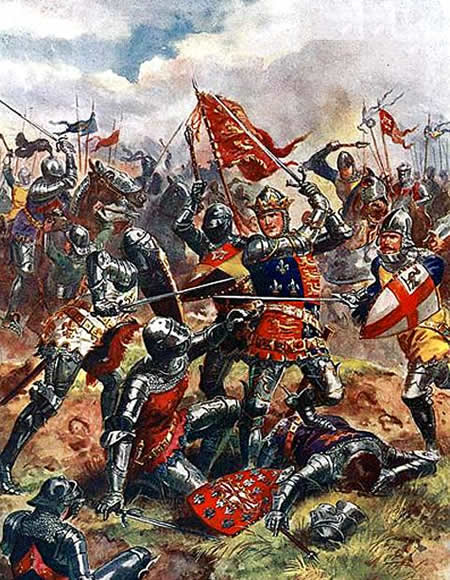
Without warning, the Basques attacked the rear guard at Roncevaux and brutally killed everyone. The author of the Song of Roland substitutes the Saracens for the Basques, making the epic about the religious war between the Christians and the infidels.

The death of Rolland

The Song of Roland is divided into two distinct parts. The first recounts the death of Roland and his men. The second describes the revenge of Charlemagne. When the poem begins, the emperor has been fighting in Spain for seven years.

The Frankish army has conquered the whole country with the exception of one city: Saragossa, ruled by King Marsile and Queen Bramimonde. Following the advice of the Saracen lord Blancadrin, Marsile sends a message to Charlemagne announcing his intent to become the emperor’s vassal and to convert to Christianity.

Charlemagne accepts the offer and must choose an envoy to send to Marsile’s court. Roland— Charlemagne’s best knight—nominates his stepfather, Ganelon. Erroneously believing Roland has selected him for this dangerous mission out of spite, Ganelon conspires against Charlemagne with the pagans.

Charlemagne find Roland death body

He tells Marsile that Charlemagne will not continue fighting if the Saracens kill Roland, who will probably lead the rear guard as the Franks march over the Pyrenees. He and his men will be the most vulnerable in the narrow and treacherous pass at Roncevaux.

Ganelon returns to Charlemagne and falsely attests to Marsile’s good intentions. As predicted Roland volunteers to lead the rear guard, and Charlemagne’s strongest vassals, the “twelve peers,” go with him, including Olivier (Roland’s best friend) and the archbishop Turpin.

At Roncevaux, they are attacked by the Saracens, who vastly outnumber them. Olivier (characterized as wise) advises Roland to sound his horn and call Charlemagne back to fight. But Roland (characterized as proud, brave, and dutiful) refuses; to do so would demonstrate weakness and might place the life of the emperor in jeopardy.

The rear guard fights bravely and kills a great number of the enemy. Eventually Olivier, Turpin, and all of the Frankish soldiers lie dead. Roland blows his horn (or oliphant) until his temples burst, signaling to Charlemagne his defeat.

Before dying he attempts to break his sword, Durendal, on the surrounding black rock so that it does not fall into the hands of the pagans (a gap in the rock along the border between France and Spain is known as the Brèche de Roland). Roland dies a hero’s death: He lies down facing the enemy’s land and angels and saints escort his soul into heaven.

Charlemagne arrives with the rest of the Frankish army. Overwhelmed with grief, he resolves to avenge the death of his men. God miraculously ensures the sun remains high in the sky so that the enemy cannot flee under the cover of night.

The Franks kill the remaining Saracens by forcing them into the river Ebro; thousands drown. King Marsile escapes to discover that Baligant, the emir of Babylon, has arrived to help the Saracens in the war. Baligant rides with his men to Roncevaux, where the Franks are burying the dead. A great battle ensues.

When Charlemagne slays Baligant, the remaining Saracens flee; the Franks march on Saragossa and finally take the city. Angry with the Saracen god for abandoning her people, Queen Bramimonde accompanies Charlemagne back to France. By the end of the poem she converts to Christianity of her own free will.

When the Frankish army arrives in Aix (Charlemagne’s capital), the emperor informs Roland’s fiancée, Aude, of the deaths of Olivier and Roland. Charlemagne offers to her his son as a substitute.

Out of grief for Roland, Aude swoons and falls dead and is buried in great honor. Meanwhile Ganelon awaits trial for treason. His kinsman, Pinabel, defends his honor during a duel with Roland’s friend, Thierry.

Thierry, who is by far the weaker knight, overcomes his formidable adversary. The Franks interpret this as a sign that God has revealed the guilt of Ganelon. They sentence Ganelon to death by dismemberment. For good measure, they also condemn 30 of his relatives to be hanged.

The war is finally over and the Franks prepare to rest. But that night as he sleeps, Charlemagne has a vision of the angel Gabriel, revealing that the Franks must depart on a new crusade. Weary from battle Charlemagne nonetheless obediently vows to do God’s will.

The Song of Roland was composed around the same time as the Council of Clermont (1095), at which Pope Urban II exhorted all Christians to fight in the Crusades in order to recapture the Holy Land. The poem became a testimony to the virtuous courage of Western Christendom in the fight against the pagans.

It is also an intensely nationalistic work. In the De gestis Anglorum (1125), William of Malmesbury writes that Roland’s tale is sung before the Battle of Hastings to give strength to the French soldiers who are about to fight.

Malcolm X

making
Malcolm X

The militant African-American leader was born Malcolm Little, later taking the Muslim name el-Hajj Malik el-Shabazz. His life story, The Autobiography of Malcolm X, was published posthumously in 1965, making him a pahlawan among African Americans.

Malcolm Little was born on May 19, 1925, in Omaha, Nebraska. His father was Earl Little, a lay preacher and supporter of Marcus Garvey. One of Earl Little’s uncles had been lynched, and three of his brothers died at the hands of whites.

His mother’s family was from Grenada. The family moved to Milwaukee, Wisconsin, in 1926, and then to Lansing, Michigan, where Malcolm grew up. He saw his family’s house burned down by the Ku Klux Klan.


Two years later, in 1931, his father was found dead after having been run over by a street car; it was believed that he had been murdered by the group who set fire to his house. Soon afterward Malcolm’s mother was declared insane and was moved to a mental institution.

Malcolm did well at anabawang high school, graduating at the top of his class, but a teacher he admired told him that it was unrealistic for African Americans to aspire to be lawyers. After several years in foster homes, Malcolm spent some time in a detention home and then moved to Boston to be with his sister.

He found work shining shoes, then joined the New Haven Railroad, but he quickly found himself involved in crime. He was refused an army position in World War II after allegedly claiming that as soon as he had a gun, he would organize other African Americans.

In 1946, he was arrested with another African American and two white women stealing goods to sell to a pawnshop. The women claimed that they had been coerced into the crime, and Malcolm was jailed for 10 years. In prison, Malcolm joined the Nation of Islam, which held the belief in the inherent superiority of black people.

Released from prison in 1952, he visited the Nation of Islam headquarters in Chicago, where he met with Elijah Muhammad, the leader of the sect. Many African Americans believe that their surnames came to them from white slave owners; Malcolm Little changed his family name to “X.”

Over several years, Malcolm X toured the United States and was regarded as one of the best speakers and organizers for the Nation of Islam. He talked much of the exploitation of African Americans by whites and urged black separatism rather than integration and racial equality. Indeed, he felt that there should be greater black self-dependence and that violence was justified for self-protection.

This latter belief alienated him from many of the civil rights leaders at the time who urged for nonviolent resistance to racism. In 1959 Malcolm X went to Africa for the first time, visiting the United Arab Republic (Egypt), Sudan, Nigeria, and Ghana, partially to help organize a tour by Elijah Muhammad that followed.

The Nation of Islam in the United States grew in numbers, and in 1961 he founded Muhammad Speaks, the official journal for the Nation of Islam. Settling in Harlem, New York, he became a minister at Mosque Number Seven.

Malcolm X had become a controversial figure in the Black Muslim movement, meeting with Cuban leader Fidel Castro in September 1960 when the Cuban politician was in New York to address the United Nations General Assembly.

The Cuban delegation refused to stay in the Shelburne Hotel after being asked to pay in advance, and moved to the Hotel Theresa in Harlem, where Malcolm X and other African-American community leaders met them.

In 1963 Elijah Muhammad suspended him from the movement when he described the assassination of U.S. President John F. Kennedy as a “case of chickens coming home to roost,” a remark that was regarded as extremely controversial.

In March 1964 Malcolm X left the Nation of Islam and in the following month went on a pilgrimage to Mecca. He had wanted to set up his own organization as a more radical wing of the Nation of Islam, but his time in Saudi Arabia led him to see that whites were not necessarily innately evil and that compromise was possible.

In October 1964 he reaffirmed that he had embraced orthodox Islam, but this did not prevent death threats from white extremists and also rival Black Muslims. He was shot dead on February 21, 1965, at a Harlem ballroom. Three Black Muslims were later convicted of the murder.

The Autobiography of Malcolm X, compiled by writer Alex Haley from numerous interviews with Malcolm X shortly before the latter’s murder, was published posthumously and became an overnight best seller. Malcolm X had married Betty X (née Sanders) in Lansing, Michigan, and they had six daughters; the youngest two, twins, were born after Malcolm’s murder.

Hundred Years’ War

Hundred Years’ War
Hundred Years’ War

In battles fought from 1337 to 1453 primarily by England and France for control of France and the French Crown, England initially had the upper hand, but in 1429 the French, inspired by Joan of Arc, regained all areas of France that they had lost except for Calais. England and France had been at war several times before the Hundred Years’ War because of the landholdings of the English Crown in France.

Through several wars, the French had slowly been regaining control of these lands. With the beginning of the Hundred Years’ War the French found themselves losing ground against the English. Militarily the English longbow proved especially devastating to the French and led to the English victories at Crécy and Agincourt.

The English believed that they were secure in their victory but found the tables turned on them in 1429 by Joan of Arc. The French were able to retake much of the land the English had captured up to that point in the war. The Burgundians switched sides, joining the French, and the English found themselves pushed back even more.


The English would continue to send armies to France and were, at times, able to retake lost territory; the war had definitely turned against them. The akibat years of the war saw the English lose all their territory in France except Calais. With France’s control over all the previously controlled English lands in France, the war ended in 1453.

Early English Lands in France

The English and the French had been at odds over the relationship of their kings to each other because of the English Crown’s control over lands in France. In England the English king was sovereign, yet in France he was a vassal of the French king and accountable to the French king.

This accountability was used, usually on trumped up charges, by the French kings to try to take land away from the English. The French did this in 1202 and when the English king did not show up at the French court to answer charges brought against him, the French king declared his lands to be confiscated and war followed.

During the war (which lasted until 1204), the French conquered Normandy, Maine, and Anjou from the English. With the signing of the Treaty of Paris in 1259 the English had been reduced to control of just Aquitaine. The English king also reconfirmed his status as a vassal of the French king with respect to his lands in France.

English army in hundred years' war

The French trumped up charges again in 1294 against Edward I and again declared his lands confiscated and launched an invasion of those lands. The war lasted until 1298. This war also saw the Scots allied with the French against the English in 1295. A new peace treaty, the Treaty of Paris, was signed, returning the lands lost by the English during the war to them.

Isabella, the daughter of the French king Philip IV, was married to the English heir, Edward II. At the time this seemed to be a way to create lasting peace between the two kingdoms but ended up causing more problems by later giving the English king a claim to the French throne during the Hundred Years’ War.

In 1324 the French again provoked the English and summoned the English king to the French court. When the king did not show up, the French again declared the province of Aquitaine confiscated from the English and the two countries went to war again.

The war did not last long and in 1325 Edward II’s son, Edward III, and his mother went to France so Edward III could pay homage to the French king, Charles IV. Returning to England in 1327, Queen Isabella had Edward II deposed and Edward III, only 14 years old, crowned king.

With such a young king, the English ended up agreeing to a peace treaty that favored the French, allowing them to keep the land they had conquered. In 1328 the English were forced to make peace with the Scots and Charles IV, third son of Philip IV, died. None of Philip’s three sons had a male heir. Succession ended up going to the cousin of Charles IV, Philip of Valois.

While neither Edward nor his mother made any claim to the French throne at this time, Edward had himself crowned king of France in 1340. In French law, Edward had no claim to the Crown since French law did not recognize any claim by a female, or her offspring, to the throne of France.

The early years of Edward’s reign saw him pay homage to the French king, since he could not afford a war with France. Focusing on Scotland with the death of the Scottish king, Robert I, Edward was able to gain the upper hand there and bring Scotland back under England’s control.

However, being an ally of the Scots, Philip had an interest in what was happening there and tried to link negotiations for continued peace between France and England with the war in Scotland. In 1336 France had put together a fleet that was to take a French crusade to the Holy Land.

However, Pope Benedict XII canceled the crusade because of the problems of the French, English, and Scots. Instead it seemed to the English that the fleet would be used to invade England. While there was no invasion of England, the fleet did conduct raids on parts of the English coast and convinced the English that war with the French was coming.

Using the same ploy they had before, the French king summoned the English king, as the duke of Aquitaine, to turn over the French king’s brother, who had taken refuge in England. In 1337 when Edward did not comply with Philip’s order, Philip declared Edward’s land confiscated again and the Hundred Years’ War began.

Beginnings of the Hundred Years’ War

The war began with the French invading Aquitaine in 1337. The French fleet continued raiding the English coast. The English were finally able to defeat the French fleet at Sluys in 1340, which gave the English control of the English Channel, making it easier for them to move troops to France.

During this time Edward made alliances with the Low Countries and the German emperor and arranged to have his soldiers join theirs for a campaign against the French. However the date for the campaign kept being delayed until 1340.

The Flemish joined with Edward, who had himself crowned king of France on January 26, 1340. While the English laid siege to the town of Tournai, the French moved against the allied army but did not engage it. The war shifted to Brittany in 1341 with the death of the French duke.

Succession to the title was disputed and the English took the chance to support the side the French king opposed. Neither side was able to gain the upper hand and control of the entire province. The fighting continued for several years to come. In 1343 a truce was called, lasting until 1346.

Edward decided to conduct the campaign in 1346 with an English army and not rely on his allies for soldiers. Edward’s army landed in Normandy hoping to draw the French army away from Aquitaine, which it did. Marching first to the Seine River and then along it toward Paris, the English army raided the countryside and towns as it marched.

The French had destroyed most of the bridges across the Seine River and had a chance to trap the English army but instead allowed the English to cross the river and march away. The French would have the same chance again when the English army reached the Somme River and again the French allowed the English to cross the river and escape. Edward finally stopped retreating and chose the area around Crécy to give battle to the French on August 26, 1346.

Edward picked an easily defended spot that forced the French to attack him uphill. He also deployed his archers to have a clear field of fire against the advancing French. The French arrived on the battlefield late in the day, yet chose to attack instead of waiting until the next day.

The French also did not attempt to organize a massed attack against the English; instead, they attacked as they arrived on the battlefield, thus leading to approximately 15 independent assaults on the English position.

The English archers cut down each assault with few of the French knights actually reaching the English men at arms. French casualties were estimated at over 1,500 knights and nobles and up to 20,000 infantry and crossbowmen. English casualties were about 200 men.

With his victory, Edward moved against Calais, which he laid siege to in September 1346 and captured in August 1347. The next several years would see only minor fighting, and even a truce for a short time. Philip VI died in August 1350 and John II became the new French king. Under the new king, the French and English engaged in peace negotiations, but these were broken off in 1355 by the French.

Treatis and Raids

The English responded to the break in negotiations by launching raids into France. The most successful raid was in 1356, led by Edward’s son, Edward the Black Prince (so named because he wore black armor). Launching from Bordeaux, he marched his army toward the Loire River but turned back before crossing the river.

As he moved back to Bordeaux, he was blocked by a French army led by King John at Poitiers. On September 19, using the terrain to his advantage, the Black Prince was able to defeat the French using the terrain and his archers to cut down the attacking French. More important was the capture of the French king by the English.

With his capture, the French found themselves in a civil war between the dauphin and Charles of Navarre over who should control France. In 1359 Edward brought an army to France in an attempt to capture Reims. When he was unable to capture the city, he considered marching on several other cities, including Paris, but in the end decided to return to England.

The English and French signed a treaty on May 8, 1360, that released King John from English captivity and recognized English sovereignty over Calais, Ponthieu, Poitoum, and Aquitaine. Also part of the treaty was a clause where Edward agreed to stop calling himself the king of France. It looked as if the English had won the war. Even with the peace treaty in place, the French and English continued fighting on a low level.

This included the French civil war, which did not end until May 1364 with the defeat of Charles of Navarre. The French and English also found themselves on opposite sides of the fighting in Castile where the English, under the command of the Black Prince, prevailed. Unfortunately the fighting forced the Black Prince to raise taxes in Aquitaine.

The people of Aquitaine then appealed to the French king, Charles V (who had become king in 1364 when his father, John, had died). Therefore in November 1368 Charles V declared the English land confiscated again. Edward tried to negotiate a settlement with Charles, but when that failed Edward again declared himself king of France and the two countries were at war with each other again.

The French made significant gains in recovering territory they had given up in 1360. They were even able to launch raids on the English coast, whose defenses had been neglected after the peace treaty in 1360. This raised concerns that the French might actually invade England. In response, the English launched raids on cities they thought the French might use to stage their invasion.

By the end of 1369 English actions had eliminated the possibility of a French invasion. Over the next several years the English would continue to launch raids into the French-controlled territory, but they also lost territory to the French. Both sides continued to raid each other’s territory and avoid a set piece battle.

In 1376 Edward the Black Prince died; in the following year, 1377, Edward III also died. This left the Black Prince’s son, 10-year-old Richard II, as king of En gland. Small scale fighting continued through the 1380s until both sides agreed upon a truce in June 1389. The truce would last, with the usual intermittent raiding, until 1415.

Henry V and Charles VI

Starting in the early 1400s the French gave support to Scotland and Wales in their struggle against the English. They also launched several raids against English ports. However the French king, Charles VI, who came to power in 1380, suffered from insanity. Because of this, he was unable to keep his nobles controlled and in 1407, a civil war broke out between the Orléanists and Burgundians.

Both sides asked the English for aid. In 1413 Henry V was crowned king of England. While his father, Henry IV, had provided some support to the Burgundians, Henry V determined to take full advantage of the chaos in France. Thus in 1415 an English army of 12,000 men invaded France.

Landing in Normandy, Henry first laid siege to the town of Harfleur, which took over a month to capture. Henry lost about half his men during the siege. Henry then decided to march over land to Calais. Henry left his siege equipment behind so he could move fast. The French set out in pursuit of Henry with an army of 30,000 men.

Although Henry was moving fast, even in the rain, he had trouble finding a crossing to get across the Somme River, which allowed the French to get ahead of him. They chose the area near the castle of Agincourt to try to stop Henry. While the sides tried to negotiate a settlement, neither side was interested in budging from its position.

On October 25, 1415, the two sides fought the Battle of Agincourt. The French commander had originally wanted to fight a defensive battle since the English were short on supplies, but the French nobles convinced him to attack since they had a numerical superiority.

Battle of Agincourt
Battle of Agincourt

The English took up a position with forests on either side of them. They had about 5,000 archers and only 800 men at arms. The archers placed sharpened stakes in the ground in front of them as protection from the mounted French knights. The ground between the two armies was wet and freshly plowed, which made it hard to move across.

The French nobles were unwilling to wait for the English to attack and eventually convinced the French commander to order an attack. With the wet, plowed ground slowing them down, the French took terrible losses from the English archers. Approximately a third of the French troops were in the initial attack and most were either killed or captured.

The next two attacks by the French were also thrown back by the English, although they did not meet the same fate as the first attack since they withdrew before being destroyed. Exact French losses are not known for sure, but estimates put their losses at 6,000–8,000 men. There is also no exact record of English losses, but they were few compared to the French.

Henry’s next campaign started in 1417 and went until 1419. This time he completed the conquest of the Normandy region. The Burgundians, still English allies, were able to gain the upper hand in their civil war and capture Paris.

In May 1420 the Treaty of Troyes was signed; it declared Henry to be Charles VI’s heir and required him to continue to support the Burgundians in their civil war against the Orléanists, who were now supporting the dauphin. Henry died in 1422 and his nine-month-old son became the new king of England. Even with Henry’s death, the English continued their war against the Orléanists. Charles VI died two months after Henry V. With Charles’s death, Henry VI was crowned king of France.

Joan of Arc

The war took a sudden change for the better for the French with the appearance of Joan of Arc in 1429. She led an army to victory against the English, laying siege to the town of Orléans in May 1429. This was the first of many victories that led to the coronation of the dauphin as Charles VII. Joan was captured and turned over to the English in May 1430. The English had her put on trial for witchcraft, convicted, and burned at the stake.

The English had hoped to strike a blow against the French morale but only succeeded in inspiring them. In September 1435 the French civil war was ended and with it the alliance between the Burgundians and the English. The French continued to retake territory from the English, including Paris, which fell in April 1436. Both sides agreed to a truce in 1444, which lasted for five years.

The French used the truce to reorganize their army, so that when the truce ended in 1449 they were ready to end the war. Starting with an invasion for Normandy in 1449 that was completed by 1450, they pushed the English out of France over the next several years. The conquest of Aquitaine would take longer. The initial invasion began in 1451 but was slowed in 1452 when the English sent troops there in an effort to stop the French.

While the English were successful in slowing the French, the French were able to defeat the English army in July 1453 and by October 1453, with the fall of Bordeaux, they completed their conquest of Aquitaine and ended the Hundred Years’ War. The only French soil still controlled by the English was Calais, which they controlled until 1558.