Showing posts with label world. Show all posts

International Monetary Fund (IMF)

s
International Monetary Fund (IMF)

Since its foundation at the end of World War II, the International Monetary Fund (IMF, or Fund) has been one of the world’s most powerful and controversial multilateral economic institutions. Debates on the role of the IMF in the global economy have intensified in recent decades, especially from the 1990s.

Like its “sister institution,” the World Bank, the IMF was conceived at the Bretton Woods Conference of 1944 and formally established the following year, its official mandate “to promote international monetary cooperation ... to facilitate the expansion and balanced growth of international trade ... to promote exchange stability ... to assist in . . . the elimination of foreign exchange restrictions which hamper the growth of world trade ... to give confidence to members by making the general resources of the Fund temporarily available to them ... ” (Article I, Purposes, Articles of Agreement of the IMF).

Headquartered in Washington, D.C., since its foundation, in 2007 it had 184 member countries, with a staff of 2,716 in 165 countries. In pursuit of its mandate, the IMF purports to engage in three principal activities:
  1. surveillance through the “monitoring of economic and financial developments”;
  2. providing loans; and
  3. providing technical assistance.
It is governed by its Board of Governors, one from each member country. The Executive Board, comprised of 24 directors, is responsible for its daily operation.

Eight of these 24 Executive Board members are appointed by the IMF’s largest “quota holders” (the United States, Japan, Germany, France, and the United Kingdom). A member’s quota “is broadly determined by its economic position relative to other members.”

s
Opposition to IMF policies
In 2007 the United States had the largest quota, based on “special drawing rights” (SDRs), with SDR 37.1 billion (equivalent to $55.1 billion). In essence, the IMF’s largest contributors wield the most power within the institution.

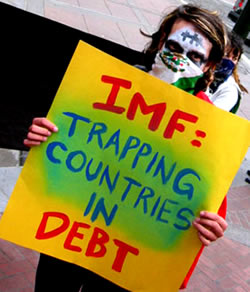
Critics charge that the IMF and the “neoliberal” economic paradigm that it promotes locks underdeveloped countries into positions of structural subordination within the global capitalist system.

Especially controversial are IMF policy prescriptions for “austerity measures” and “structural adjustment” that include privatization of state-run entities, reduced public expenditures, and radically curtailed intervention of national governments in their national economies.

Opposition to IMF policies and their underlying rationales has intensified in recent decades, as evidenced in part by the rise of left-leaning neo-populist regimes in Venezuela, Brazil, Argentina, Chile, Peru, and elsewhere in Latin America from the 1990s.

Denouncing IMF policies as unjust, immoral, corporate welfare, and a major contributor to poverty, unemployment, and human misery worldwide, critics characterize the IMF and associated multilateral institutions and treaties (the World Bank, the G-7, the World Trade Organization [WTO], NAFTA, and many others) as instruments of the wealthy and powerful and major obstacles to social justice, economic well-being, and political rights among the world’s poor. As economic globalization accelerates in the 21st century, debates on the role of the IMF are likely to intensify.

Piracy in the Atlantic World

Not long after the Spanish colonies in the Americas started to generate massive wealth, pirates started to attack the ships, taking the gold, silver, and other treasures from the Americas to Spain and later from Brazil to Portugal. In addition to attacking ships, some of the more daring buccaneers, such as Francis Drake, went as far as attacking ports.
Piracy in the Atlantic World

While some of the early raiders were freelance pirates, the cost of maintaining a ship and the ability to find a friendly port meant that many were privateers. These were French, Dutch, and more particularly English sailors, who operated in the Caribbean and in the Atlantic on behalf of their government, who had issued them a “letter of marquee,” allowing them to attack enemy shipping in times of war.

Often the news of the end of a particular conflict took a long time to reach remote outposts and as a result attacks often still took place in peacetime. Some pirates also regularly exceeded their “letters of marquee” and attacked any ships they came across.

Although privateers could use the excuse of attacking enemy ships in time of war, many modern historians are more understanding of their actions given the appalling Spanish treatment of the indigenous population of the Americas, from which they gained much of their gold and silver.

The initial attacks on Spanish ships sailing across the Atlantic led the Spanish to establish a treasure fleet from the 1560s. This involved a large number of ships, including many men-of-war, sailing together taking manufactured goods to the Americas and returning with gold or more often silver. By this time, the English, French, and Dutch had established settlements in the Caribbean, which their privateers used as bases in their attacks on the Spanish.

The English buccaneer Francis Drake managed to capture some of the Spanish treasure fleet in 1580 and sacked the ports of Santo Domingo and Cartagena in the Caribbean in 1585, and later that year attacked and sacked the port of Cádiz in Spain.

This led to the Anglo-Spanish War of 1585–1604, which turned many of the English pirates into privateers, weakening the Spanish merchant navy and providing a large source of profit for English and Dutch traders.

While Francis Drake operated ostensibly for patriotic reasons, the Spanish denounced him as a pirate, and by the early 17th century, there were large numbers of pirates operating in the Caribbean. Many used isolated European settlements around the West Indies, with a few operating from their own bases in isolated bays.

A few places, such as Port Royal in Jamaica, became famous haunts of the pirates, growing rich but also becoming exceedingly dangerous places, gaining the reputation of being one of the “richest and wickedest” cities in the world. Other places used by pirates included the islands of Antigua and Barbados.

The Thirty Years’ War, which lasted from 1618 until 1648, led to renewed Protestant-Catholic conflict in Europe, which led to fighting in the West Indies, and British as well as Dutch ships attacked those belonging to Spain and France. It was during this period that English privateers and pirates started to use the Mosquito Coast of Nicaragua to establish bases, which allowed them to attack Spanish ports and Spanish ships with ease.

From 1660 until 1720, the so-called golden age of piracy, pirates again operated as privateers. This period saw some sailing under the famous “Jolly Roger” flag, with attacks by English pirates on both Spanish and French ships. There were also English attacks on the Dutch; the island of Saint Eustatius, a Dutch sugar island, was attacked by pirates and British soldiers on many occasions, changing hands 10 times during the 1660s and early 1670s.

French pirates also started operating freely from their ports on the island of Hispaniola (modern-day Haiti and the Dominican Republic). Sir Henry Morgan, a Welsh buccaneer, sacked the Spanish town of Portobelo in Panama, which had been well garrisoned.

Morgan later destroyed Panama City in 1671 but was arrested by the British, as the attack violated a treaty between England and Spain. At his trial in London, Morgan was able to prove he had no prior knowledge of the treaty and was released, knighted, and appointed lieutenant governor of Jamaica.

Other pirates such as Edward Teach, “Blackbeard,” became infamous not only for his savagery but for his outlandish appearance. He was killed in combat in 1718. There were also female pirates such as Anne Bonny, originally from Ireland, and Mary Read from London, who were captured and tried in 1720 in Jamaica, with both escaping execution.

The career of these two female pirates, which started when the former joined the crew of “Calico Jack” Rackham, and the second a ship captured by him, was related in many published books of the period.

After 1720, stronger European garrisons throughout the Caribbean caused a massive decline in the number of pirates operating in the region. At the end of the War of the Spanish Succession, the 1714 Treaty of Utrecht allowed the British to sell African slaves in the Americas, and many of the former pirate crews found that they were able to operate legitimately as slave traders.

The nations involved in Caribbean trade decided to eliminate the pirate threat to their lucrative trade routes. In 1720, two famous pirates, Charles Vane and “Calico Jack” Rackham, were hanged at Port Royal, and two years later some 41 pirates were hanged there in a single month.

Without the ability to seek refuge in places such as Port Royal, although some pirates continued operating through to the 1750s, they had access to fewer and fewer ports. This coincided with the European powers’ massively strengthening their hold on their West Indian possessions, and it became far more likely that pirates would be caught.

As a result there was a decline in piracy, with the former pirates having to find work in the slave trade, legitimate shipping, or the lumber industry, cutting logwood and later mahogany in what became British Honduras (modern-day Belize).

The romantic image of the pirates was nurtured by many writers, such as Daniel Defoe, who wrote A General History of Pyrates (1724), which described the lives of many of the more famous individuals, and much later Robert Louis Stevenson in Treasure Island (1883); a small number of pirates published their own accounts. The subject of pirates and piracy remains popular in today’s novels, plays, and films.

Mercantilism

Mercantilism
Mercantilism

The theory and practice of mercantilism in early modern Europe were densely entwined with both the emergence of capitalism and the formation of overseas empires. Briefly, capitalism can be defined as an economic system in which goods and services, produced by individuals and privately owned firms, are bought and sold in markets, thus benefiting individual owners of capital and private property.

In early modern Europe, mercantilism extended this notion regarding capitalist production and exchange to the level of the state. More specifically, it refers to the theory and practice of how the early modern European states and nation-states related to each other and to their respective colonies.

The basic theory behind mercantilist practice was fairly simple. The whole point of creating overseas colonies was to augment the economic, political, and military power of the colonizing state, often referred to as the “mother country,” though this locution is deceptive, since the unit of analysis is less a “country” than a specific state apparatus.


Colonies were to serve the colonizing state in two principal ways: as a market for manufactured goods produced in the home country, and as a source of raw materials from which the nation-state’s private producers would create manufactures.

An ideal mercantile relationship was thus conceived as hierarchical, reciprocal, and exclusive; the colonizing power was to be dominant, the colony subordinate. Manufactures were to flow in one direction, raw materials in the other. At the same time, rival colonizing states were to be excluded from this relationship.

It would not serve the English state’s mercantile interests, for instance, for its rivals (e.g., Spain or France) to trade with its colonies. From the perspective of any given colonizing state, the whole point of creating overseas colonies was to enhance its own power vis-à-vis competing states.

It would therefore be counterproductive for a colonizing state to permit its rivals to benefit by trading with its colonies by either exporting manufactures to them or receiving raw materials from them. The exclusionary nature of the ideal mercantilist relationship was thus just as important as its hierarchical and reciprocal qualities.

Finally, mercantilism also called for low wages and minimal consumption in the home country and for maximizing of exports, thus encouraging industrial development and permitting the greatest percentage of money and resources to be kept in the hands of the state.

Mercantilist practice often deviated from mercantilist theory, however, depending on time, place, and circumstance. Spain, the New World’s first colonizing power, endeavored relentlessly to forge an exclusive mercantile relationship with its colonies, with decidedly mixed success.

Despite an abundance of laws and decrees intended to ensure an exclusive relationship, smuggling, contraband, and other forms of illicit trade made Spain’s mercantile system, hermetically sealed in theory, exceedingly leaky in practice. In addition, Spain did not have the industrial base with which to meet its own or its colonies’ demands for manufactured goods.

As a result, much of the silver and gold plundered from its New World colonies slipped through the fingers of the Spanish state on its way to Dutch, Flemish, and English merchants, who were able to provide the industrial manufactures that Spanish merchants were not.

The English were more successful in achieving the mercantilist ideal, principally through a series of Navigation Acts (most notably in 1651 and 1660) that required England’s colonies to trade exclusively with the mother country. But here, too, smuggling and contraband poked many holes in the system, rendering mercantilist practice a far cry from the ideal.

The Dutch state, committed to free trade and frequently encouraging its capitalist class to invest in its rivals’ colonies, rarely adhered to mercantilist theory, yet Dutch merchants and the Dutch state succeeded in amassing vast quantities of capital during the colonial period.

Principally because their domestic economies had undergone the most extensive transition to capitalism, by the end of the colonial period the English and French states had become the most successful in employing mercantilist theory and practice to augment their own economic, political, and military power, and, by extension, the power and prestige of their respective nation-states.

Ferdinand Magellan - Portuguese Explorer

Ferdinand Magellan - Portuguese Explorer
Ferdinand Magellan’s exact date of birth is unknown but is believed to be in 1480. His parents were petty nobles. After the return of Vasco da Gama’s expedition from India, Portugal launched subsequent expeditions there.

When Francisco de Almeida, who would become the first Portuguese Indian viceroy, set out for India in 1505, Magellan joined his expedition. Magellan spent eight years there in a number of different positions. He was also involved with Diogo Lopes de Sequeira’s expedition to Malacca in 1508–09. Magellan returned to Portugal in 1513.

Magellan then served in Morocco, where he was involved in a number of battles and skirmishes. He also served as quartermaster in charge of the spoils of war. Upon his return to Portugal, he requested an increase in pay from King Manuel, but the request was denied because of rumors that he sold cattle to Portugal’s enemies in Morocco.

Magellan returned to Morocco to clear his name so the king would consider his request for more pay. King Manuel still denied the increase. This was apparently one of the main motivations behind Magellan’s decision to approach the Spanish with his idea of finding a passage from Europe to India sailing west, either around or through the Americas.


Magellan convinced the Spanish to back the expedition in 1517. The expedition set out in September 1519 with five ships. They sailed to the South American coast of Brazil.

From there Magellan explored the bay at Rio de Janeiro and the Rio de la Plata before halting for the winter in Patagonia from March through August 1520. It was during this time that Magellan faced a mutiny and saw one of his ships desert the expedition. With winter over, Magellan continued south along the coast of South America.

Upon reaching the southern tip of South America, Magellan took 38 days to find a passage to the Pacific through the strait that now bears his name, the Strait of Magellan. Having found the way through to the Pacific, the expedition started up the western coast of South America on November 28, 1520.

Magellan took 98 days to cross the Pacific with hopes of reaching China but instead made landfall at Guam. From there, the expedition continued on a western course that brought them to Cebu on April 7, 1521. There Magellan made an alliance with the local leader and agreed to help them attack a neighboring island.

It was during this attack that Magellan was killed on April 27, 1521. The expedition continued west and eventually made its way back to Spain, having rounded the Cape of Good Hope in September 1522, three years after having left.

While Magellan did not actually live to complete the circumnavigation of the globe, the journey was the product of his ambition and determination. More important was his discovery of a way to travel from the Atlantic Ocean to the Pacific Ocean going west rather than around Africa.

Francis Drake - English Explorer

Francis Drake - English Explorer
Sir Francis Drake was an English mariner-adventurer, and sometime privateer, who circumnavigated the globe. Drake was born near Tavistock, Devon, England, not far from the important port of Plymouth. He came from a well-connected Protestant farming family, one of 12 children born to Edmund Drake.

At approximately age 13, Francis went to sea on a cargo bark and eventually became the master of the ship at age 20. These early seafaring years spent in the North Sea built his experience as a skillful sailor and navigator and gave him a sense of command. When he was 23 he joined his cousin Sir John Hawkins and for the first time voyaged to the New World. In association with Hawkins, he undertook the initial English slave-trading expeditions to the New World.

Drake discovered the lure of the Spanish Main with all its riches in silver, gold, and slaves. He disliked the Spanish from the onset, no doubt in part for their Catholicism, and in the 1560s, began his campaign against Spanish interests, appearing a pirate to some and a privateer to others. His raids demonstrated his bravado and determination, but almost cost him his life.

Drake’s most famous attack came in 1573 when he took the Spanish Silver Train at the port of Nombre de Dios. Finding the silver too heavy to carry, he took all the gold he could and returned to Plymouth on August 9, 1573, with 30 survivors. Unfortunately, Queen Elizabeth I had undertaken a temporary truce with Philip II of Spain, and Drake’s exploits were not officially celebrated.


In 1577, Queen Elizabeth, facing new Spanish hostilities, sent Drake with 150 men and five ships on an expedition against the Spanish interests on the Pacific coast of the Americas. Two ships had to be abandoned at Río de la Plata and the remaining three navigated the Straits of Magellan, making Drake the first Englishman to do so.

The voyage continued to be difficult; another ship was destroyed, and still another separated and returned to England. Drake sailed along the coast of South America alone in the Golden Hind, attacking Spanish interests, plundering Valparaíso, and seizing cargo as he moved. He continued along the coast of North America looking for a passage to the Atlantic, possibly as far north as the present state of Washington.

He stopped for supplies and repairs in San Francisco Bay and named the area New Albion. Drake now made the decision to cross the Pacific. He rounded the Cape of Good Hope and eventually returned on September 26, 1580, to Plymouth, laden with treasure. His exploits could not be denied even in the face of Spanish fury, and Queen Elizabeth knighted him.

War with Spain

Another war with Spain in 1585 put Drake back in his element. He took command of a fleet and launched assaults against Vigo in Spain, São Tiago in the Cape Verde Islands, and the New World ports of Santo Domingo and Cartagena, as well as St. Augustine in Florida.

In 1587, he “singed the King of Spain’s beard” with a preemptive and destructive raid on Cádiz, burning 31 ships and holding the town for three days in the process. This attack delayed the Spanish Armada sailing by a year.

Statue of Francis Drake
By the time the Spanish Armada sailed to England to invade in 1588, Drake was vice admiral in command of the English fleet. It was at this time that the famous Drake myth first appeared that had Drake enjoying a game of bowls on Plymouth Hoe as the Spanish fleet approached. Here he supposedly stated that he had plenty of time to finish the game before the Spanish arrived.

The English fleet pursued the Spanish through the channel. Drake caught the rich galleon Rosario and Admiral Pedro de Vales in the process. On July 29, 1588, Drake and Lord Howard of Effingham organized the fire ships that broke the Spanish formation, causing damage that forced the Spaniards into the open sea toward Calais. The following day, Drake and the rest of the English fleet defeated the Spanish at the Battle of Gravelines.

Drake’s tamat expedition against the Spanish occurred in 1595, supported by Hawkins. On this occasion, the Spanish inflicted defeat, particularly against Drake’s raids on San Juan, Puerto Rico. Hawkins died off Puerto Rico and Drake became ill from dysentery and died on January 28, 1596, while in the process of mounting a further attack on San Juan. Placed in a lead coffin, Drake was buried at sea with his crew burning the town of Puerto Bello as a dedication to his passing.

Drake’s life was one of adventure and determination, which helped enrich England with his plunder. He established claims to the New World and made England a recognized naval power.

Bull of Demarcation

Christopher Columbus’s first voyage to the Americas threatened to intensify the rivalry between the Catholic kingdoms of Spain (Castile) and Portugal into open warfare. Both kingdoms wanted to claim all newly discovered lands that were not Christian, that is, not Catholic.

The Line of Demarcation was Pope Alexander IV’s solution to this problem. He issued the Bull of Demarcation to prevent Spain and Portugal from battling over new territories with resources such as gold. The bull successfully prevented a war between Spain and Portugal in the 16th century.

Neither the pope nor the Spanish or Portuguese actually knew what this line was dividing. The knowledge of the lands west of Europe was sketchy, and most people thought that the land Columbus had reached was part of Asia.

The pope may have believed that the Spanish would reach the same lands sailing west over the Atlantic that the Portuguese would reach sailing east around Africa. Previously in 1455, 1456, and 1481, popes had issued bulls about newly discovered land, although they had no knowledge of the actual geography of the earth.

The Roman Catholic nations left out of these bulls, including the French and Dutch, paid no attention to the papal decrees. The power of the Catholic Church in the Middle Ages had guided all international affairs in Europe up to the 15th century. France and Holland ignored the document, showing that the temporal power of the church was waning.

When Columbus returned from the Americas, he stopped in Portugal before going to back to the court of Ferdinand V and Isabella I of Spain. King João II of Portugal claimed the lands Columbus told him about even though the explorer had sailed for the Spanish monarchs.

Ferdinand and Isabella appealed to Pope Alexander VI, a Spaniard, for a solution. He issued the Inter caetera, the papal Bull of Demarcation, which was very biased toward Spain.

This document conferred all non-Christian lands found west of the designated line to Spain to explore and convert to Christianity. Portugal was to have all non-Christian lands east of the line. This decree in principle shut the Portuguese out of the Americas.

Dissatisfied, the Portuguese appealed to both the pope and Spain. Two more papal bulls followed—Examinae devotionis and another Inter caetera. These documents drew a line 100 leagues west of Cape Verde Islands.

Discoveries east of the line were to belong to Portugal, and discoveries west of the line were to belong to Spain. This resulted in Spain’s domination of all of South and Central America except Brazil, which the Portuguese claimed. The Treaty of Tordesillas modified the papal bull in 1494.

The Bull of Demarcation and later decrees gave the rights to colonize, exploit, and convert all non-Christian territory to Catholicism. These decrees treated all newly discovered nations and people as property and disregarded all non-Christian governments the Catholic explorers found.

Later the church realized these bulls were the cause of the enslavement and brutalization of native peoples and tried to emphasize peaceful, noncoerced conversion to Christianity. But it was too late; the system of Europeans’ forcibly taking control of non-Christian lands was already entrenched in the Americas, Africa, and Asia.

There have been modern movements for the revocation of these papal bulls. Indigenous peoples feel they were used for the subjugation of non-Christian indigenous peoples and should be rescinded to reflect modern thinking.

Certainly, the leaders in Rome could not have foreseen the horrendous decimation of native peoples that the conquest by the European powers caused. The Falkland War of the 1980s was in part justified by Argentina’s claim that the Falkland Islands is based on the Inter caetera. However, the Treaty of Madrid in 1750 annulled the boundary line.

Afonso de Albuquerque - Portuguese Explorer

Afonso de Albuquerque - Portuguese Explorer

One of the great sea captains in Portuguese history, Afonso de Albuquerque captured the cities of Goa, Malacca, and Hormuz and founded the Portuguese empire in Asia. He was born in Alhandra, near Lisbon. Both his paternal grandfather and great-grandfather had been confidential secretaries to King João I and King Edward (Duarte), and his maternal grandfather had been an admiral in the Portuguese navy.

He grew up at the court of his godfather King Afonso V, and when he was 20 he sailed in the Portuguese fleet to Venice and was involved in the defeat of the Turks at the Battle of Taranto. He then spent 10 years in the Portuguese army in Morocco gaining military experience.

Albuquerque was present when the Portuguese under King Afonso V captured Arzila and Tangier in 1471, and Afonso’s son, King João II, made him a bodyguard and then his master of the horse. He returned to Morocco in 1489 and fought at the siege of Graciosa. When John’s brother Manuel I became king in 1495, Albuquerque returned again to Morocco.


It was during this time that Albuquerque became interested in Asia. The possibility of opening up a trade route was tantalizing to Albuquerque and in 1503 he joined his cousin Francisco to Cochin on the southwest coast of India, where they built the first Portuguese fortress in Asia.

King Manuel appointed Dom Francisco de Almeida as the first viceroy of India with the aim of increasing trade and establishing a permanent presence on the Indian subcontinent. In April 1506, Albuquerque set out on his second (and final) voyage—one that would last nine years. He was skilled in military tactics, seafaring, and handling men and was incredibly ambitious.

However he was only in charge of five of the fleet’s 16 ships. Overall command was given to Tristão da Cunha, who led the expedition up the east coast of Africa, and around Madagascar. They built a fort at Socotra to prevent Arab traders from passing through the mouth of the Red Sea and ensure a Portuguese trade monopoly with India.

In August 1507, Albuquerque was given permission by Tristão da Cunha to take six ships and 400 men. They headed straight for the Arabian and Persian coasts and, heavily armed, they sacked five towns in five weeks. Albuquerque then decided to attack the town of Hormuz (Ormuz), which was located on an island between the Persian Gulf and the Gulf of Oman.

Taking it would cripple Turkish trade with the Middle East as it was the terminus for caravan routes from Egypt, Persia, Turkestan, and India. Even though Hormuz had a population of between 60,000 and 100,000, Albuquerque was able to capture the town and force it to pay him an annual tribute.

Monument of Afonso de Albuquerque
Albuquerque, appointed to succeed Almeida, found Almeida reluctant to hand over the office. Almeida was keen to avenge the death of his son, who was killed by an Egyptian fleet. He jailed Albuquerque and then led the Portuguese into a naval battle off the island of Din near Goa in February 1509.

In October 1509 the marshal of Portugal, Fernando Continho, on a tour of inspection, ordered the release of Albuquerque and demanded that Almeida hand over his office. Albuquerque then set out to create the Portuguese empire in Asia.

In January 1510 he attacked the port of Cochin but was unable to capture it. Two months later he attacked and took the town of Goa. After being there for two months he was forced out, but retook Goa in November 1510.

Albuquerque then made for Malacca (now Melaka), the richest port on the Malay Peninsula. It was the center where traders from the Indonesian archipelago brought their spices. It had a population of 100,000 and was well armed.

With 15 ships, three galleys, 800 European and 200 Indian soldiers, in July 1511, he attacked Malacca and after a day, took the city, which his men looted. They loaded their treasure into the Flor do Mar, and the ship was so overloaded that it sank off the coast of Sumatra; the wreck has never been found.

Back in Goa, Albuquerque fought off the attackers and then took a group of Portuguese and Indians to try to take the port of Aden. They failed and they returned to India. In February 1515, he again sailed from Goa, taking 26 ships to Hormuz.

However he was taken ill in September and sailed back to Goa. On the way back he heard that his success had made him many enemies in Lisbon and he had been replaced by an enemy, Lopo Soares. Albuquerque died on December 15, 1515, at sea off the coast of Goa.

Amerigo Vespucci - Florentine Explorer

Amerigo Vespucci - Florentine Explorer
An innovative explorer, pioneering cosmographer, and highly effective self-promoter during the age of discovery, Amerigo Vespucci was the first to recognize that the lands encountered by Christopher Columbus and Pedro Álvares Cabral represented an entirely “New World,” a term he coined in his collection of letters and documents titled Paesi novamente retrovati, published in Italy in 1507.

During that same year, a Latinized version of Vespucci’s given name—America—was applied to these lands for the first time in a map published by an obscure French clergyman named Martin Waldseemüller in his collection of documents titled Cosmographiae introductio. Thus an explorer not involved in the initial discovery of the lands of the Western Hemisphere had the singular distinction of having two continents bear his name.

His career as an explorer and cosmographer was actually Vespucci’s second, as he had built his fortune as a merchant and agent for the Medici interests in Italy. Launching his second career in 1499 at the age of 45, Vespucci joined the expedition of Spanish navigators Alonso de Ojeda and Peralonso Niño in 1499 in their exploration of the coasts of northern South America. By prior agreement, Vespucci separated from Ojeda and Niño and sailed south, exploring the mouth of the Amazon as well as various Caribbean islands.


In 1500, he returned to Spain and in 1501 switched patrons. He served under King Manuel of Portugal when he explored nearly 10,000 kilometers of the southern coastline of South America and made many discoveries, including the Rio de Janeiro in Brazil. Sailing as far south as 50 degrees south latitude, south of the mouth of the Río de la Plata, Vespucci kept detailed notes, revisions of which were published in 1507.

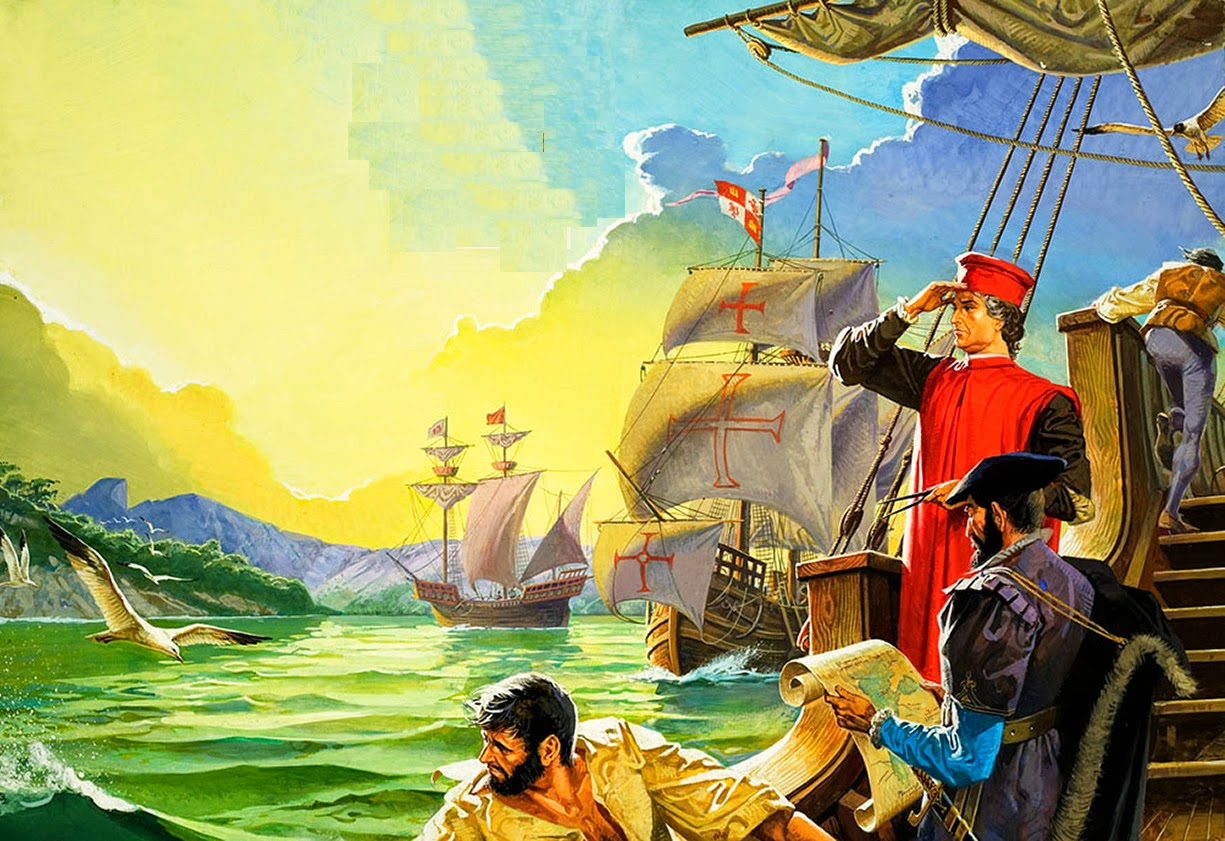
Amerigo Vespucci Sighting America (Original) art by Severino Baraldi at The Illustration Art Gallery
Amerigo Vespucci Sighting America

As did other explorers of his day Vespucci emphasized the most extraordinary and titillating features of the natives he encountered, describing them as perpetually naked (“just as they spring from their mother’s wombs so they go until death”), sexually promiscuous (“they marry as many wives as they please; and son cohabits with mother, brother with sister, male cousin with female, and any man with the first woman he meets”), without property of any kind (“neither do they have goods of their own, but all things are held in common”), without religion (“they have no church, no religion”), and horribly deformed by “unwonted and monstrous” ornamentation on their bodies and faces.

In addition to his discoveries and publications, Vespucci was a pioneer in the art and science of cosmology, developing a method for computing nearly exact longitude (which up until then had been determined by dead reckoning). He also calculated the circumference of the Earth to within 80 kilometers of its actual dimensions.

Voyage of Amerigo Vespucci

For centuries, most scholars discounted Vespucci’s accomplishments as secondary and derivative, a perception that was only corrected with the work of Italian scholar Alberto Magnaghi in the 1920s and 1930s. Vespucci died in 1512 at age 58, from malaria contracted during his explorations.

Treaty of Tordesillas

Treaty of Tordesillas

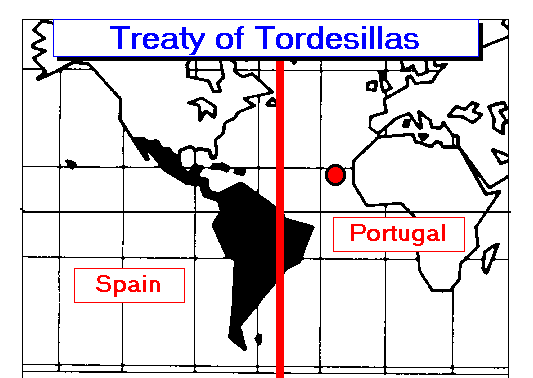
A modification of the papal Bull of Demarcation issued in 1493 by Pope Alexander VI, the Treaty of Tordesillas (June 7, 1494) divided the recently discovered New World between its two signatories, Spain and Portugal.

The treaty created an imaginary pole-to-pole meridian in the Atlantic Ocean 370 leagues west of the Cape Verde Islands, granting all lands west of the demarcation line to Spain, and all lands east of it to Portugal.

In this masa of uncertain geographic knowledge, both sides recognized that the division was imprecise and unlikely to prevent future conflict. Spain reckoned that the newly discovered Indies (Caribbean) fell well within its sphere of dominion, while Portugal was mainly interested in securing its sea route to Asia around Africa’s Cape of Good Hope.


Notably, the treaty was concluded six years before the Portuguese, under Pedro Álvares Cabral, discovered Brazil (1500), though once Brazil was on the map, there was little doubt that the land fell under Portugal’s jurisdiction.

Thornier problems arose once it became clear that the Indies (Americas) lay between Europe and Asia, a fact that became clear after Portuguese navigator Vasco de Gama’s journey to India and back in 1497–99, Spanish explorer Vasco Núñez de Balboa’s discovery of the Pacific Ocean in 1513, and Portuguese navigator Ferdinand Magellan’s journey to the Pacific around the southern tip of South America in 1520 in the service of Spain. In the wake of these advances in Europe’s knowledge, Portugal refused to abide by a treaty that essentially granted all of Asia to its Iberian rival.

Thus, following a series of armed conflicts in the Moluccas and elsewhere in the Pacific, the Treaty of Tordesillas was modified in 1529 in the Treaty of Zaragoza, which continued the meridian established in 1494 onto the other side of the globe, to a position of 145 degrees east.

Still, the reality remained that military might effectively determined who got what—illustrated for example by the case of the Philippines, which clearly fell within Portugal’s sphere, yet the Spanish first colonized and refused to relinquish until the United States took the island-colony in 1898.

Seen in a broader context, the Treaty of Tordesillas represents the earliest instance of European powers’ carving up the globe among themselves in pursuit of their own domestic, strategic, and imperial designs, a tradition that continued well into the 19th century and after.

Ships and Shipping

Ships and Shipping
Ships and Shipping

By the 15th century, contact between seafarers from northern Europe and their counterparts in the Mediterranean had brought about the development of a number of ship types in use throughout Europe.

Ship-builders from the Atlantic seaboard borrowed frame-first construction techniques from the Mediterranean roundships and galleys, while southern European builders borrowed the more maneuverable square sail and the stern post rudder from ships built to weather the heavier seas of the Atlantic and North Sea.

The result of such cross-fertilization was a series of ship types that would not undergo any more radical transformations until the age of steam; a 15th century tall sailing ship had more in common with the vessels of the early 19th century than with those of only 100 years before.


The basic ship types in use in Europe at the dawn of the 15th century were the carrack, a tall sailing vessel, and the galley. Much sleeker and lower in the water, the galley was propelled primarily by oars, though it also carried sails to be used in favorable conditions.

Sometimes very large, up to more than 1,000 tons, carracks were driven by three or four masts, each with one or two square sails, with the exception of the mizzenmast, the one nearest the rear or the stern of the ship, which carried a lateen sail.

Carracks were guided by a centrally mounted stern post rudder. These ships were often quite slow and cumbersome, their breadth being roughly two-thirds their length, but they were much more seaworthy than their medieval ancestors, the roundship and the cog.

The galley was smaller by comparison, ranging from 100 to 150 tons; was roughly eight times as long as it was wide; and carried either one or two masts fitted with lateen sails. They were steered by a pair of large oars fitted one on each side of the vessel.

All elements combined to make the galley a much faster ship: the lateen sail was much more efficient at harnessing the wind while the oars meant that the ship never got stuck in calms. The galley was also incomparably more expensive to operate. More sailors were necessary to work the great triangular sails, but most of all the hundreds of oarsmen had to be fed and even paid, unless they were slaves or convicts, as was often the case.

It was primarily the difference in operating costs that made the galley the vessel of choice for transporting light, expensive goods such as spices, silk, or precious metals through the Mediterranean, while bulky goods were sent over long distances in carracks.

Introduction of the Cannon

The widespread introduction of cannon in the 16th century changed the face of shipmaking. Throughout the Middle Ages a ship’s fighting capacity and ability to defend itself resided in the number of able-bodied men it had aboard. This gave the galley an advantage; each oarsman could be given a sword. Artillery changed that.

Now a ship’s fighting ability was measured in the number of cannon the ship carried, and tall sailing ships could mount more guns than low, sleek galleys. Galleys did not disappear overnight, but by the 17th century, they were relegated more and more to patrolling coasts or providing rapid transport to dignitaries.

The carrack, on the other hand, continued to evolve. Hulls were lengthened in proportion to width, giving the vessels greater speed and stability. The results of this evolutionary process, the smaller caravel and the great galleons, became the instruments of European exploration and expansion.

The European tradition, however, was far from universal. The Turkish fleets as well as those of North African ports were quick to adopt the changes introduced in European shipping, though the seafarers active in the Persian Gulf and Indian Ocean produced ships of a very different type.

Overseas and coastal trade tended to be carried in dhows, Arab vessels of varying sizes, which can still be found along the east coast of Africa and in the Red Sea. Dhows ranged from small craft to deep, oceangoing ships mounting one or two large lateen sails. The hulls, however, were made of planks fitted together and sewn to each other rather than nailed to an internal structure as in European ships.

Such ships were unable to stand up to the cannon-carrying European vessels that began arriving in the Indian Ocean in the early 16th century. As a result, Europeans were able to dictate the terms of shipping, but European shipbuilding techniques spread to the Indian Ocean area.

Chinese Ships

Chinese ships form a category of their own. The most important Chinese ship type, the junk, mounted a stern-post rudder as early as the 12th century, though it carried fanlike bamboo sails, lugsails, and had a squared, flat-bottomed hull.

By the 15th century, Chinese junks could be as large as 1,500 tons, and, unlike European vessels, were built in several watertight compartments. The centralized government of China failed, however, to encourage development of oceangoing sea power and, as a result, the Chinese presence on the sea diminished considerably beginning with the late 15th century.

European Trading Empires

The early modern period witnessed the expansion of European-based colonial and trading empires throughout much of the globe. That expansion would not have been possible without the developments in European shipbuilding techniques that came about during the 14th century. Substantially, the rest of the period merely witnessed the continued refinement of the ship types developed at the end of the Middle Ages.

These versatile vessels were then imitated both in the eastern Mediterranean and to a large degree among the long-distance traders of the Indian Ocean region as well. The Chinese, on the other hand, having developed a robust and seaworthy ship type of their own, remained largely impervious to the developments that had taken place in Europe and that had been adopted in so much of the world.

Scientific Revolution

Scientific Revolution

Between 1500 and 1789, especially the period of 1600–1750, there occurred a shift in humans’ thinking from the medieval emphasis on God’s eternal unchanging world, which governed people, the universe, and nature, to an approach that defined knowledge and understanding as derived from the immutable laws of nature independent of received truth.

Knowledge and truth were to be gained by putting forth an idea, testing it, and expressing the results mathematically. The British coined the term empiricism to summarize the concept gained through human interaction with nature and continental Europeans followed the philosopher Descartes who put forth rationalism with its emphasis on knowledge that could be logically and mathematically proved.

Emphasis on Different Sciences

Different sciences came to the fore during these centuries. Physics and astronomy were especially prominent in the latter part of the 16th century and then 17th century; chemistry and biology, in the latter part of the 17th century and 18th century; and mathematics, throughout the period as part of scientific calculations. New methods of thought pushed to the surface.

These new patterns harkened back to the writings of Aristotle and other Greek and Roman philosopher/scientists that emphasized the use of reason in addition to faith in pursuit of knowledge, nature, and contemplating humanity and the universe. The methodology associated with these thoughts came to be called the scientific method and involved two approaches—the deductive and the inductive.


The former, which was associated with the medieval mindset, put the stress on going from a general proposition to particular situations. The inductive method started with an approach to a particular problem, then through testing and observation, the drawing of valid conclusions.

When combined, the two methods formed what came to be known as the scientific method. One would state a general proposition; then investigate through a review of the literature, logic, and experimental research; and then apply the result to a specific proposition or hypothesis.

The hypothesis would then be subject to observation, experimentation, and collection of data as part of a proof. The test result would either be positive or negative. Conclusions would then be reached confirming or denying or declaring the proposition moot or not proved.

The proponents of these combined related approaches to bring about a new scientific revolution were René Descartes and Sir Francis Bacon, respectively. Their seminal writings, published in the 1620s, became the underpinnings for the new way of thinking associated with the scientific revolution.

Descartes (1596–1659), the French philosopher and mathematician, concluded that thought stemmed from the mind. The use of logic would deduce all truths starting with the existence of God and the basic reality of both the material and spiritual worlds.

His grand concept was that of a unified and mathematically ordered universe that ran as a perfect mechanism. Everything could be explained rationally through logic and mathematics. “I think, therefore I am” summarized the approach known as rationalism.

Sir Francis Bacon (1561–1626), a politician and scientist, went a step further. He conceived of an approach that later was identified with the inductive method. He presented a system that used human reason to interpret human experiences.

Bacon recommended that facts derived from experiments could be validated through proving the hypothesis. These hypotheses would then be subjected to further experimentation and ultimately be proved so as to reflect fundamental laws of nature.

His approach was validated with the advent of new scientific instruments that could measure the physical world. In the 17th century, the thermometer, barometer, air pump, pendulum clock (grandfather clock), telescope, and microscope became readily available.

Heliocentric Theory

The scientific revolution dates from the work of astronomer Hellenistic Greeks, he advanced the heliocentric or Sun-centered theory of the universe.

His work was reinforced by the observation of Tycho Brahe, who made hundreds of observations via the telescope. Brahe’s data were supported by Johannes Kepler through mathematical calculations that showed that the planets moved elliptically around the Sun and that the Sun exerted a magnetic and gravitational pull on the planets.

Galileo Galilei, the mathematician, physicist, and astronomer, perfected the telescope to investigate the Moon, sunspots, the satellites of Jupiter, and the rings of Saturn. He also did work on physics through his former work from the leaning Tower of Pisa that originated basic laws of physics—the laws of motion and gravitation.

His experiments demonstrated that the velocity of falling bodies was related to the height from which they fell rather than their weight. These observations highlighted the relationship of gravitational pull to moving bodies. Acceleration would be constant no matter what the size or weight.

His experiments, which also involved hydrostatics, optics, and the pendulum, helped to develop his most famous law—the law of inertia—a body at rest or in motion will remain at rest or remain in motion unless affected by an external force such as gravitation.

Galileo and Copernicus suffered for their scientific advances. Both put forth ideas that went against the teachings of the Catholic Church; as a result, both were deemed heretical and had their discoveries challenged not scientifically, but theologically.

In the succeeding years of the 17th and 18th centuries, physicists built on the previous work. The French physicists Blaise Pascal and Jean Gay-Lussac developed laws and mathematical equations on volume, liquids, and gases.

Two professors at the university of Bologna, Mona Agnesi and Laura Bassi, verified Galileo’s work in mathematics and physics, respectively. Christian Huygens developed a wave theory to explain light. Otto von Gernicki proved the material composition of air in terms of its ability to have weight and exert pressure.

Other breakthrough work was done in other sciences. In astronomy, astronomer and mathematician Pierre Laplace discovered that comets were governed by mathematical laws, and that the Sun, which once had been a gaseous mass, threw off the planets as it solidified and contracted.

In biology, Antoni van Leeuwenhoek discovered bacteria, protozoa, and human spermatozoa. Robert Hooke discovered the cellular structure of plants. Andreas Vesalius gave detailed drawings of the human anatomy. William Harvey traced the circulation of blood.

Chemistry Advances

Chemistry also saw breakthroughs. Robert Boyle developed an atomic theory and investigated fire, respiration, fermentation, evaporation, and metal rusting. Joseph Priestley also developed ammonia, generated carbon monoxide, and discovered oxygen and offered an explanation of combustion. Henry Cavendish discovered hydrogen. Antoine Lavoisier proved that combustion resulted from a combination of oxygen with other elements.

He also showed that respiration was another form of oxidation. Ultimately, this led to a famous law of conservation—“Matter cannot be created or destroyed.” The supreme thinker of the early scientific age, perhaps, was Johannes Kepler, who developed differential calculus, mathematics of infinity, variables—the bases for modern algebra, geometry, and calculus.

So dominant was Isaac Newton (1640–1727) in the later scientific age that physical science is often characterized as Newtonian, pre-Newtonian, and post-Newtonian. His writing and ideas were so prevalent that ultimately they affected philosophy, religion, and social science. His ideas influenced reformers who believed (based on Newtonian science) that a science of humanity could solve human problems just as natural sciences were beginning to solve the questions of science.

Why was Newton so influential? It was because he was able to synthesize previous discoveries. His law of gravitation stated that all natural objects attract other bodies—inversely, according to the square of their distances and directly in proportion to the products of their masses. Newton had arrived at this conclusion by methods that combined the methods advocated by Descartes and Bacon in his major work, Principia.

In that work, he used mathematical proofs that were tested by observation. He arrived at the conclusion that underlies all modern science—all selesai conclusions have to be based on solid facts. Accordingly, the hypothesis even if supported by mathematics must be rejected if it is not supported by observation or experimentation.

More importantly, his basic premise, based on his own experiments in gravitation, was that laws govern all nature, including the universe. His universal laws were then applied to every area. The result in terms of religion and philosophy was deism. Succeeding philosophers following Descartes and Newton divided reality between mind and matter.

Science assisted human reason in dealing with matter; faith dealt with the truth beyond the natural senses and helped the mind to intuit truth directly from God. Taking the clue from Newton, clergymen subordinated science to faith. The world was run by universal laws, of which the first law was God’s will.

Deism

The greatest influence of science and future events was in the development of deism—a belief held by many of the leading members of the American Revolution such as Benjamin Franklin and Thomas Jefferson. Even though deists considered themselves Christians, they rejected many tenets of traditional Christianity.

They did accept Jesus Christ but as a great budpekerti teacher rather than as a human savior. The view of most deists was that God was a rather impersonal force—the great physicist or master clock winder in the universe. God set things in motion, but if people behaved according to the golden rule and the Ten Commandments, everything else was left to them.

God proposed; humans disposed. All budpekerti decisions were based on the individual’s reason and conscience. No formal denomination held their allegiance—nature was their church and natural laws were their spiritual guides, even their bibles.

In the 18th century, sciences passed into general acceptance. Kings endowed observatories, cities funded museums, wealthy benefactors established parks and gardens, and learned societies sponsored popular lectures. Learned societies were established, such as the Royal Society of London, the French Academy of Science, and the American Philosophical Society for Promoting Useful Knowledge. The role of the sciences changed markedly in the 18th century.

Benjamin Franklin was lionized on both sides of the Atlantic for his many achievements including the Franklin stove and especially his research and experimentation that proved that lightning was another form of electricity. Whereas scientists such as Giordano Bruno were burned for heresy in 1600, and Galileo was forced by the Inquisition to recall his writings in 1633, the situation was different in the 18th century.

Isaac Newton received a well-compensated paying position, was knighted, and when he died in 1727, received the ultimate accolade—he was buried at Westminster Abbey. Joseph Priestley was a well-respected theologian and high-ranking church official as well as a scientist.

Effects on Technology

Just as the scientific revolution affected society, it also affected technology. Among the consequences was the application of scientific methods to farming. Scientific agriculture including planting with fertilizer and utilizing crops that restored fertilizer to the soil through legumes such as turnips, along with new methods of drainage such as irrigation, became common.

Landowners also began to experiment with cross-breeding so as to improve their livestock. England especially led the way. Jethro Tull plowed land that was planted in rows through the use of a drill he invented. Charles Townshend experimented in restoring soil fertility by applying clay lime mixture as well as planting turnips in crop rotation.

Robert Bakewell developed new techniques of stock raising through selective breeding that not only increased the size of meat cattle, but also increased the milk yield of dairy cows. Arthur Young lectured on the new agriculture and popularized the new method of scientific farming.

Science was applied to medicine, which utilized the findings of Vesalius, Harvey, and Leeuwenhoek. Dr. Edward Jenner developed the field of immunology through the injection of cowpox to combat smallpox, which had been the scourge of populations for two centuries.

Scientific knowledge was applied to draining mines, pumping water, drying textile fibers, producing gunpowder, manufacturing pottery, building ships, and improving navigation. The Industrial Revolution began in the first half of the 18th century of the application of science to economic development.

John Kay invented the flying shuttle and James Hargreaves invented the spinning jenny. Thomas Newcomen produced the first steam engine; James Watt improved the design and revolutionized both factories and transportation.

Richard Arkwright invented the water frame. Samuel Crompton invented the water mule. Edmond Cartwright invented the power loom. This first stage of the Industrial Revolution in the middle and latter parts of the 18th century stemmed directly from the scientific revolution.

The scientific revolution marked the transition of society from the Middle Ages to modern times. It advanced the perception of people and their place in the universe, the source of knowledge, and the relationship of human society to nature. It led to great advancements in science and mathematics.

Beyond this direct outcome, its emphasis on reason directly led to the Enlightenment, which emphasized the natural rights of all human beings. Its questioning of previously accepted doctrines developed into a skepticism regarding received truth that ultimately led to revolution against the established order.

New technologies transformed economic options and eventually living situations as people moved from the countryside to cities to seek work in the factories based on the scientifically derived inventions that preceded this technology. Above all, the scientific revolution enshrined the spirit of human initiative, innovation, and invention, which has led to change and progress in succeeding ages.

Black Death

Black Death
Black Death

The Black Death (Black Plague, The Plague, Bubonic Plague) was so named because the skin on many of its victims turned black, a result of massive blood clots. Although there have been many plagues throughout history, the three most associated with the term Black Plague are pandemics (epidemics that affect huge geographic areas) that occurred in Justinian, began in Egypt, according to Procopius.

The disease spread from the coasts to inland areas, killing thousands of people each day. Allegedly, corpses were put on ships and sent out to sea to be abandoned. The power shift from south to north and from the Mediterranean to the British Isles is attributed to this devastation.

It was the second pandemic—a series of outbreaks that escalated from an early adegan in 1331 to the disastrous events in 1346—that is most frequently referred to as the Black Death. In 1346 a Mongol prince and his armies attempted to lay siege to Caffa, in the Crimea. However, the soldiers were stricken with this dreadful disease and withdrew, but not before catapulting infected corpses over the city wall.


The Christian defenders, who thought they were now safe from attack, left to return home but perished from the plague. The few who reached home spread the disease throughout Europe and as far north as Greenland. Within a year 80 percent of Marseille had died. According to various sources, the death rate varied from 12 to 50 percent. It is estimated that in Europe 20–25 million, and throughout the world 42 million people died.

There are three forms or types of the disease: bubonic, pneumonic, and septicemic. The most dramatic is the septicemic version. Immense numbers of bacteria cause DIC (disseminated intravascular coagulation), a condition where there is so much debris in the bloodstream, the blood hemorrhages under the skin and the afflicted person’s body, or parts of it, becomes black. These victims died almost immediately, within one to three days after they showed symptoms of the disease.

Plague doctor...the "beak" would contain herbs that would help to protect the Doctor from contracting the disease. It was basically useless...of course they didn't realize how disease was spread and the different methods of cross contamination, etc...
Plague doctor
Giovanni Boccaccio (1313–75), the author of characteristic symptoms after being exposed.

The most painful symptom was swelling of the lymph glands in the armpit, groin, and neck. These enlargements would become buboes, painful abscesses; skin infections filled with pus. When the bubo broke and drained, the purulent material inside was infectious and therefore spread to whomever touched the patient or the anything the patient’s clothing, bedding, or items that he handled.

Boccaccio wrote, “... in men and women alike there appeared, at the beginning of the malady, certain swellings, either on the groin or under the armpits, whereof some waxed of the bigness of a common apple, others like unto an egg, some more and some less, and these the vulgar named plagueboils ... to appear and come indifferently in every part of the body; wherefrom, after awhile, the fashion of the contagion began to change into black or livid blotches, which showed themselves in many, first on the arms and about the thighs and after spread to every other part of the person ... a very certain token of coming death ...”

Patients with the bubonic form spread the pneumonic form via fine droplets from a cough or sneeze. Although it was less lethal than the septicemic version, victims suffered from painful coughing episodes and eventually they coughed so much that the lining of their lungs became irritated and they coughed up blood.

People were so fearful of catching the plague that they abandoned their own family members, friends, homes, and public spaces in order to escape contact with anyone stricken with the disease. Doctors who were still willing to treat patients donned hoods with masks, beaks and hats in order to avoid breathing the air around a plague victim. They had no way of understanding the natural history or cause of this disease.

They blamed an unlucky conjunction of astrological influences, such as Saturn, Jupiter and Mars, and poison from the tails of comets, or blamed Jews for allegedly poisoned the wells. But even after the wells had been sealed, people continued to get the plague.

Some of the treatments such as cupping, purging and bleeding, although acceptable in the 14th century, did more harm than good and weakened anyone who remained alive after such insults to their feeble bodies. Amazingly some people survived and because of their illness, developed antibodies that provided immunity against a future attack.

The Spread of the Black Plague

The Black Death ripped through Europe

This second pandemic was facilitated by a number of factors. Populations had reached such high numbers in Europe that there was not enough food to feed everyone. Consequently those who could not afford the rising cost of food lacked adequate nutrition, and became easy targets for any new threat to health. There were trade routes connecting urban centers and increased travel in the form of caravans. Returning crusaders were spreading Christianity and, at the same time, the plague.

The causative organism Pasturella pestis (now called Yersinia pestis) was already present in the burrowing rodents of the Manchurian-Mongolian steppes but did not create a plague until the black rat (Rattus rattus) spread to Europe with a specific kind of flea. Rattus rattus originated in Asia but reached Europe during the early Middle Ages. They thrived in environments where people lived, near water, and traveled by ship.

The black rat’s flea Xenophylla cheopsis would bite the rat, but instead of being satisfied with its blood meal, its digestive tract would get plugged with plague bacteria, thus creating a constant hunger. It would voraciously bite anything in its path, including humans. When it found a human host, it spread the disease through repeated bites.

Europe had eradicated both the opportunity and the infection, but Asia suffered acutely. In the early 1890s an epidemic broke out in southern China, then in the city of Guangzhou in January of 1894, where 100,000 were reported dead. By May it had spread to the Tai Ping Shan area of Hong Kong.

As in any epidemic high population density, poor hygiene, inadequate health education, and the government’s inability to maintain a decent water supply and sewer treatment facility added to the poor defenses of the population. That year, 2,552 people died. Trade was affected and many Chinese left the colony. Plague continued to be a masalah in Asia for the next 30 years.

The causative organism of the plague was not isolated and described until the third pandemic in 1894. Shibasaburo Kitasato and Alexandre Yersin simultaneously discovered the bacteria responsible for the plague, soon after they arrived in Hong Kong to assist in the eradication of the plague there.

Originally named Pasturella pestis, the organism responsible for causing the Black Death was renamed Yersinia pestis after it was reclassified into a different genus on the basis of its similarities to other Enterobacteriaceae species.