Showing posts with label russia. Show all posts

Boris Yeltsin

Boris
Boris Yeltsin

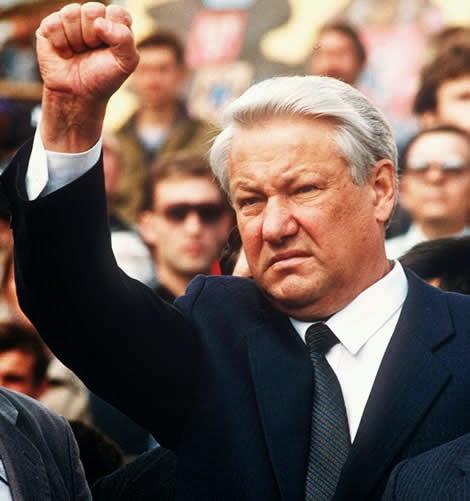
Boris Yeltsin was the first president of Russia following the collapse of the communist Union of Soviet Socialist Republics (USSR). Yeltsin struggled against the vestiges of the former regime and the chaos following its col lapse to introduce a stable, democratic system.

Yeltsin was born in the region of Sverdlovsk in 1931. He studied construction at the Ural Polytechnic Institute, graduating in 1955. Yeltsin served in the Communist Party of the Soviet Union (CPSU) from 1961 to 1990. He first became a party direktur in 1969 and continued to develop contacts within the Soviet system.

Yeltsin rose to the top of the CPSU during the 1980s through connections with General Secretary Mikhail Gorbachev, the de facto leader of the country, and other reformers. Gorbachev appointed Yeltsin to the Politburo. Yeltsin portrayed himself as a reformer and people’s champion despite his lavish lifestyle. His initiatives became popular.

BorisBoris

However, Yeltsin repeatedly shuffled and fired staff members and underwent criticism by hard-line Communists. Soon Gorbachev also began to criticize Yeltsin. In 1987 Gorbachev removed Yeltsin from his high-ranking party positions. Yeltsin became a harsh critic of Gorbachev and advocated a slow pace of reform, which became a hallmark of his later policies.

This was an effort to counter Gorbachev’s favoring of a decentralization of power to create hurried reform. In response, Yeltsin was demoted. He vented in the Congress of People’s Deputies, a parliamentary body established by Gorbachev. Yeltsin’s detractors attempted to undermine his integrity, accusing him of being heavily intoxicated in public.

Growing dissatisfaction with the Soviet system made men who opposed it, such as Yeltsin, popular. In 1989 Yeltsin ascended to the Congress of People’s Deputies as delegate from the Moscow district and gained a seat on the Supreme Soviet. In 1990 Yeltsin became chairman of the Supreme Soviet of the Russian Soviet Federated Socialist Republic (RSFSR).

In June 1990 the Congress of People’s Deputies of the RSFSR adopted a declaration of sovereignty. Soon after, Yeltsin resigned from the CPSU. During the 1991 democratic presidential elections, Yeltsin won 57 percent of the vote. In August 1991 hard-line Communists launched a coup against Gorbachev, who was held in the Crimea.

Yeltsin returned to his presidential office in Moscow, which was surrounded by troops, to deal with the coup. From a tank turret, Yeltsin made a rousing speech that rallied the troops to defect in the face of mass popular demonstrations. The leaders of the coup were dispersed; Yeltsin emerged a national hero.

Gorbachev returned to power with diminished authority. Throughout 1991 the Russian government continued to take over the Soviet Union government. In November, Yeltsin banned the CPSU in the RSFSR.

In December, Yeltsin met with the presidents of Ukraine and Belarus to discuss the Soviet Union’s dissolution and its replacement with a voluntary Commonwealth of Independent States. On December 24 the Russian federation took the Soviet Union’s place in the United Nations. The next day, Gorbachev declared that the Soviet Union would cease to exist.

Despite the Soviet system’s collapse, its vestiges remained. The Supreme Soviet contained many opposed to Yeltsin’s policies, and local elites collaborated with criminal organizations. Yeltsin bypassed the Supreme Soviet and deliberated policy with his own inner circle.

Throughout 1992 Yeltsin attempted to implement economic reforms by decree and declined to hold new elections. In January, Yeltsin removed state control over the prices of most goods, thereby reintroducing a capitalist system and stabilizing currency. The administrative elite of the Soviet kurun retained control of factories, shops, offices, and farms.

Consequently they retarded implementation of Yeltsin’s reforms. Lobbyist groups pressured Yeltsin, who granted a concession continuing governmental subsidies and guarantees that the denationalization of companies would not hinder directors’ and workers’ immediate interests.

To appease his detractors, Yeltsin appointed their candidates to some key positions. In the face of skyrocketing inflation Yeltsin fired his premier and replaced him with Viktor Chernomyrdin, who introduced limits on profit rates for several goods.

Popular disenchantment with Yeltsin increased, and the country descended into crisis. Many farmers went unpaid for deliveries to state purchasing agents, and industrial production declined. Crime continued to grow. Several Russian republics rebelled. Yeltsin reasserted central authority, enacting a no-tolerance policy toward separatist movements to maintain the Russian state’s integrity during the implementation of reforms.

Yeltsin maneuvered around cabinet members appointed to appease the opposition. He had inherited a constitution enabling the Congress of People’s Deputies to intervene in any organ’s jurisdiction. Former Communist elites in positions of power were concerned with securing their dominance and engaged in a power struggle with Yeltsin.

In April 1993 Congress unsuccessfully attempted Yeltsin’s impeachment. In response, Yeltsin held a national referendum concerning popular trust in his socioeconomic policies. The results encouraged Yeltsin, who dissolved the Russian parliament in September.

Some of Yeltsin’s detractors barricaded themselves in the parliament building; Yeltsin ordered the seizure of the building and their forced removal and arrest. Yeltsin briefly declared a state of emergency. In December new elections were held under limited censorship, and Yeltsin initiated a new constitution increasing presidential authority.

Yeltsin reappointed his favored cabinet and quickly implemented reforms. He continued to position his supporters as provincial governors. Russia’s inability to establish a stable multiparty system gave Yeltsin freedom to maneuver.

In late 1993 remaining price controls were lifted, and privatization continued. By 1994, however, Yeltsin realized that economic reform was happening too fast, and conditions were improving unevenly throughout the country.

Yeltsin’s politics verged on opportunism. Following the nationalists’ success in the 1993 elections, Yeltsin pursued nationalist policies. Following the Communists’ success in 1995, Yeltsin adopted Communist policies. In December 1994 Yeltsin ordered Russian troops into the breakaway republic of Ichkeria.

His military campaigns were unsuccessful and unpopular, damaging his political reputation and his image as protector of Russia’s integrity. In 1995 Yeltsin suffered a heart attack. In 1996 he narrowly won the presidency in the face of a Communist resurgence resulting from disillusionment with democracy.

Yeltsin became increasingly unstable, and his alcohol consumption mounted. He resumed his economic reforms and reduced the budget deficit. However, Yeltsin did little to curb the corrupt practices carried out by his administration.

That same year Yeltsin announced Russia’s default on its debts; financial markets panicked; and Russia’s currency collapsed. In 1999 Yeltsin again fired his entire cabinet. His approval rating plummeting, Yeltsin resigned as president in favor of Prime Minister Vladimir Putin.

Dissolution of the Soviet Union


In 1989 eastern European countries of the Warsaw Pact, which had been beholden to the Soviet Union since the end of World War II, had their communist governments replaced with noncommunist governments. For the first time in over 30 years the borders between eastern and western Europe were opened.

The following year the Congress of People’s Deputies changed the Soviet constitution and removed the Communist Party’s monopoly from the constitution by allowing multiple parties. In March the Baltic States held elections and their national independence parties gained majorities in each of the republics. At this time Lithuania decided to declare its independence from the Soviet Union, the first republic to do so.

In June 1990 Russia declared its right to rule itself separate from the Communist Party of the Soviet Union. During the remainder of the summer the other republics also declared their right to self-rule. Mikhail Gorbachev tried to find a way to salvage the Soviet Union.

whichwhich

His efforts were to be put to a vote in August 1991, but hard-line communists launched an unsuccessful coup in Moscow. The failed coup brought the Communist Party down, and none of the republics was interested in trying to save the Soviet Union. On Christmas Day 1991 Gorbachev resigned, ending the Soviet Union.

Throughout 1989 Poland, East Germany, Hungary, Czechoslovakia, Romania, and Bulgaria, which had been under Soviet control since the end of World War II, established democratic governments and cut their ties with the Soviet Union.

Seeing these events, the Baltic countries started to voice their desire to be free of the Soviet Union also. The Baltic countries had been absorbed by the Soviet Union as part of a treaty (the Nazi-Soviet Pact) it had made with Nazi Germany in 1939.

Gorbachev did not care how a republic had come to be part of the Soviet Union; in his view none of the republics should be allowed to leave the Soviet Union. Seeing the events in eastern Europe only encouraged the Baltic republics. Attempts to buy off the republics with token freedoms only encouraged them to continue to push for separation from the Soviet Union.

Following the Baltic republics’ lead was the Moldavian Republic. Originally part of Romania, Moldavia was given to the Soviet Union as part of the Nazi-Soviet Pact. Independence movements also appeared in the Trans-Caucasian region of the Soviet Union, made up of the republics of Georgia, Armenia, and Azerbaijan.

In Armenia and Azerbaijan, the growth in nationalistic parties also led to a dispute between them over the Nagorno-Karabakh region. In Georgia, the massacre of female protesters in the capital of Tbilisi in April 1989 only fueled the desire to be free of the Soviet Union.

In early February 1990, the Communist Party’s Central Committee met to consider a draft anjuran to allow multiple parties. The congress also created the office of the president of the Soviet Union and elected Gorbachev to the office.

After the congress, in April, Gorbachev announced the Law of Secession, which laid out the process that the republics would have to follow in order to gain their independence. The process was long and drawn out.

which
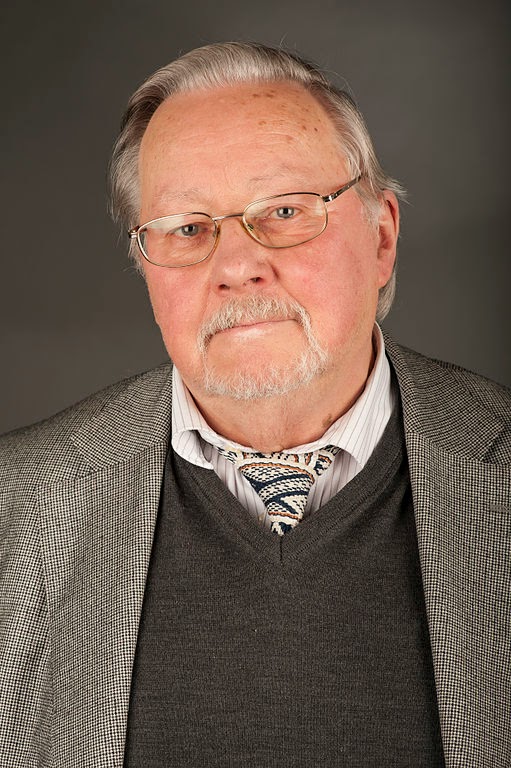
Lithuanian president: Vytautas Landsbergis

One of the first uses of the law was to pressure Lithuania to do as the Soviet government said or face the consequences. Lithuanian president Vytautas Landsbergis refused, saying that a foreign power had no right to make decisions about how his country should be run. On April 18, the Soviet government started an economic blockade of Lithuania.

The Soviets lifted the blockade on June 29 when the Lithuanian parliament suspended the independence decree. Latvia (May 4) and Estonia (May 8) followed Lithuania’s lead, and even though Gorbachev outlawed their decrees, they did not suffer the blockade as Lithuania did.

The Baltic republics were not the only ones moving toward independence. In Russia, the Russian Supreme Soviet elected Boris Yeltsin as chairman on May 29. Running against 13 other candidates, Yeltsin introduced a platform that pushed for Russian sovereignty in the Soviet Union, making Russian law take precedent over Soviet law; provided for multiparty democracy; and declared that Russia should conduct its own foreign policy with all other countries, including other republics of the Soviet Union. The actual declaration came on June 12, 1990, at which time Russia also declared its right to control the natural resources of its country. Other republics followed suit.

Through the end of 1990 Lithuania continued to try to work out a deal with the Soviet government, but the Soviets continued to stall. Therefore, on January 2, 1991, Landsbergis withdrew the suspension of the independence decree. In response to this action, paramilitary police in Vilnius (the capital of Lithuania) and Riga (the capital of Latvia) seized various buildings.

Then on January 7 the Soviet Ministry of Defense ordered troops into all three of the Baltic States as well as Moldavia, Georgia, and the Ukraine. The Soviet military continued to occupy buildings belonging to the Lithuanian government, and on January 13 it attacked the capital’s television center and in the process killed 14 people and wounded over 200.

At about the same time, Gorbachev was telling the Soviet government that force would not be used against the people of Lithuania. These contradictory actions and talk hurt Gorbachev, who claimed not to have had any advanced knowledge of what the military was going to do.

A few days later, on January 20, violence broke out in Latvia when Soviet paramilitary police stormed a government building in Latvia and killed two local police officers. The Baltic republics gained support from Russia when Yeltsin signed a document recognizing the independence of the Baltic States on behalf of Russia, which was exerting its right to conduct its own foreign policy separate from that of the Soviet Union.

Although the Baltic republics had started out leading the move toward independence from the Soviet Union, Russia now began to take a more prominent role. In January 1991 Gorbachev issued a decree that the Soviet army was to patrol the streets of the larger cities in the Soviet Union to help stop crime and control protests; Russia objected.

When Yeltsin attacked Gorbachev during a television interview, Yeltsin found himself under attack by various groups. Although Gorbachev’s actions might be decidedly anti-independence for the republics, he still had the support of many of the people in the Soviet Union and Western countries.

On March 17, 1991, the idea of maintaining a union of the republics was put to a vote of the people of the Soviet Union. The vote passed, although six of the republics (Lithuania, Latvia, Estonia, Armenia, Georgia, and Moldavia) did not participate in the referendum since they claimed that they were not part of the Soviet Union.

Yeltsin claimed that the referendum was nothing more then an attempt by Gorbachev to generate support for his leadership. Gorbachev then called a conference and invited Yeltsin and the presidents of eight other republics to talk about a anjuran for a new Union Treaty and new Union Constitution. Gorbachev and the other presidents signed a declaration supporting the drafting of a new treaty and constitution.

May saw more changes as the republics continued to move away from the Soviet Union. On May 5 the Russian branch of the KGB separated itself from the Soviet Union’s institution. Moldavia changed its official name to the Moldavian Republic, dropping the words Soviet and Socialist. Then on May 26 Georgia had its first-ever direct presidential election.

The Coup

which
Coup to remove Gorbachev from power (1)

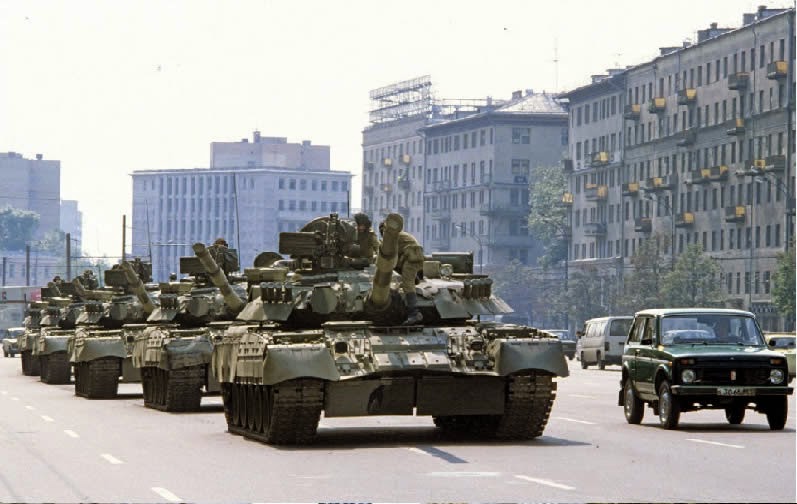
Gorbachev and Yeltsin continued to work out the details of the new Union Treaty. The treaty would keep the Soviet Union alive, but would limit the areas over which it could exercise control and make participation in the union voluntary. Before the treaty was enacted, a group of hard-line communists launched a coup to remove Gorbachev from power. The coup lasted for only three days.

The committee in charge of the coup announced a state of emergency and placed Gorbachev under house arrest, cutting off his ability to communicate with the outside world. They then tried to get him to sign a decree declaring a state of emergency, but he refused. With Gorbachev’s refusal to cooperate, the coup started to come unraveled.

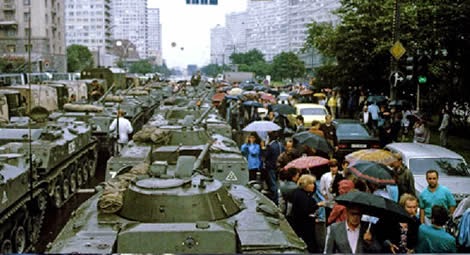
The plotters had planned to arrest Yeltsin also, but missed their chance. Instead, Yeltsin went to the Russian Parliament building and appealed to the citizens of Moscow to ignore the unlawful coup. The military was unwilling to move against the civilians, and the coup ended on August 21.

Gorbachev returned to Moscow. Because of the coup, Yeltsin became the satria of the hour, and his popularity grew rapidly. Unfortunately for Gorbachev, his popularity plummeted and accelerated the decline of the Soviet Union. Yeltsin forced Gorbachev to return control of the natural resources and enterprises on Russian territory back to Russia from the Soviet Union.

which
Coup to remove Gorbachev from power (2)

December saw the Soviet Union brought to an end. On December 1 the Ukraine held a referendum to allow the people to vote in support of or against the declaration of independence from the Soviet Union. The referendum passed by a wide margin.

Then the leaders of Russia, the Ukraine, and Belarus met to determine the future of the Soviet Union and their republics. On December 8 they announced the end of the Soviet Union and the creation of a Commonwealth of Independent States (CIS). Membership in the CIS was open to all former members of the Soviet Union and any other state interested in joining.

On December 12 Kazakhstan, Kyrgyzstan, Tajikistan, and Turkmenistan joined the CIS. More meetings were held on December 21, and Moldavia, Azerbaijan, and Armenia joined. During this meeting the republics agreed to abolish the position of president of the Soviet Union.

Gorbachev still held the position, but on December 25, he announced his resignation. With Gorbachev’s resignation the remaining members of the Soviet Parliament had the Soviet flag removed from the Kremlin, and at midnight on December 31, 1991, the Soviet Union ceased to exist.

which
Post Soviet Union states: Armenia(1), Azerbaijan(2), Belarus(3), Estonia(4),
Georgia(5), Kazakhstan(6), Kyrgyzstan(7), Latvia(8), Lithuania(9), Moldova(10),
Russia(11), Tajikistan(12), Turkmenistan(13), Ukraine(14), Uzbekistan(15)

Sino-Soviet Treaty (1950)

The People’s Republic of China was proclaimed on October 1, 1949, and won immediate recognition from the Soviet Union and Eastern European communist nations. Not yet secure after winning the civil war against the Nationalists, China needed support from the Soviet Union.

Thus Mao Zedong (Mao Tse-tung), chairman of the Chinese Communist Party (CCP), declared his "lean to one side" policy to form an international united front with the Soviet Union.

Mao went to Moscow in December 1949, his first trip abroad, ostensibly to help celebrate Joseph Stalin’s 70th birthday but more importantly to negotiate a treaty with the Soviet Union. A 30-year treaty of friendship, alliance, and mutual assistance was signed on February 14, 1950, clearly directed against the United States.

A second agreement allowed the Soviet Union to continue its presence in Port Arthur and Dairen in China’s southern Manchuria and to operate a railway in the region (rights Stalin had obtained at Yalta in 1945 without agreement from China) until 1952. The treaty provided for a $300 million loan from the Soviet Union in five equal annual installments between 1950 and 1955.

andand

During the next decade the Soviet Union sent tens of thousands of scientists and advisers to help the Chinese army, navy, air force, and 156 industrial enterprises during China’s First Five-Year Plan.

A total of 6,500 Chinese students went for advanced studies to the Soviet Union instead of Western countries; Russian replaced English as the compulsory second language in Chinese schools. In 1952 the Soviet Union returned to China the over U.S. $1 billion of loot it had taken from Manchuria at the end of World War II.

China agreed to recognize independence for Outer Mongolia, a part of China that had become a Soviet satellite in 1924. In October 1950 China intervened in the Korean War to prevent the collapse of North Korea, an ally of both China and the Soviet Union.

By the late 1950s the Moscow-Beijing Axis was collapsing for many reasons. Although both nations were ruled by communist parties, the CCP had from its inception resented Moscow’s domination and interference. Although Mao respected Stalin’s seniority in the communist world, he firmly rejected Nikita Khrushchev’s similar claim after Stalin’s death, and Mao offered himself as the world communist leader.

Mao also denounced Khrushchev as revisionist for his de-Stalinization policy after 1956. In 1959 Khrushchev withdrew an earlier promise to help China build a nuclear bomb and recalled Soviet aid workers from China. Mao called Khrushchev a coward for backing down before the United States in the Cuban missile crisis in 1962.

Mao’s claim to be an original contributor to Marxism-Leninism, with special relevance to the non-Western world, was rejected by Moscow. Finally, China felt aggrieved over large territorial losses to imperial Russia in the 19th century and wanted the Soviet Union to acknowledge that they were the result of unequal and therefore illegal treaties, claims that the Soviet Union firmly rejected.

Relations deteriorated further when Soviet leader Leonid Brezhnev sent troops to Czechoslovakia in 1968 and announced his doctrine that the Soviet Union had the right to intervene in communist countries that deviated from its interpretation of the socialist cause. Serious border clashes between the Soviet Union and China occurred in 1969, and war loomed.

Russian Federation


In the years after 1991 Russia experienced a revolution in the name of reform. The Union of Soviet Socialist Republics had been a one-party dictatorship that strove to control all aspects of life. Its collapse unleashed a host of social forces and triggered an array of experiments as people sought simultaneously to create a democratic government, a market economy, and a civil society.

Other countries, including other remnants of the Soviet Union, were attempting similar experiments on different scales at the same time. No one, however, had ever attempted this before, and there was no blueprint to follow.

During this period, the administration of Boris Yeltsin would be identified with the destruction of the old structures, a struggle among alternative visions, and chaotic and sometimes contradictory efforts to build something new. The administration of Vladimir Putin would represent a longing to reestablish order, stability, and security.

RussiaRussia

The Soviet collapse in 1991 came with remarkable rapidity. Unlike the collapse of czarist Russia in 1917, which was also sudden, this one was neither preceded by a world war nor followed by a civil war. There were relatively few violent conflicts, and those tended to be clashes between rival nationalisms.

The last Soviet leader, Mikhail Gorbachev, had underestimated the attraction of nationalism to his country’s various constituent peoples and had overestimated people’s loyalty to the communist system.

In forcing people, officials and citizens alike, to conceal their personal beliefs as well as inconvenient political and economic facts, the Soviet system had denied its own leaders the ability to gauge the true situation and had denied people in general the possibility of fully developing their own ideas.

Gorbachev’s efforts to reform the system, in part by releasing the energies of the citizenry in the hope of using them against a sclerotic bureaucracy, resulted in the system’s demise.

Free multicandidate elections to a new national legislature in 1989 and elections to republic-level legislatures in 1990 unleashed a mass of rebellious and conflicting demands. In the course of the year, most of the republics declared "sovereignty" within the Soviet Union, that is, they asserted that republic law would henceforth be above federal law.

The Russian Soviet Federative Socialist Republic, as the Russian portion of the Soviet Union was officially known, did so on June 12, 1990. At about the same time, the media began to free itself of government control.

On the anniversary of the sovereignty declaration, June 12, 1991, while the republic was still part of the Soviet Union, Boris Yeltsin, a former Communist Party official who had fallen out with the leadership, became Russia’s first elected president.

A failed reactionary coup launched by party, military, and police officials in August 1991 was the simpulan blow in the centrifugal process that was tearing the Soviet Union apart. In the aftermath, the Communist Party was dissolved and no comparable integrative institution was created to replace it.

Yeltsin began appearing alongside Gorbachev, the Soviet president, as a coequal. Key republics, especially Ukraine, began to believe they would be better off without the "burden" of the other republics and moved toward independence. At the very least, they ceased forwarding tax receipts to the capital, compelling Russia to take over responsibility for financing central state functions.

On December 8, 1991, confronted with Ukraine’s precipitous unilateral independence, Yeltsin and the leaders of Ukraine and Belarus declared their republics a Commonwealth of Independent States (CIS), even though Russia had never formally withdrawn from the Soviet Union.

Leaders of other republics, petrified at the prospect of their sudden isolation, immediately demanded membership in the CIS as well. On December 25, 1991, Gorbachev resigned from the presidency in frustration. No one attempted to replace him, and the Union of Soviet Socialist Republics legally ceased to exist. In many ways it had already evaporated, although just when this occurred is difficult to determine.

After a brief attempt to maintain unified CIS armed forces, the republics took control of the military assets of their respective territories and created their own armies. Republics with nuclear arms stationed on their territories agreed to send them to Russia.

Each republic also acquired its portion of the assets of the Committee for State Security, which continued to exist in some form. In Russia the KGB underwent a series of renamings and reorganizations that ultimately left it as five separate entities: one each for internal security, foreign intelligence, border defense, communications security, and the personal protection of state leaders.

Redefinition

With the Soviet Union gone, the next question was what would replace it. The Russian Soviet Federative Socialist Republic eventually renamed itself the Russian Federation.

The re-creation of a Russian national identity was somewhat complicated, not only by the presence of more than 120 ethnic minorities within the federation’s borders and by the fact that some 25 million ethnic Russians were now living as minorities in the 14 other successor states of the Soviet Union, but also by the fact that the pre-Soviet Russian state had included the entire Soviet territory. In the other former Soviet republics, as in Eastern Europe, the communist system could be viewed as something imposed by the Russians.

There, nationalists, anticommunists, democrats, and economic reformers could form coalitions, at least in the beginning. In the Russian Federation, although some Russian nationalists had seen the other republics as a burden, others had identified with the Soviet Union as a great power and saw its collapse as a tragedy.

Some adherents of the Soviet system and some Russian nationalists nostalgic for the old empire saw in the CIS a potential replacement that would ultimately amount to a rebirth of the Soviet Union. This never came about.

The leaders of the various republics focused on their own entities, and the CIS itself failed to develop into an alternative power center. Rather, the CIS functioned as a loose association that oversaw the peaceful severing of the numerous ties that linked the republics to one another.

Russia, not the CIS, inherited the Soviet Union’s nuclear weapons, United Nations seat, overseas embassies, and foreign debt. This, however, did not prevent Russia from pressuring the more reluctant successor states into joining the CIS during the 1990s. Only the three Baltic States remained outside.

In the early days, Russians were concerned that the unraveling might not stop with the collapse of the Soviet Union. Within the Russian Federation were former "autonomous soviet socialist republics", now simply termed "republics", regions with a substantial non-Russian ethnic population. Several of these declared sovereignty over their natural resources and asserted the primacy of their laws over federation law. Some appeared to be contemplating independence.

In March 1992 all but Tatarstan and Chechnya signed the new Federation Treaty; Yeltsin was compelled to renegotiate center-periphery relations on an ad hoc basis with several individual republics and even ethnic Russian regions. Tatarstan signed such an agreement in February 1994. In the end only Chechnya carried out the secessionist threat, triggering two wars with the Russian army.

Politically, two tendencies were prominent in the early years of Russian independence. For members of the first group, the highest-priority goals were the establishment of democratic norms and the rule of law, the creation of a viable market economy, and integration into the Western world.

For the second group, the highest priorities were building a state strong enough to defend itself, both internally and externally; assuring that national industries survived; and preserving Russian uniqueness.

Constitutionally, the form that the Russian government was to take was also under dispute. The muchamended constitution of 1978 remained in force while negotiations continued over a new Russian constitution. In this, as in economic policy, Yeltsin and the legislature took strongly opposed positions.

The legislature at the time continued the cumbersome form innovated in the Gorbachev era: a Congress of People’s Deputies, with 1,068 members, that was supposed to meet twice a year, vote on the most important issues, and elect from among its own members a smaller legislature— the Supreme Soviet—to meet between its own sessions. The constitution’s provision that the legislature was the supreme state body was not modified after the creation of the elected Russian presidency in 1991.

Crisis and Confrontation

The period from the end of 1991 to late 1993 was marked by economic crisis and political confrontation that ended in bloodshed. The two poles of confrontation centered on the reformist presidency and the holdover parliament, the Congress of People’s Deputies, which fought a protracted battle over who held ultimate authority.

For the post of prime minister, Yeltsin named Yegor Gaidar, a young academic who had taught himself market economics during the late Soviet period, but the legislature refused to confirm him. Gaidar, nonetheless, continued in office as acting prime minister for one year.

The economy was in dire shape, quite apart from the normal inefficiencies of the centrally planned Soviet system. In the name of economic reform the Gorbachev government had ceased issuing orders to state-owned economic enterprises, but he had failed to establish the institutions of a market economy, resulting in a state-run system that did not work properly. The breakup of the Soviet state exacerbated the situation by disrupting economic ties between regions.

Gaidar’s response was a rapid shift, often termed "shock therapy", to free prices, balanced budgets, and monetary restraint. This went into effect on January 1, 1992, and resulted in an enormous leap in prices in addition to the already existing shortages of supply.

Normally, the shortages and rising prices should have worked as an incentive for enterprises to increase production. State enterprises, however, had not been privatized, and adequate market-based incentives had not been established.

Wholesale trade, at the time, was still widely regarded as a form of illegal "speculation". The implicit assumption that an economy dominated by gigantic plants producing military equipment could instantaneously convert to the production of consumer goods was probably naive in any event.

Managers commonly viewed the inflation as an opportunity to increase revenues while working less. When monetary restraint restricted cash flows, enterprise managers informally extended credit to each other and expended their political influence trying to get subsidies reinstated.

The Congress of People’s Deputies was the main focus of their attention. Elected in March 1990, the Congress was permeated with state-enterprise managers and former communists, most of whom now called them-selves "independents".

It repeatedly doled out payments to bankrupt enterprises, undermining the intended impact of Gaidar’s policies; issued resolutions that contradicted government policies; and threatened the president with impeachment. For his part, Yeltsin responded with the threat to establish a "presidential republic". Each side ignored the acts of the other, contributing to a growing general disregard for the law.

The personification of resistance to the president was the speaker of the Congress, Ruslan Khasbulatov; he and vice president Aleksandr Rutskoi moved steadily closer to the opposition. Both had been Yeltsin allies at the beginning of the transition.

In late 1992 Gaidar left the office of prime minister. His replacement, Viktor Chernomyrdin, was initially more acceptable to the Congress. Chernomyrdin was a hybrid bureaucrat-entrepreneur.

As minister of the gas industry, he had participated in a "spontaneous privatization" that converted the ministry into one of Russia’s largest and most profitable companies, Gazprom. Nonetheless Chernomyrdin and his finance minister, Boris Fedorov, maintained the austerity policies and even closed some inefficient state enterprises.

A referendum on economic reform and the division of power between the executive and legislative branches in April 1993 gave Yeltsin enough support to press ahead with his programs. Yeltsin and the legislature each began drawing up a new draft constitution.

The crisis came to a head in September 1993. To break the impasse, Yeltsin dissolved the Congress of People’s Deputies and called for a referendum on a new constitution and elections for a new legislature in December. Meeting in emergency session, the Congress impeached Yeltsin and declared Rutskoi president.

On Yeltsin’s order, army units surrounded the legislative headquarters on September 27, but 180 members refused to leave. After a standoff of several days, Rutskoi called for a popular uprising, which led to some street disorders but not the outpouring of support that he had anticipated.

Armed men seized the mayor’s office on October 3 and attempted to take the Ostankino television facility, where a firefight with Interior Ministry troops lasted for several hours. At this point, the army dropped the neutral position it had sought to maintain.

On October 4 tanks opened fire, and by that afternoon the rebel leaders—including Khasbulatov and Rutskoi—had emerged and surrendered. After the "October events", no parliament would defy the president so openly again. Disputes, however, were far from over.

Constitution and Elections

Yeltsin’s draft constitution was approved by referendum in December 1993, in the shadow of the October events. It created a bicameral legislature, called the Federal Assembly (Federal’noe Sobranie).

The upper house, the Federation Council (Soviet Federatsii), had two members representing each of the country’s constituent regions, territories, and republics. The lower house, the State Duma (Gosudarstvennaia Duma), had 450 members, half of them elected from single-member districts and half from party lists.

The legislature was real, not a rubber stamp, but the constitution clearly gave the preponderance of power to the president. The president named the prime minister and cabinet, who were responsible to him.

The cabinet, therefore, did not have to reflect the distribution of parties in the State Duma, so there was no incentive to form coalitions to build a parliamentary majority. Initially, committee chairmanships were doled out among parties and factions in proportion to the number of seats they held.

Technically, the State Duma had the right to approve or disapprove the president’s choice for prime minister, but if it rejected three candidates it was the legislature, not the government, that was subject to dissolution. Moreover, the president had the power to issue decrees on his own.

The first post-Soviet parliamentary elections were held simultaneously with the referendum approving the constitution, two years after the collapse of the Soviet Union. A number of political organizations had essentially evaporated in the interim. The parties that did exist were often small, fractious, personalistic, and only loosely connected to the electorate.

Parties arose, combined, split, recombined, and vanished with great ease. The most substantial and organized party was the newly constituted Communist Party of the Russian Federation, although it lacked anything resembling the status and power of the former Communist Party of the Soviet Union.

The results of the elections were far from what Yeltsin and the reformers would have hoped for. The largest percentage of votes in the party-list portion of the ballot went to the Liberal Democratic Party of Russia, a misnamed authoritarian, ultranationalistic grouping with a leader, Vladimir Zhirinovsky, who was once described as a "dangerous buffoon".

The communists came in second. The reformists had split the vote by dividing into four separate parties that constantly squabbled among themselves, the two most important being Gaidar’s neoliberal Russia’s Choice and the more social-democratic Yabloko.

Despite the evident potential for renewed polarization, Russian politics did not return to the chaos of the pre-October days but settled down into a relatively normal pattern. Politicians of various stripes gradually became accustomed to open politics and even adept at it.

Despite their extremist rhetoric, the ultranationalists proved relatively supportive of the government, and the communists could be counted on for a backroom deal when the need arose. The fractious reform parties, never satisfied with compromise, often created the greatest difficulty for the reform process.

Gaidar’s original reform plan came to be implemented more consistently, without Gaidar. Prime Minister Chernomyrdin became increasingly prominent, while Yeltsin occasionally receded into the background amid rumors of drinking and the state of his health.

Economic policy was no longer undermined by subsidies granted to bankrupt factories by the legislature. Also, the privatization kegiatan made progress, although this required a presidential decree. The economic situation began to stabilize, but it did not fully recover and grow.

With new legislative elections planned in December 1995, Yeltsin eliminated elections for the upper house and determined that each jurisdiction would be represented by its governor and its legislative speaker.

He also attempted to create two new parties as the basis for a two-party system: One, a center-right organization intended to become the government party, was led by Prime Minister Chernomyrdin; the other, envisioned as a center-left loyal opposition, was led by Ivan Rybkin.

Chernomyrdin’s party, called Our Home Is Russia, managed to draw about 10 percent of the vote as long as he was prime minister. The second party, which was actually listed on the ballot as "Ivan Rybkin’s bloc", never got off the ground. The relatively poor showing, if nothing else, indicated the limits on Yeltsin’s ability to manipulate the electorate.

Forty-three parties participated in the 1995 elections, but only four of them surpassed the 5 percent threshold necessary to obtain seats under the proportional-representation system.

The four that did succeed were the Communists, the ultranationalist Liberal Democrats, Our Home Is Russia, and the social-democratic Yabloko. The Communists received the largest share this time, setting the stage for Russia’s first post-Soviet presidential election, to be held in two rounds in June and July 1996.

The Communists’ hard core of support constituted about 20–30 percent of the electorate at this time. Support was especially strong among pensioners and others who had suffered extreme hardships during the inflation and chaos of the early reform period. They had trouble, however, breaking beyond that core.

Yeltsin, who had been doing very poorly in opinion polls, ran an anti-Communist campaign and eked out a plurality of 35 percent in the first round. Communist candidate Gennadii Zyuganov finished just behind him with 32 percent. Eight other candidates were eliminated from the second round.

After hiring the third-place candidate as his national security adviser, Yeltsin then managed to consolidate the anti-Communist vote and was reelected in the second round, 54 percent to 40 percent. Significantly, all sides accepted the results of the election without protests or claims of fraud.
Chechnya and Russia


In the early years, the leaders of the new Russian Federation were worried that Russia could unravel along ethnic lines as the Soviet Union had done. They responded strongly to the one ethnic republic that did attempt to secede, Chechnya, even though that response was delayed by the general chaos prevailing in Russia in the early 1990s.

The Chechens were a Muslim people of the Causcasus Mountains who, in the 19th century, had fought a prolonged war against the Russian occupation of their region. Like several other Soviet minorities they had been accused by Stalin of collaborating with the Nazis, and they were all deported to Soviet Central Asia afterward.

Nikita Khrushchev allowed their return, but when the Soviet Union collapsed, the Chechens sought secession. Under Dzhokhar Dudayev, a former Soviet air force general, Chechnya declared independence in 1991.

thethe

Yeltsin declared a state of emergency in Chechnya, issued a warrant for the arrest of Dudayev, and sent a detachment of Interior Ministry troops. The Chechens easily repulsed the half-hearted intervention, by ruse more than by force, and seized strategic facilities within their republic.

Yeltsin ordered an economic blockade and then, given the chaotic state of Russia at the time, basically ignored the situation for the next three years. The lack of any police force facilitated smuggling and other criminal operations.

In a search for outside resources and allies, the Chechens made contacts with mafias from Russia and Islamist extremists from the Middle East. Corruption spread, the economic situation grew dire, and Dudayev became more dictatorial.

After supporting a failed attempt by a rival Chechen faction to seize power, Russia sent three armored columns into Chechnya on December 11, 1994. The Russian legislature, which had not been informed, protested vociferously.

The invasion did not go smoothly. The Russians made a hasty and ill-prepared assault on Grozny, the republic’s capital, which they seized only after a month-long bombardment that killed an estimated 25,000 people and left the city a ruin.

Dudayev and his fighters receded into the mountains, from where they conducted an extended guerrilla campaign. Civilian casualties continued to run high. The struggle attracted Islamist volunteers from North Africa, the Middle East, and Afghanistan.

In March 1996, with presidential elections looming in Russia, Yeltsin offered to negotiate with Dudayev through an intermediary. A Russian missile killed Dudayev in April. Fighting flared again in June, and the Chechens reoccupied parts of three cities, including Grozny.

A cease-fire was finally signed in August. Russian troops began to withdraw. Although the agreement left Chechnya’s permanent status to be decided, the republic proceeded to act as if it were independent.

Aslan Maskhadov, the chief of staff of the Chechen armed forces and a former Soviet army colonel, was elected president of the republic in January 1997. Little rebuilding was accomplished, however, and Maskhadov was unable to establish order. In the prevailing lawlessness, kidnapping for profit became a widespread practice. In an effort to outflank the Islamists in factional infighting, he imposed Islamic law and courts.

Chechnya became the focus of attention again in 1999. Shamyl Basayev, formerly a field commander and briefly a prime minister under Maskhadov, had broken with the Chechen regime. In April 1998 he and a Jordanian-born Islamist founded the Congress of the Peoples of Chechnya and Dagestan, which proposed to unite these two adjacent ethnic republics.

In August 1999 they launched a raid into Dagestan and then declared that the republic had seceded from Russia. The following month, a series of bombs exploded in apartment buildings in Moscow and other Russian cities. The act was widely attributed to the Chechens.

On August 9, 1999, Yeltsin dismissed Sergei Stepashin, who had been prime minister for three months, and appointed Vladimir Putin to replace him. Putin had catapulted through a number of Kremlin staff positions to become head of internal security in July 1998.

He was still generally unknown to the public when he was named prime minister, but he quickly became associated with the new Chechen war, which was known as Putin’s "antiterrorist operation". Opinion polls gave Putin an approval rating of 33 percent in August, 52 percent in September, and 65 percent in October, in a land where few politicians rose above single digits.

In October Russian armor was once again moving into Chechnya, without any distinction being made between the Chechen government and renegade commanders. The army performed more effectively this time. The cities were taken quickly, and a pro-Russian Chechen administration was put in place.

Resistance, however, would drag on year after year in the countryside, and there would be terrorist attacks in other parts of Russia. Russian forces would respond at times with extreme brutality. With the bomb blasts fresh in people’s minds, however, this Chechen war was far more popular with the Russian public than the previous one.

Four months before the legislative elections of December 1999, Yeltsin once again created a new party from scratch, Unity, a party completely dependent on the Kremlin for funding, expertise, and personnel. Putin gave it his public endorsement, and the party, too, became identified with the Chechen war effort.

Unity won 23 percent of the party-list vote and 64 single-member districts, leaving it second only to the Communist Party. In third place was Fatherland–All Russia, a coalition of personalistic parties built around prominent governors. For the first time, the State Duma had a dominant bloc of parties that were not ideological adversaries of the Kremlin.

Yeltsin, within seven months of the end of his second term in office, surveyed a political landscape that suddenly appeared quite favorable. He then shocked the world by promptly resigning on December 31, 1999, and naming Putin as acting president.

An early presidential election was called for March 26, 2000, which Yeltsin’s chosen successor would now approach with all the advantages of incumbency while other candidates were caught off guard.

Indeed, Putin won in the first round with 52.9 percent of the vote against 10 other candidates, despite having been a virtual unknown the previous August. He promptly obliged his predecessor by issuing a blanket pardon for anything Yeltsin might have done during his years in office.

As president, Putin no longer devoted himself solely to the prosecution of the war. Economic reform continued but Putin’s primary focus appeared to be order, stability, security, and consolidation of the Russian state.

Russia was very much in need of order by that time, but Putin’s notion of consolidating the state reflected his upbringing within the Soviet Union. Rather than make state institutions more effective, he set out to make all institutions dependent on the president.

Vladimir Putin

Vladimir Vladimirovich Putin was born in Leningrad on October 7, 1952, and was very much a product of the Soviet system. His family background was ordinary and reflected the hardships of postwar Soviet life.

Putin applied himself to improving his position in the Soviet order and looked, once he graduated in law from Leningrad State University, to a career in the security services (KGB) as the best method of doing so.

Following initial duties dealing with Leningrad dissidents, Putin took up from 1985 to 1989 a KGB posting in East Germany. After the collapse of the East German regime, Putin moved to the international affairs section of his old university and within a short time joined the Leningrad politician Anatoly Sobchak as an aide; following Sobchak’s election in 1991 as mayor, Putin became deputy mayor.

His abilities were noticed in Moscow, and he joined the Kremlin staff in 1996 as an assistant to Pavel Borodin overseeing Russian economic assets. This post soon brought him to the attention of President Boris Yeltsin, who, in 1998, appointed Putin head of the Federal Security Service (the replacement for the KGB), from which post Putin quickly rose to be head of the Security Council in 1999.

VladimirVladimir

These times were unstable ones for Yeltsin and the Russian Federation. Within a period of 18 months several prime ministers came and went. When Yeltsin fired Sergei Stepashin in August 1999, he appointed Putin prime minister. He was now in position for succession to the presidency, which unexpectedly came his way when Yeltsin resigned on December 31, 1999, and Putin became acting president.

A presidential election followed in March 2000, and Putin won convincingly. The backing of the security services and many economic reformers gave him a political base to overcome any threats from the nationalist Fatherland Front.

In his first years in office, Putin faced a number of crises stemming from the unrest and malaise of the Yeltsin years. Chechnya, controlled by Islamic militants, was clearly the most significant. He attempted to resolve the war, but terrorist bombings in Moscow brought a swift and punishing military retaliation.

In addition, he wanted to reverse some of the decentralizing traits of the Yeltsin years, and this meant imposing more Moscow control over the outlying regions through a system of appointed governors.

He moved against the oligarchs who had profited during the Yeltsin years. The crisis following the sinking of the submarine Kursk in August 2000 hurt Putin’s reputation when the government appeared incapable of reacting to the disaster.

In terms of policy, Putin wanted to restore something of the order and pride that had existed during the Soviet era. This meant that some old symbols of state were preserved along with the belief in centralizing control over both the economy and the media. Following Putin’s Unity Party landslide victory in the 2003 parliamentary election, it was suggested that control of the state media produced the favorable results.

On March 14, 2004, Putin won decisively his second term in office. He continued his campaign to strengthen state powers. There were also improvements in the justice system and reform of the difficult tax laws that inhibited investment and development.

Some see recent actions as a reflection of the antidemocratic instincts that lurk behind the scenes in Putin’s administration. Putin’s 2004 support of Viktor Yanukovych in the Ukrainian election was viewed by critics as an exercise in undue influence on the affairs of a neighboring independent state.

In foreign affairs, Putin built positive relationships with much of the West, including the president of the United States, although he opposed the Second Gulf War. However, after the events of September 11, 2001, he was generally supportive of U.S. action in the War on Terror, including the use of bases in former Soviet Central Asian territories.

His country’s own campaign against Islamic terror made him a willing ally. His provision of nuclear technology and advanced weapons to Iran raised doubts as to his sincerity. He also reluctantly accepted the U.S. abrogation of the ABM treaty as part of America’s missile defense program.

Putin cooperated with the enlargement of the North Atlantic Treaty Organization, which now includes former Baltic Soviet Republics bordering Russia. Relations with Europe were strengthened by an agreement in 2005 with Germany to construct a major oil pipeline that should bring economic benefits to both Russia and Germany. Putin also attempted to build favorable relationships—economic and political—with his Asian neighbors, China and Japan.

It is too early to determine Putin’s legacy but he maintained his popularity with campaigns against corruption and the oligarchs. Economic improvements and stability were welcomed by a public often left in turmoil following the collapse of the Soviet Union.

Although not an open democracy on Western terms, and with features that suggest the possibility of returning to old ways, Russia remains a world force and one that has the unrealized potential for full democratic development.

Nikita Sergeyevich Khrushchev

Nikita Sergeyevich Khrushchev was first secretary of the Communist Party and de facto leader of the Soviet Union between 1953 and 1964; he concurrently served as premier from 1958 to 1964.

Nikita
Nikita Sergeyevich Khrushchev
Colorful and highly controversial, Khrushchev was a reformer whose shrewd intellect was frequently overshadowed by his impulsive personality. He abolished the most ruthless aspects of the political system and tried with limited success to catch up with and overtake the U.S. economy.

In foreign affairs he forcefully maintained the unity of the Eastern bloc and veered between “peaceful coexistence” and several dangerous confrontations with the United States. He was, without question, one of the most important figures of the cold war.

Khrushchev was born in April 1894 in Kalinovka, Russia, near the border with Ukraine. His parents were illiterate peasants, and young Nikita was more familiar with hard labor than formal education. The family relocated to Ukraine in 1908, where he worked various factory jobs and got involved in the organized labor movement.

In 1917 he joined the revolutionary Bolsheviks and he later fought for the Red Army. After the war he obtained some Marxist training at a technical college and was assigned a political post in the Ukraine. Over the next 20 years Khrushchev would rise rapidly through the ranks of the Communist Party, and in 1939 he became a full member of the Politburo.

His success was largely due to his loyalty to Stalin. During World War II he helped organize the defense of the Ukraine and the relocation of heavy industry into the Russian interior, and he was at Stalingrad when the Red Army turned the tide of the war against Germany.

After the war Khrushchev remained an influential member of the Politburo, and when Stalin died in March 1953, he battled with Georgy Malenkov, Lavrenty Beria, and Nikolai Bulganin for the leadership.

Malenkov was made premier and initially seemed to be the true successor, but as first secretary of the Communist Party, Khrushchev possessed the real power. By early 1955 he had emerged as the clear leader of the Soviet Union.

Nikita
Khrushchev with Mao

Once in firm control, Khrushchev embarked on ambitious economic reforms. Khrushchev also continued the policy of spending heavily on the military. Under his leadership, the Soviet Union kept pace in the nuclear arms race with the United States and developed a space aktivitas that had significant successes. The launch of the Sputnik satellite in 1957 and the first manned space flight in 1961 were great technical triumphs for the Soviet Union.

Khrushchev also decided, in a very risky move, to expose the horrors of the Stalinist abad and to promote political reforms. In February 1956 he gave a speech to the 20th Party Congress that denounced Stalin’s “cult of personality,” documented various crimes of the old regime, and introduced the policy of “de-Stalinization.”

The speech sparked hopes that Khrushchev would tolerate autonomy and perhaps even democracy within the Eastern bloc. These hopes proved illusory when a popular 1956 uprising in Hungary was suppressed by a brutal military intervention authorized by Khrushchev.

This action shocked the West, which had welcomed the assurances of Khrushchev that the Soviet Union desired “peaceful coexistence” between capitalism and communism. Khrushchev seemed unable to resist the temptation to taunt the West periodically, and he had several alarming showdowns with the United States.

He tried fruitlessly to force the United States and its allies out of Berlin between 1958 and 1961, eventually building the infamous Berlin Wall. He also humiliated Eisenhower in 1960 by revealing the capture of a U.S. U-2 spy plane and its pilot.

Riskiest of all, in 1962 Khrushchev secretly placed nuclear missiles in communist Cuba. The purpose of this gamble was to protect Cuba from U.S. attack and to provide the Soviet Union with instant strategic parity. When U.S. spy planes detected the missiles, however, a standoff resulted that brought the world alarmingly close to nuclear war.

In the end the Cuban missile crisis was resolved through diplomatic back channels, with the Soviets removing the missiles in exchange for a U.S. pledge not to invade Cuba and the removal of U.S. missiles from Turkey. Both sides gained something, but Khrushchev was widely perceived to have backed down in the face of U.S. resolve.

By this time he had already made too many enemies within the Soviet Union. Finally, in late 1964, Khrushchev was removed from power by a conservative faction led by Leonid Brezhnev. His life was spared, perhaps a testament to the success of his political reforms, but Khrushchev spent the rest of his life under house arrest. He died in Moscow in September 1971.

Peter I the Great - Czar of Russia

The rise to power of Peter the Great was fraught with death and uncertainty, but his reign as czar greatly strengthened Russia in regard to its acquisition of territory in the Baltic and Black Sea regions, and the modernization of Russian society. Czar Alexei (1645–76) and his wife, Natalia Naryshkin, did not believe their son Peter would drastically change the course of Russian history when he was born on May 30, 1672.
 Peter I the Great - Czar of Russia

The death of Czar Feodor III (1676–82) created a persoalan for the continuation of the Romanov dynasty in Russia since Fedor left no heirs; the debate developed concerning Ivan or Peter as successor.

Ivan was Fedor’s brother, but Ivan, who was 16 years old, was mentally and physically handicapped. Peter was the half brother of Ivan and had the support of many of the boyars and the patriarch Joachim, since this healthy 10-year-old offered stability to the Russian throne.

The Zemsky Sobor, an assembly of boyars, was assembled and voiced its support for Peter, but Sophia, Feodor’s sister, refused to allow Peter to be crowned as czar and attempted to incite the Streltsi, a regiment of guardsmen, to turn against Peter. On May 15, 1682, the Streltsi, upon hearing rumors that Ivan and a number of boyars were murdered, rebelled and stormed the Kremlin.

The Streltsi swore their loyalty to the Romanov family after Ivan Naryshkin and Doctor Van Gaden were brutally murdered. These two individuals were killed because the Streltsi believed they played a role in the presumed death of Ivan.

Following these murders, the Streltsi decided that Ivan and Peter would corule Russia, with Ivan acting as the senior czar and Sophia as the regent over both czars. The double coronation ceremony was held on May 26, 1682.

Sophia’s control over the Russian government quickly deteriorated with mounting tension between Sophia and Peter as Peter tried to assert his authority over her. In August 1689, Sophia called up some of the palace guards to protect her from a suspected attack from supporters of Peter.

This intensified the situation, because a number of people loyal to Peter believed that these guards were called up to attack him. Peter fled for refuge to the Monastery of the Holy Trinity, where he rallied a sizable force. Sophia, fearful of Peter’s increasing strength and of her declining support, capitulated.

Peter’s mother, Natalia, was selected to replace Sophia as the regent of the czars, but her regency was short, as she died in 1694. Ivan died shortly later in 1695, leaving Peter as the czar of Russia, and in a position to pursue his own policies.

Military Might

Peter’s first interests were against the Crimean Turks, as Peter was anxious to acquire access to the Black Sea so that Russia could trade with Europe throughout the whole year. The battle against the Turks at Azov in 1695 was a failure despite the fact that Peter assembled an army of approximately 31,000 men to attack Azov, and another 120,000 men to fight near the Dnieper River.

The reason for the failure was that the Turks could still ship supplies to Azov via water transport. Peter decided to correct this oversight in his strategy and collected money from monasteries and boyars to build a Russian naval fleet. The second attempt to take Azov in June 1696 with an army of 80,000 soldiers and a fleet was successful.

With the campaign against the Turks a success, Peter decided to focus his attention toward the West. In 1697, Peter and an entourage of 250 Russians toured Europe to examine Western knowledge and technology. Peter was impressed with the wealth Holland was able to acquire through its trading access and commercial fleet.

This wealth left such an impression on Peter that he was determined to emulate this success by constructing his own commercial fleet. He wanted to give Russia a window to the West via trade and to acquire more European technology to strengthen Russia.

Peter also wanted to import Western culture to Russia; he forced the nobles to shave their beards, changed the Russian calendar to conform to the European calendar, and made the Russian New Year conform to the European New Year.

In fact, the historian Paul Bushkovitch has credited Peter with introducing modern culture and political thought to Russia. Peter was also able to create a stronger state by making the Eastern Orthodox Church subservient to the Russian government.

The money Peter seized from monasteries and the reformed tax system helped Peter to build an academy to improve the education system in Russia. Peter was also able to bring order to the Russian social hierarchy by formulating the Table of Ranks in 1722, which determined an individual’s status in Russian society.

Moving West

Instead of pursuing Russian expansion to the south against the Turks, as previous Russian foreign policy dictated, Peter moved west, initiating hostilities against Sweden. The Great Northern War against Sweden dominated much of Peter’s reign.

In order to defeat the Swedish, Peter built a large army based on the same model as his Preobrazhenskii regiment, which had Western-style uniforms, training, and promotion through the ranks based on merit instead of birth. Poland sent a declaration of war to the Swedish government in January 1700, and Denmark quickly followed suit.

These two countries gave Peter allies in a war against Sweden, initiated when the Russian government declared war against the Swedish government on August 20, 1700. Unfortunately for Peter, the Danes sued for peace on August 20, 1700, leaving Russia and Poland to fight against the Swedish empire without this valuable ally.

As this alliance between Poland and Russia developed, Charles XII of Sweden reviewed his plans to protect his empire. Unfortunately, he was not able to recognize the major threat to his country’s boundaries. The Swedish strategy during the Great Northern War consisted of concentrating the main bulk of their forces against the Polish armies while Charles relied upon a token force to limit the Russian advance in the east.

It is true that the Swedes quickly attacked and defeated a Russian force at Narva on November 30, 1700. At this battle, a small Swedish force of 10,000 soldiers was able to overwhelm a Russian force of 40,000 men and seize the battlefield.

Despite this victory, the Swedes did not follow up their attack with further pressure against the Russians. The Swedish strategists preferred to concentrate their war effort against the Poles. It took the Swedes eight years to launch their second invasion into Russian territory.

Following his victory at Narva, Charles maintained a Swedish force of 15,000 men to protect his Baltic possessions. This force proved to be inadequate in the defense of the eastern portion of his empire against the armies of Peter. In January of 1702, Peter gained some momentum with his victory over the Swedes at Errestfer.

This battle had major consequences for the Swedish war effort since its army lost 3,350 soldiers. This Swedish defeat was compounded by another Swedish rout half a year later. This defeat cost the Swedish army a significant number of soldiers and provided the stimulus Peter needed in order to expand into the Baltic area.

Peter was able to strengthen Kronstadt after the capture of the fortresses of Nyenskans and Nöteborg. Peter was determined to hold on to his acquisitions in the Baltic region and give Russia closer ties with the rest of Europe by founding St. Petersburg in 1703, which became the future capital of Russia.

It is important to note that the Russian armies acquired more than territorial gains from this Baltic campaign. Through these military victories, the Russians were able to acquire more experience and confidence, as well as increase the size of their army.

When Charles XII finally turned his attention toward the Russian front, Peter had already established himself on the eastern coast of the Baltic Sea. The eight-year gap between the two Swedish invasions of Russian territory provided Peter with a reprieve in which he could strengthen his armies.

The number of cavalry regiments increased from two in 1700 to 34 regiments at the time of Charles’s return. As Charles advanced through the Ukraine, Peter was obliged to follow a scorched earth policy in order to stall for time and demoralize the invading Swedes.

Vicious methods were employed to deprive the Swedes of anything of use as the town of Dorpat was destroyed after the inhabitants were forcibly moved eastward and Russians were forbidden to provide Swedish troops with provisions.

Swedish Defeat

On May 11, 1709, the Swedish army unknowingly began a siege that would lead to the capitulation of the Swedish government 12 years later. The Poltava battle accurately foreshadowed the decline of Swedish power in the affairs of the Baltic as this battle cost the Swedish army 9,700 soldiers. This is a significant number of men compared to the 4,545 casualties the Russian army endured.

The consequences of this battle were further devastating to the Swedes. On July 1, 1709, fully 20,000 Swedes surrendered to the Russian armies at the town of Perovolochina. The Russians were unable to capture their royal opponent as Charles XII, who abandoned a significant portion of his army, fled south to the Ottoman Empire.

Poltava is recognized by scholars as a battle that not only changed the course of the Northern War, but completely altered the balance of power in northeastern Europe. It must be noted the governments of Western Europe were anticipating not only the destruction of the Russian army, but the further expansion of Swedish influence into eastern Europe.

The consequences of the Battle of Poltava ended any hope of imposing Swedish influence on the Russians. Not only did the Swedes lose a substantial portion of their army, but the old alliance against them was strengthened.

In this respect, Peter shifted from a passive role during the first alliance into a more active role. Peter, who encountered Augustus on the Vistula River, agreed to help his former comrade reclaim his throne since he was deposed following the Swedish victory over the Poles at Kliszow in 1702.

Peter attempted to make the Polish throne more secure to the family of Augustus by making the Polish monarchy a hereditary position. This illustrates the massive degree of power Peter now possessed in the internal affairs of the Polish government. The Danes, already allied to Augustus, wished to restore the old balance of power in northern Europe.

Invasion of Finland

Peter was able to use his gains in the Baltic to their fullest potential as he launched an invasion of Finland in order to strengthen his position at the upcoming peace negotiations with the Swedish government. The Russians won a remarkable victory against the Swedish at Storkyro in March 1714.

This land victory was followed by a Russian naval triumph over the Swedish navy at Gangut. In 1718, the Swedish government faced another threatening situation: Charles XII died during a battle in Norway. Ulrika, Charles’s sister, faced increasing pressure resulting from Peter’s invasions of the Swedish heartland.

The Russians were also enlarging the size of their Baltic fleet at an alarming pace. These threats compelled the Swedish government to end the war against the Russians. The Russians were able to gain a significant degree of power in the Baltic region from the Treaty of Nystadt.

The agreement between these two powers allowed the Russians to take possession of several islands, the territories of Livonia, Estonia, Ingermanland, and a section of Karelia. The Russians were given significant influence in Baltic affairs since they kept the fortress of Viborg.

More important, the Russian czar was regarded as an imperial monarch by the Prussians and the Dutch. Even the Swedes and other western Europeans eventually acknowledged this title.

Peter’s death on January 28, 1725, brought uncertainty to the succession of a new ruler for two reasons. Peter did not have a male heir to succeed him, and he failed to nominate his successor before he died. Peter’s only son and heir to the throne, Alexei, died on June 26, 1718, as a result of the torture inflicted on him for his rebellious attitudes.

Alexei was an outspoken critic of Peter’s reforms and feared the wrath of his father, resulting in his flight to Austria in 1716. Despite the fact that he was plotting against his father, Alexei was eventually persuaded to return to Russia and was imprisoned in the Peter and Paul Fortress, where he later died. His wife, Catherine, was nominated to succeed Peter since she had the support of a number of Peter’s advisers and the Imperial Guard.

Treaty of Kaikhta

The Treaty of Kaikhta in 1727 between China and Russia defined the boundary between Russian Siberia and Chinese Outer Mongolia.

The Treaty of Nerchinsk of 1689 between China and Russia drew the boundary between the two empires between Russian Siberia and Chinese Manchuria in the northeast but left the boundary between Chinese Outer Mongolia and Russia undefined. Thus another treaty was needed to complete the border between these two empires and to settle other issues.

The first treaty with Russia allowed Qing (Ch’ing) emperor Kangxi (K’ang-hsi) to defeat the Olod Mongol chief Galdan in 1697, thus extending his domain to Outer Mongolia in the north and Hami in the northwest. However, China was still not completely secure from the Olod threat and feared plotting between them and Russia because the Olod had earlier become vassals of the Russian czars.


Russia was also anxious to negotiate with China over trade and the establishment of an Orthodox religious mission in Beijing (Peking). Meanwhile both rulers who had negotiated the Nerchinsk Treaty (Kangxi, emperor of China, and Peter the Great of Russia) had died, succeeded by Yongzheng (Yung-cheng) and Catherine I, respectively.

In 1725, Empress Catherine I sent envoy Sava Vladislavich Ruguzinski to China, ostensibly to congratulate Yongzheng on his accession to the throne. The Russian negotiations with China’s chief delegate Tulisen used Jesuit missionaries as interpreters.

They reached agreement in 1727; it was called the Treaty of Kaikhta, named after a frontier town where the signing took place. It provided for a commission to settle on the spot the border between the two countries from the Sayan Mountain and Sapintabakha in the west to the Argun River in the east.

In addition to existing trade at Nerchinsk, another trading station would be opened at Kaikhta and every three years a Russian caravan of 200 men would be allowed to go to Beijing to buy and sell goods without duties. Russia would be allowed to establish a religious mission and church in Beijing, and deserters and fugitives from each country to the other would be extradited.

Russia gained 40,000 square miles of territory between the Upper Irtysh and the Sayan Mountains and land south and southwest of Lake Baikal, trading concessions, and the right to open a religious mission in Beijing.

China gained security by cutting off Mongol tribes from access to Russia. A follow-up embassy from China to Russia in 1731 won for China the right to pursue the Mongol into Russian territory. This provision would be important in China’s quest to consolidate its northern border.

Both Treaties of Nerchinsk and Kaikhta were negotiated between two equal empires and to their mutual benefit. Unlike in relations with all other European nations, whose ambassadors to China were treated as tribute bearers from vassal states, the Russian envoys were regarded as representatives of an equal nation.

While Russian envoys performed the kowtow to the Chinese emperors, likewise the Chinese envoys to St. Petersburg kowtowed to the Russian monarchs. The Russian religious mission in Beijing that trained students in Chinese would give Russia an advantage in the 19th century in negotiations with China.

Ivan IV the Terrible

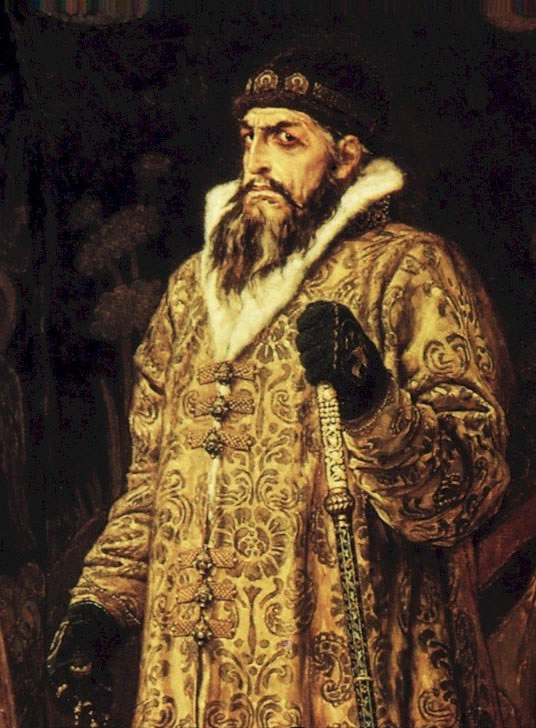
Ivan IV the Terrible

Ivan IV, the grand duke of Muscovy, or Moscow, is usually considered the first czar of Russia, although many historians argue that the title should belong to Ivan III (the Great). Ivan IV was born in 1530, the son of Vasili III, who had ascended the throne after the death of his father, Ivan III the Great, in 1505. Vasili continued the deliberative policy of “gathering in” the Russian lands begun by his father.

Vasili III also faced a threat from the Tartars, the Russian and Polish name for the Mongols. By 1519, the Golden Horde had been conquered by the Gerei dynasty of the Crimean Khanate, who would rule the Crimea until its last khan surrendered in 1783 to Catherine the Great of Russia. When Vasili died in 1533, he left a stable and expanded grand duchy to his successor, Ivan IV.

Ivan was only three years old when his father died, and his childhood was a nightmare of a sanguinary feud between the dominant families of the Kremlin and the Shuisky and Belsky families. He was purposely ignored, an object of contempt, and lived a life in fear of assassination. At the age of 13, he dramatically demonstrated his right to rule against the elite families of the boyars, or high nobility.


On December 29, 1543, 13-year-old Ivan called for Prince Andrew Shuisky to be arrested and thrown to starving hunting dogs. Ivan showed clear signs of sadism through his treatment of animals and women as well, whom he and his compatriots often raped and killed.

In January 1547, Ivan IV was crowned with great ceremony as the Russian czar. He underscored his “Russianness” by marrying a native-born Russian woman, Anastasia Romanova, of the wealthy Romanov dynasty. The Romanovs, while not hereditary boyars, were a wealthy trading family, whose fortune depended on royal patronage.

In this, Ivan was following the model of most European monarchs, who were now favoring the ascendant middle class, who would be beholden to them directly, rather than their ancestral nobles, many of whom also had claims to the thrones of their countries.

The early years of Ivan’s reign were indeed promising for Russia, and he seemed to be following in the careful, almost analytic footsteps of Ivan III and Vasili III. It was the same cautious way that Russia would expand into Central Asia, beginning in Ivan’s own reign, by fortifying each resting place before undertaking further progress.

Ivan called a Russian great council and swore that he would carry out continual reforms in the government of the state. Reforms were carried out in local government to diminish the influence of the boyar nobility and enhance the participation of all classes, in a conscious attempt to bind them to throne. A Foreign Ministry was officially established, and a Ministry of War was also put on a permanent foundation.

Ivan IV in Livonian War

In 1550, Ivan embarked on a period of military reform that essentially made him the father of the Russian army. He realized the importance of muskets and artillery as a way to overcome Tartar tactics. The reliance on muskets and artillery assured Muscovite, or Russian, superiority in most battles.

In 1552, Ivan felt confident enough to use his new army to attack the Khanate of Kazan, one of the successor states to the Golden Horde. Since all such kingdoms traced their origins to sons or grandsons of Genghis (or Chingiz) Khan, these are known to history as the “Chingizid” khanates.

Kazan fell to Ivan, as did the Khanate of Astrakhan in 1556. The Khanate of the Crimea felt sufficiently threatened by Ivan’s sudden eastward expansion that in 1555 Dawlet Gerei Khan had raided Moscow, but the attack did not deter Ivan.

In the same year, the Crimean Tartars raided Moscow, Ivan began the Livonian War in 1555. It would end fitfully in 1583, absorbing most of Ivan’s energies, manpower, and treasure for three decades. (Some accounts give the dates of the Livonian War as 1558–82.) Taking advantage of Ivan’s preoccupation in the Livonian War, the Crimean Tartars returned in 1571 to burn Moscow.

Still, the extensive negotiations Ivan carried out with Elizabeth I of England not only ensured England a welcome partner in the lucrative Baltic Sea trade, but also supplied Ivan with a reliable source of high-grade gunpowder for his army. The downside, however, was that the war produced the political union of Lithuania and Poland in 1569, although the two countries had been united by royal marriage since 1386.

In March 1553, the second, darker, period of Ivan’s reign began, after he recovered from a high fever. When his queen, Anastasia, died in 1560, he had several of the boyars tortured and executed because he suspected them of poisoning his wife.

boyarin Feodorov, arrested for treason

Then in 1564, he left Moscow, vowing never to return. Ivan established the oprichniki, who may have terrorized Muscovites in earlier years. When he felt Novgorod defied him, he had the city destroyed, and Pskov almost suffered the same fate.

The oprichnina, among whom were Boris Godunov and Anastasia’s brother, Nikita Romanov, rode with dogs’ heads (some say heads of wolves) dangling from their saddles and established a reign of terror. The oprichnina was an attempt by Ivan to terrorize all Russians into obeying his will without complaint. Ivan’s experiment in state-sponsored terror succeeded.

Although many causes have been brought forward to explain Ivan’s apparent insanity, one seems to have received comparatively little attention—mercury poisoning. It is known that in his later life Ivan ingested large quantities of toxic mercury. Mercury was used as late as the World War I as a treatment for syphilis, a disease a later autopsy determined Ivan had.

Syphilis itself in its simpulan phase can also cause insanity. In November 1581, Ivan IV, in a rage, raised the iron-tipped staff he carried and struck dead his beloved son, Ivan. The czar never recovered from his terrible act. In March 1584, Ivan IV died while playing a game of chess.