Showing posts with label north america. Show all posts

Powhatan Confederacy

The Powhatan Confederacy, which included approximately 30 different Algonquian-speaking tribes at the height of its power, developed on the Eastern Seaboard of North America in present-day Virginia.
Powhatan Confederacy

Powhatan, who was the leader of this confederacy in the late 16th and early 17th centuries, maintained control from his main residence in Werowocomoco on the York River. Before the English settled at Jamestown in 1607, the Powhatan Confederacy was the strongest force in the area.

Powhatan kept control by marrying the daughters of defeated chiefdoms in an attempt to link their families to his family and appointing a family member to the position of chief. To minimize the risk of tribes within the confederacy combating one another, Powhatan organized a hunting expedition in the Piedmont to incite conflict against the Monacan and Manahoac tribes.

Despite the fact that there was some degree of cooperation between the Powhatan and the English colonists, mutual suspicion destroyed the relationship between the two races. The English colonists thought very highly of Powhatan.

Despite the desire to use the English as allies, Powhatan was still suspicious of their intentions and attempted to contain their settlement; he was also concerned that the English might ally with his enemies. In order to contain the English settlement of Jamestown, Powhatan used the Paspahegh to create conflict with the English settlers.

The English soon adopted another policy to deal with the Powhatan—kidnap their children to force the Powhatan into a more subservient position. In 1613, the English captured Powhatan’s daughter Pocahontas and took her back to Jamestown, where she converted to Christianity and assumed the name Rebecca. Powhatan accepted the fact that the English had captured his daughter and tried to reach some peace settlement by offering her to the English.

The peace settlement Powhatan arranged with the colonists improved relations between the Powhatan and the English colonists. Pocahontas accepted the English way of life by dressing in European fashions, marrying an Englishman named John Rolfe in 1614, and giving birth to a child.

She left her father to travel to England, where she succumbed to disease in 1617. Her father died in 1618 and was replaced by his brother Opechancanough, who changed the dynamics in the relationship between the Powhatan and the English colonists.

The major point of contention between the Powhatan and the English arose over ownership of land as the English colonists needed a significant area of land to grow tobacco. The fact that more English colonists continued to arrive in Virginia strengthened the resolve of Opechancanough to strike at the English before their numbers became too great.

The first major attack took place on March 22, 1622, and resulted in the death of approximately 347 colonists. The English retaliated by organizing offensives against Powhatan towns and destroying their crops before the harvesting period.

The Powhatan Confederacy, suffering from starvation, participated in peace negotiations with the English colonists. In 1623, at the closing stages of the peace talks, 250 natives met with the leaders of the English colony in what they believed was a cordial meeting, but the English poisoned the drinks of the natives and killed the delegation. This led to further reprisals by the Powhatan, who organized a massive offensive on April 18, 1644, which resulted in the deaths of more than 400 colonists.

At this point, it was a losing battle for the Powhatan as there were too many colonists for them to overcome. The resistance of the Powhatan to English imperialism sustained a further blow when Opechancanough was captured in 1646 by the English and shot by a disgruntled colonist while in prison.

The Powhatan Confederacy suffered greatly from English colonization, as frequent warfare and epidemics dropped the population from 24,000 Algonquians when the English settled Jamestown in 1607 to 2,000 Algonquians in 1669. The selesai dispersal for the Powhatan Confederacy occurred with the Treaty of Albany in 1722, which protected the Powhatan from Iroquois attacks, allowing the Powhatan to disperse into various groups.

William Penn - Colonial Leader

William Penn, a Quaker, founded the English colony of Pennsylvania in 1681. He envisioned his colony as a “holy experiment” where people of different faiths could live in harmony.
William Penn - Colonial Leader

Born in England, William Penn grew up in wealth and privilege. His father, Admiral William Penn, afforded him a university education, several large estates, and important connections to England’s elite. In 1667, Penn became a member of the Society of Friends, a religion founded 20 years earlier by George Fox.

The Friends, called Quakers by their detractors, abandoned formal religious services and sought the “Inner Light” by which God revealed himself to each individual. The Quakers suffered persecution in England, but after his conversion, Penn began to use his wealth and influence to advocate the tolerance of all Protestants in England.

In 1676, Penn looked to America to put his ideas of religious liberty into action when he and several other Quakers became trustees of West New Jersey. However, problems with the charter and the large number of trustees thwarted Penn’s hopes to create a religious refuge. Accordingly, Penn petitioned King Charles II for a land grant of his own.

To cancel the debt of £16,000 that he owed to Penn’s father, the king granted Penn 45,000 square miles of land west of the Delaware River, to be named Pennsylvania (Penn’s Woods). According to the 1681 charter, Penn was made sole proprietor, meaning he could organize Pennsylvania as he wanted so long as it did not violate English law.

Penn dispatched the first settlers in October 1681. This party asserted Penn’s authority over the European colonists and Lenni Lenape (Delaware) Indians already living in the region. They also established the colony’s capital of Philadelphia. Penn arrived in late 1682.

From the start, Penn encouraged a variety of Protestants and Europeans to settle in the colony. At his behest, the nascent Pennsylvania legislature in December 1682 issued a law granting full rights of citizenship to all freemen who declared “Jesus Christ to be the son of God” and “saviour of the world.”

Penn also insisted that his colony have no tax-supported religious establishment, not even for Quakers. This and the economic opportunities available in Pennsylvania caused the population to reach 11,000 in 1690.

Despite Penn’s success at religious toleration, his tenure as proprietor was unsteady. He returned to England in 1684, leaving behind incapable governors, and in 1693, a schism led by George Keith divided the colony’s Quakers. The Crown suspended his charter from 1692 to 1695 “by reason of the great neglects and miscarriages” caused by Penn’s absence.

Penn returned in 1699 but found his colonists contentious and uninterested in paying him quitrents on their lands. Frustrated, Penn left two years later but not before issuing the Charter of Privileges, which granted the colonists considerable latitude in crafting their own laws.

The unprofitability of Pennsylvania and Penn’s penchant for extravagance landed him in debtor’s prison in 1707. In 1712, he suffered a debilitating stroke, leaving his wife, Hannah Callowhill, to manage the colony in his stead. After Penn’s death in 1718, the proprietorship passed to his sons.

New Netherland

New Netherland
New Netherland

This Dutch colonial outpost existed along the Hudson River from 1609 to 1664. A relatively small and ineffectual colony, it was known for its trade and diversity. It was eventually captured by the English and became the colony of New York.

Following its independence from Spain in the 1570s, the Netherlands began constructing a worldwide empire due in large part to its powerful navy and savvy traders. In one of the country’s first colonial ventures, Dutch merchants in 1609 financed Henry Hudson to explore North America and Hudson discovered the river that bears his name.

In 1614, the Dutch established their first permanent settlement at Fort Nassau, later relocated and renamed Fort Orange (present-day Albany). This northerly settlement never grew very large and existed primarily to trade with Iroquois Indians for furs.


In 1625, the Dutch West India Company established New Amsterdam on Manhattan Island to control access to the Hudson River. This southerly settlement soon attracted a variety of settlers to farm.

New Netherland was beset by a series of problems for most of its history. Relations with Native Americans were generally poor. Fort Orange was largely dependent on the Iroquois for its survival, while colonists in the south drove Algonquians from their lands and fought four wars in 20 years with them.

Of more pressing concern, however, were the colony’s mismanagement and ineffective leadership. The colony never produced a profit for its investors, while its most effective governor was the autocratic Peter Stuyvesant (1647–64), who barred the colonists from participating in their own governance.

Because of these problems, New Netherland had trouble attracting colonists. The Dutch West India Company did offer patroonships, large land grants with manorial rights, to anyone who took 50 settlers to the colony. However, Kiliaen Van Rensselaer was the only person to take up the company’s offer seriously.

Lacking Dutch settlers, New Netherland opened its borders to dissenters from New England including Anne Hutchinson as well as emigrants from Belgium, France, Scandinavia, and Germany and African slaves. As one visitor noted of New Amsterdam: “There were men of eighteen different languages.” Very quickly the Dutch became a minority in their own colony.

Ethnic diversity invited religious differences and although Stuyvesant attempted to privilege the Dutch Reformed Church, the company insisted upon a policy of religious toleration. Puritans, Quakers, and Lutherans were common in New Netherland, and Jews received greater religious freedom than anywhere else in America.

Ultimately, New Netherland suffered the most from foreign competition. A Swedish colony on the Delaware River proved a distraction to the Dutch and, in 1655, Stuyvesant engineered a military takeover of New Sweden. However, Dutch hegemony proved short-lived as in 1664 an English fleet under the command of Richard Nicolls arrived off New Amsterdam.

Although Stuyvesant attempted to mount a defense of his colony, “a general discontent and unwillingness to assist in defending the place became manifest among the people.” On August 27, Stuyvesant surrendered New Netherland to Nicolls, who granted the colonists generous terms, including the preservation of their property rights, inheritance laws, and religious liberty.

New France

New France
New France

Although arriving late to the European scramble for North America, France for a time claimed the largest portion of today’s United States and Canada, stretching from Newfoundland to Louisiana and including the Great Lakes and Mississippi Valley. However, New France failed to attract a large population and, by 1750, France was near losing much of its territory to an ascendant British North America.

In 1524, Italian explorer Giovanni di Verrazano was hired by France’s King Francis I to find a passage through North America to Asia, a route that, after many nations failed to find this “Northwest Passage,” was eventually confirmed to be mythical.

However, Verrazano did bring back information about Atlantic coastal regions from Carolina to Nova Scotia. A decade later, seeking gold and the elusive sea passage to the Orient, Jacques Cartier, who may have been part of Verrazano’s expedition, commanded three voyages.


He sailed into the St. Lawrence River, planting a cross bearing the king’s coat of arms to claim a region that included sites that became Québec and Montreal. Returning in 1541, Cartier and his crew established the tiny and short-lived colony of Charlesbourg-Royal, near Montreal, causing tension with the Iroquois and other local tribes.

Scurvy and fierce winter weather soon ended the colonial experiment. After a series of exploratory trips, Cartier returned to France carrying what he believed were gold and diamonds; his booty proved to be iron pyrite (fools’ gold) and common quartz.

Although Crown-sanctioned explorations faded after Cartiers’s inauspicious akibat voyage, fishermen from France (and many other European countries) maintained a robust presence in North America as did traders in furs who dealt with local native tribes. It was these opportunities that reawakened French interest in North America.

New France Beginnings

Samuel de Champlain was a map maker employed by a fur-trading company, not a military man, but his leadership abilities during renewed French explorations in the early 1600s made him New France’s “father” and its first governor. In 1608, Champlain and his associates chose a location on the St. Lawrence River at Québec as their fur-trading settlement.

Champlain forged alliances with many Indian tribes, including the Huron of the Great Lakes, and also championed the idea of more permanent French settlement along the St. Lawrence. In 1633, two years before his death, Champlain was appointed New France’s governor by Cardinal Richelieu, top minister to King Louis XIII.

Eastern Canada was not the only focus of French interest in North America. As fur traders penetrated deeper into the continent in search of the best pelts and cooperative native suppliers, their efforts led to further exploration and land claims.

In 1673, Canadian-born Louis Jolliet and French Jesuit missionary Père Jacques Marquette used information from natives to trace the oceanward course of the Mississippi River in hopes, soon dashed, that it flowed into the Pacific Ocean.

Father Marquette, who was a missionary to tribes in what is now Michigan, died soon after this exhausting expedition on the banks of a river later named the Père Marquette in his honor. Jolliet, who had early on given up the priesthood for fur trading, later explored Hudson Bay and mapped the Labrador coast.

Four years after this Mississippi expedition, French-born René-Robert Cavelier, sieur de LaSalle, who had relocated to New France in 1667, pushed French territorial claims yet further. Arriving at the huge river’s mouth in 1682, LaSalle claimed the vast Mississippi Valley for France, naming this territory Louisiana, for King Louis XIV.

LaSalle’s ambitions, fueled by greed and possible mental illness, did not stop there. Promising to claim Spanish Mexico for France, the adventurer ran out of supplies and was murdered in 1687 by his own hungry men.

Born into a wealthy Montreal family, Jean-Baptiste Le Moyne, sieur de Bienville in 1701 became acting governor of France’s new southern claims and for 40 years fought to keep his small French colony safe amid Indian, Spanish, and British hostility. In 1718, Bienville spearheaded the creation of New Orleans as an administrative center and port.

Unlike the British in their early colonial years, France did not have excess population at home and provided little incentive for its citizens to brave a stormy Atlantic and face a harsh climate and often-hostile Native population in the New World.

Early on, the tiny French presence in Canada was 80 percent male and consisted mainly of fishermen, fur traders, and Franciscan and Jesuits priests. Known by the Indians as the “Black Robes,” the priests intended to convert Indians to Catholicism.

An early religious mission, called Sainte-Marie, among the Hurons, was built in 1615. Located on Ontario’s Wye River, by 1639, it was home base for 13 priests. When fighting broke out in 1648 between the Huron and their Iroquois enemies, the priests set fire to their mission, fearing its desecration.

From 1627 to 1663, a centralized commercial company created by Cardinal Richelieu struggled to squeeze profits out of New France, succeeding only with furs. There were barely 3,000 colonists in 1663, when King Louis XIV intervened, making New France an official French province.

Troops were sent to protect settlements with fortifications, and to project French power to native tribes and European rivals. A royal shipment of 850 prospective brides, known as filles du roi, or “the king’s young women,” helped to stabilize the colony and assure natural increase in its population. By 1700, New France had 19,000 white inhabitants.

Under this new regime, St. Lawrence River estates were set aside for nobles and military officers. A near-feudal setup, it was called the seigneurial system. New France’s habitants, or ordinary settlers, mostly farmed land owned by some two hundred seigneuries granted by the Crown. This tenant farming system of rents and allotments outlasted French control (and the French monarchy), surviving into the 19th century.

Although agriculture would occupy the energies of the great majority of French Canadians, the voyageurs—fur traders who traveled to French outposts like Detroit (founded in 1701 by Antoine de la Mothe Cadillac) and Prairie du Chien (Wisconsin)—had a more romantic image.

Generally, voyageurs were licensed by the authorities; their rivals were the socalled coureurs de bois, unlicensed traders who aggressively explored the farthest reaches of French America, including New Orleans, in pursuit of valuable furs, especially beaver pelts, and markets for their animal skins and other goods.

Challenges to French

Compared to the British and Spanish in this era, French colonists treated Native Americans with great respect. Friendly relations with local Indian tribes were crucial to French success in the fur trade; colonists were also well aware that their numbers were too small to deter major attacks. From the Indian viewpoint, the fact that Frenchmen were not arriving in huge numbers assured some tribal leaders that they could coexist with these interlopers.

On the other hand, good intentions on both sides did little to spare the Indians from deadly smallpox and other European diseases. Jesuit pressure on Indians to adopt Catholicism, along with European clothing and behavior, although attracting quite a few converts, was generally met with suspicion. There was a significant level of intermarriage, mostly between French men and Indian women, creating a group known as Métis.

The Huron and other Great Lakes and eastern tribes began forging strong alliances with the French in 1615, but wars with the powerful Iroquois Confederacy, allies of Britain, punctuated the history of New France.

New France’s huge landholdings were a noose that encircled Britain’s Atlantic Seaboard colonies, leading to a number of altercations between the two European superpowers, both at home and in North America.

The 1713 Treaty of Utrecht that ended the 12-year-long War of the Spanish Succession gave Britain dominion over a large sector of eastern French Canada including the rich agricultural lands of Acadia and destroyed much of France’s overseas trade.

By the time war again broke out in 1754, the population of British North America was 20 times larger than New France’s and France’s grip on North America was near its end. When French emperor Napoleon I sold Louisiana to the new United States in 1803, New France was a memory, although its French Canadian and Cajun cultures would survive and flourish.

Natives of North America

Natives of North America

Perhaps no other group in human history has experienced as extreme a change in its circumstances as did the indigenous inhabitants of the Western Hemisphere between 1450 and 1750.

The so-called Columbian exchange, set off by Christopher Columbus’s 1492 voyage from Spain, completely altered the ecology, economy, and web of social relationships among the diverse peoples that Columbus (inaccurately) named “Indians.”

The people who populated North and South America between 40,000 and 15,000 years ago crossed what was then a land bridge between Siberia and modern Alaska and gradually settled the hemisphere.


When a worldwide Ice Age ended about 10,000 years ago, the land route between Asia and the Americas disappeared. By the time of Columbus’s first voyage, historians and anthropologists have estimated that the hemispheric population stood between 10 million and 75 million, most living in Central and South America.

The peoples of North America were diverse in almost every possible way except biologically. Experts argue about the extent of North America’s precontact population—the range is 1 million to 18 million—but most agree that populations began declining several hundred years before Europeans showed up.

By 1450, some large Indian communities in the Southwest, Pacific Northwest, and middle Mississippi Valley had vanished or dispersed, abandoning sophisticated buildings and artifacts. Factors that have been proposed to explain these declines include climate change, warfare, and disease.

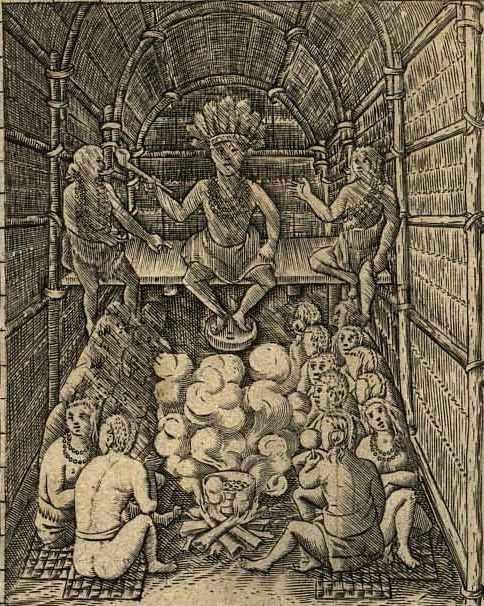
By 1450, there were dozens of tribal groups and alliances speaking diverse languages and following very different religious and social customs. There were some commonalities: Most Indians were animists, believing in the spiritual power of their natural surroundings.

They devised elaborate rituals to placate these spirits, especially those of animals they had killed. In many areas human burials were placed in elaborate and extensive earthen mounds. Most tribes respected shamans (healers) and believed that a Great Spirit oversaw the natural world.

Because tribes were likely to move often in search of better land or more abundant game—or to avoid other hostile tribes—property ownership in the European sense was all but unknown. Archaeologists have found abundant evidence of trade routes that spanned the continent, bringing tribes together in the process of tukar barang and exchange.

In most North American tribes, women were in charge of agricultural production, while men hunted for game. Maize (corn), first cultivated in Mexico, was by the time of contact a basic crop in much of North America.

Squash and beans were also staples of most tribes’ diets. While by no means environmentalists in any modern sense, most North American tribes were well adapted to their surroundings and were often helpful to inexperienced Europeans.

For example, natives taught French explorers how to build lightweight birchbark canoes to travel where their clunky wooden ships were useless. Others helped Europeans identify strange plants and animals, learning which were edible and which poisonous.

Most famously, Squanto, a Patuxet who had been kidnapped by an English slave trader in 1614, returned to America in time to teach the Pilgrims how to fish and grow corn, keeping them alive to hold a Thanksgiving in 1621.

Warfare was a constant among various Indian groups both before and after European contact. Early on, some tribal groups welcomed alliances with Europeans as a way to overpower their traditional rivals, in part by acquiring the foreigners’ goods and technologies, especially their superior weapons.

But as the trickle of Europeans became a flood, especially in British-claimed regions, some tribes forged alliances with traditional friends and even enemies to counter European threats to Indian survival.

For example, Algonquian chief Powhatan, head of a strong confederacy, at first welcomed Jamestown settlers, even allowing his daughter, Pocahontas, to marry Englishman John Rolfe.

But in 1622, Powhatan’s brother Opechancanough, now leader of the Powhatan Confederacy, launched a surprise attack on settlers, killing more than three hundred of them and capturing women and children. Ultimately, the Virginians rallied, using trickery and even poison to reclaim their holdings.

In this early war, as in later conflicts, tribes were responding to growing white populations. Whites were no longer perceived simply as traders who would soon move on; they had become settlers using—and claiming as their own—traditional tribal lands.

Disease did even more damage than European land grabs and weapons of war. Because Indians were genetically very similar, and because they had been isolated in the New World for many centuries, they were at the mercy of pathogens carried by the invaders.

The worst of these was smallpox, with measles and influenza also sowing death. These diseases killed Europeans, too, but ravaged the Indian population. Long before germs were known to cause disease, Europeans praised God for smiting Indian enemies, thus making it easier to colonize America.

Some Europeans “assisted” this process by purposely distributing to Indians smallpox-infected blankets and other tainted goods. Smallpox epidemics could and did change the course of battles and negotiations between natives and Europeans.

Southwest

Descendants of the Anasazi, whose complex civilization came to a puzzling end in about 1300 c.e., the Pueblo Indians, including Hopi and Zuni, for centuries had lived in settled agricultural communities in today’s southwestern United States.

The Spanish, who had already made a fortune exploiting Central and South America, in the 17th century also began aggressively exploring the southern reaches of North America, with terrible consequences for the native population. In 1598, Juan de Oñate marched four hundred soldiers, priests, and colonists into New Mexico, killing almost half the residents of the cliff city of Acoma and forcing most of the rest into slavery.

In 1680, Popé, a Pueblo religious leader who had been punished for rejecting Franciscan priests’ attempts to convert him, led the Pueblo Revolt, the most successful native retaliation in this masa of European occupation.

Indian ranks had thinned through disease and compelled labor, but they still outnumbered the Spanish colony of about three thousand. The Pueblo peoples spoke several different languages, yet they managed to unite, with the help of traditionally hostile Apache, to expel the Spaniards and destroy symbols of Catholicism.

Although internal native strife, including raids by Apache and Navajo enemies, soon resumed, and the Spanish retook New Mexico in 1692, the Pueblo were treated with greater respect, becoming one of the few tribal groupings in North America to mostly retain ancestral homelands.

Southeast and Florida

In 1513, Hernán Ponce de León invaded Florida in search of slaves, wealth, and promises of eternal youth but was repulsed by local Calusa Indians. More sustained and far-ranging efforts led by Hernando De Soto and others in the 1540s explored the Gulf coast and penetrated as far as the Great Plains. Not until 1565 did King Philip II authorize what was essentially a Florida military base to deter British, French, and Dutch piracy of Spanish gold.

In the process, the Spanish massacred a tiny colony of refugee French Huguenots and built a fort at St. Augustine, the oldest U.S. site continuously peopled by Europeans. Efforts to convert the local Guale tribe sparked an uprising in 1597. The tiny Spanish colony put down the uprising in 1602 but never attracted more than a few thousand settlers.

In other sections of the Southeast, a confederacy among four tribes—the Cherokee, Chickasaw, Choctaw, and Creek—preceded the European invasion. They would be tested by European incursions that forced these tribes to relocate, sometimes competing among themselves for territory.

By 1745, the Cherokee were allied with the British in their effort to contain France and Spain, focusing on lands between Florida and the recently established colony of Georgia. In this period, Creek began migrating to Florida under pressure from both Europeans and members of their own tribe. In the 19th century, they would call themselves Seminole.

British and French American Alliances

The five (later six) tribes that became the Iroquois Confederacy (Haudenosaunee) centered in what became New York State, had also, prior to European contact, initiated a Great League of Peace in response to destructive warfare among tribes.

These “people of the longhouse” included the Mohawk, Seneca, Onondaga, Cayuga, and Oneida tribes, joined in the early 1700s by Carolina’s Tuscarora. The Iroquois were not nomadic but lived in large villages. Their longhouses were wood and bark structures that might be 400 feet long and accommodated many family groups.

Skilled negotiators, the tribes individually and confederacy as a whole for a time held their own against Dutch, British, and French claims and demands. Some among the Iroquois hoped to remain neutral, but they soon were edging toward the British.

By the 1670s, the Iroquois and British had pledged mutual friendship. After a sneak attack by French forces in 1687, the Five Nations retaliated by attacking New France settlements on behalf of British objectives in what was known in North America as King William’s War.

They fought both the French and France’s Indian allies, including the Huron and Abenaki and Algonquian people of the Great Lakes region. Both groups of Indians inflicted and suffered terrible casualties; by 1701, the Iroquois were promising their people to remain neutral in future European conflicts.

By 1750, eastern and Great Lakes Indians of many tribes, displaced by white settlement, were seeking new lands in the Ohio Valley, on the frontier between British and French territorial claims and control.

The Iroquois, as well as Shawnee, Delaware, Cherokee, and Chickasaw, were all trying to use this no-man’s-land to enhance trade and perhaps prevent both the British and French from expanding even farther into the continent.

In 1749, Virginia awarded some of its favored citizens development rights to almost 8,000 square miles of the Ohio Valley. The ensuing French and Indian wars would set off a series of events that ultimately made hundreds of Native tribes—survivors of 258 years of warfare, land loss, and disease—strangers in their own land.
Nahua (Nahuatl)

Nahua
Nahua
While Nahua, or Nahuatl, is the primary Mesoamerican linguistic group, its origins are actually in North America, where the first speakers of the language originated. It is from the general linguistic family known as the Uto-Aztecan, one of several language groups spoken by Native Americans. Among related languages are those spoken by the Hopi, the Comanche, Shoshone, and Ute in the current United States.

It is also spoken by the Tarahumara, Huichol, and Yaqui peoples today in Mexico, among other tribes. In what is known as the Classical period, before the Spanish conquest of 1519–21, it was the language spoken by the imperial Aztecs of Mexico.

The Athabascan language group, in the American Southwest, includes languages spoken by many of the Apache clans, such as the Chiricahua, Jicarilla, Mescalero, Lipan, and Western Apache. It is also spoken by the Kiowa, who are related to the Apache but took to the southern Great Plains of America, where they rode with the Comanche.

Archaeological evidence suggests that the Athabascan-speaking Indians came after the Uto-Aztecans. Some archaeological sites point to what could have been savage warfare between Athabascans like the Navajo and Apache and the Uto-Aztecan Hopi.


There is a theory that the Hopi took to their high mesa homes as a refuge from these more warlike people. An indication of this situation is that there is evidence that the Hopi first called themselves the Hopituh, or “the peaceful ones.” Even today, there is rivalry between the Navajo and the Hopi for land in the Southwest United States.

Language

As with all languages, much effort has been made to classify the Nahua, or Nahuatl, branch of the Uto-Aztecan language group. While the Aztecs (Mexica) are no doubt the most well-known Mesoamerican (Central American) speakers, Nahuatl really made its first appearance around the seventh century c.e., when the Toltec came from the north and began to expand at the expense of settled people like the Mayas of Guatemala and the Yucatán in Mexico.

The warrior cultures of both the Toltecs and the Aztecs, including their common language, could lead to the theory that both were from the same general area in North America, the present day United States or Canada, and that the Toltecs were the first wave of conquerors. The Aztecs made their dramatic appearance in the Valley of Mexico in about the 14th century, and perhaps represented the last wave of conquering immigrants from the north.

Chicano (Mexican-American) activists have placed Aztlan in the southwestern United States, in the region that was seized from Mexico by the United States during the Mexican-American War of 1846–48.

This may be, archaeologically speaking, a more accurate assessment. As discussed, the Aztecs and the other Uto-Aztecans may have originated farther north, even with the migration of Asiatic tribes from Siberia, the traditional route of Native Americans into the Americas.

The Indians already settled in Mexico called the newcomers like the Toltecs and Aztecs, the Nahuatl speakers, Chichimecas, a term loosely translated as “barbarians.” Aztec legend recounts there were seven Aztec tribes, including the Tepenecs and the Acolhuas. The Aztecs were the last to arrive in Anahuac, as they called the Valley of Mexico.

The arrival of the Spanish in the 16th century with Hernán Cortés, who landed at Vera Cruz in 1519, was the end of Aztec independence, and ultimately that of all the peoples of Mesoamerica. Early Spanish missionaries, after viewing the blood sacrifices of the Aztecs, made it their goal to eradicate the Aztec culture and with it their Nahuatl language.

However, there were scholars among the missionaries who saw that the culture of the Aztecs merited preservation. Thus rather than being destroyed, Nahuatl was preserved in considerable measure by enlightened members of the religious orders whose majority attempted to destroy it.

Today some 1.5 million Mexicans still speak Nahuatl, although the language of the Classical period ended with the defeat of the Aztecs. Today Nahuatl is enriched by a large vocabulary of Spanish “loan words,” as Spanish and English have been enlivened by Nahuatl words.

Geographically speaking those who use Nahuatl also include those as far south as the Pipil of El Salvador, thus embracing the whole of Mesoamerica. Considering its influence on English, one can say that today perhaps a larger area is influenced by Nahuatl than at any other time in the history of the language.

Massachusetts Bay Colony

Massachusetts Bay Colony

In the early 17th century, England began acting on its imperial ambitions by chartering business organizations called joint-stock companies, which undertook the actual work and expense of spreading England and its institutions around the world. The system had created the colony of Jamestown, Virginia, and the Council for New England, under the leadership of Sir Ferdinando Gorges.

During the 1620s, one of the council’s patents went to some Dorchester merchants to develop a fishing industry at Cape Ann on the New England coast. By 1626, the effort had failed, although John White, a Puritan minister in England associated with the project, began to see the enterprise as a potential refuge for discouraged Puritans from England.

Unfortunately for White and a group of fellow Puritans who had joined him, the Council for New England had ceased effective operation, and the group instead applied directly to the government for its own charter for the lands it already held. The charter, for a company called The Governor and Company of the Massachusetts Bay in New England, was issued in March of 1629.


The company was to be managed by a governor and a council of 18 assistants, who were to be elected by a General Court of investors, which also had the power to legislate for the company. Not part of the charter was the usual requirement that the company conduct its business meetings in England.

This omission, quite possibly done by design, allowed the company to hold its meetings wherever it chose. In late August of 1629, in what is known as the Cambridge Agreement, the company opted to move its operations, including the charter, to New England.

When control of the company quickly passed into the hands of dedicated Puritans willing to leave England, the company started its transformation into a colony. By late 1629, the company had sent out John Endicott to assert its control over a settlement at Salem and had then supported that effort with five more ships and possibly one hundred additional settlers.

City Upon a Hill

Thus, by April of 1630, when a flotilla of 11 ships left England, the Massachusetts Bay Company was already a significant presence on the New England coast, and its conversion into a full-fledged colony assured. John Winthrop, elected the company’s governor, established the character of early Massachusetts in a sermon preached at the outset of the journey.

He stressed that the colony would be created as a covenant with God, and that religious orthodoxy would be maintained by the merging of civil and ecclesiastical power and consolidated in the hands of the colony’s leaders. His reference to Massachusetts as a “city upon a hill” to serve as an example to England of what God intended for his people further solidified the religious nature of the proposed colony.

There is no question about the success of the enterprise. The Company of the Massachusetts Bay was indistinguishable from what came to be called simply the colony of Massachusetts. And the religious nature of the colony was secured by requiring that only male church members could vote in colony elections.

There were challenges to some aspects of the colony from Roger Williams, Anne Hutchinson, Quakers, and the freemen of the colony who demanded an elected body to represent them, but there was never any likelihood in New England that the colony would not succeed.

But that certainty was not the case in England. Sir Ferdinando Gorges, still hanging on to the remnants of the Council for New England, argued that the colony’s charter had been secretly obtained and started a campaign to have it annulled.

To the same end in 1635, the council gave up its own charter and requested that the king reassign the disputed territory to eight members of the former Council for New England. The outbreak of the English Civil War, or Puritan Revolution, in 1640, however, prevented any of the grants except the one for Maine from being made.

By the time of the Restoration of the Stuart monarchy in 1660, Gorges had died, the Council of New England had passed from the scene, and Massachusetts had become too powerful and too independent to be easily tamed.

Control of Commerce

With the Restoration, England commenced a colonial policy that stressed the importance of commerce in the empire and the necessity of England’s control of that commerce for the greater good of the mother country.

Massachusetts viewed such a policy as interference in its self-styled independence. When England decided to oust the Dutch from New Netherland in 1664, the leaders of the expedition were ordered to investigate the situation in New England. Their report was especially critical of Massachusetts, but through delay and avoidance the colony managed to escape serious ramifications.

England tried again in 1676, when it sent over Edward Randolph. Randolph’s report was more damaging than the previous commissioners’ account, and the English government felt compelled to act.

It ordered the colony to send representatives to negotiate a settlement, but when England determined that the colony had not lived up to its agreements, it commenced legal action against the original charter as the only method whereby Massachusetts could be brought under control.

England completed the effort in 1684, and the courts annulled the original 1629 charter. The colony existed dependently until it was incorporated into the Dominion of New England in 1686. In the aftermath of the Glorious Revolution in England, Massachusetts received a new charter in 1691 as a royal colony, the Province of Massachusetts Bay.

The Puritan old guard were displeased, but by the end of the 17th century the original charter had generally outlived its usefulness, as perhaps demonstrated by the Salem witchcraft trials.

The more practical and forward-looking portion of the colonists recognized that future growth and prosperity lay with a royal charter, the institution of a property qualification for the vote, and a more cooperative relationship with English authority. Those whose ancestors had migrated as Puritans under the 1629 charter had become the Yankees of the 1691 charter. They and their colony were ready for the 18th century.

Maryland

Maryland was chartered in 1632 as a refuge for English Catholics, although the colony’s religious mission was ultimately undermined by internal disputes. As did neighboring Virginia, colonial Maryland maintained an economy based on tobacco and bound labor.

Since the Reformation, Roman Catholics in England had faced persecution. Wanting to provide a place where they could worship freely, George Calvert, the first Lord Baltimore, envisioned an American haven for Catholics. Baltimore was a recent convert to Catholicism and had previously invested in several colonization schemes.

In 1632, King Charles I granted Baltimore’s request and issued a charter for a colony in the upper Chesapeake. The king was sympathetic to the plight of Catholics and Maryland was named in honor of his Catholic wife, Henrietta Maria. Unlike previous charters, Maryland’s named Baltimore and his heirs “absolute Lords and Proprietors,” essentially giving the Calvert family total control over the colony.

English colonists first reached Maryland in 1634, settling on the north side of the Potomac River at St. Mary’s City, the colony’s first capital. Within the first decade, settlers began erecting tobacco plantations and importing indentured servants to work them. The colonists established an elective assembly in 1638, although the governor and governor’s council were appointed by Lord Baltimore.


Economic success ensued, but religious tensions threatened the colony’s stability. Maryland had attracted both Protestants and Catholics from the start, although Baltimore gave the best lands to Catholic gentlemen and appointed Catholic governors and councilors.

In contrast, Protestants came over largely as indentured servants and were shut out of the political process. Inspired by the English Civil War, Protestant colonists seized control of the colony in 1644 in what was termed “the plundering time.”

Hoping to prevent future confrontation, Baltimore granted An Act Concerning Religion in 1649, guaranteeing that no person “professing to believe in Jesus Christ” would be “any ways troubled, molested, or discountenanced.” The first American law to ensure religious liberty, the act was intended to preserve the rights of Catholics, who had already become a minority in their own colony.

Religious strife continued nonetheless. During the Glorious Revolution of 1689, Protestants led by John Coode again seized the colony. This time, the Calverts did not regain control until 1715, when the family converted to Protestantism.

During the interim, the colonial assembly established the Anglican Church and barred Catholics from owning firearms and holding office. Thereafter religious conflicts abated as the population and economy diversified. In the late 17th century, African slaves replaced servants and became an important minority in the colony, constituting a third of Maryland’s population at the revolution.

In the northern counties, iron foundries were established and wheat farming appeared in the 1740s. Annapolis became the capital in 1694 and soon grew into a center of culture, boasting a newspaper, academy, and several clubs by the middle of the 18th century.

To the end of the colonial period, Catholics remained an important minority in Maryland. When the Maryland delegates signed the Declaration of Independence in 1776, one of the signatures belonged to Charles Carroll of Carrollton, a Catholic.

Maroon Societies in the Americas

Maroon societies is a term designating communities of runaway slaves in the Americas, the formation of which constituted a recurrent feature of the history of African slavery over nearly 400 years, from the first importation of African slaves in the early 1500s through the selesai abolition of slavery in the Western Hemisphere in Brazil in 1888. The term derives from the Spanish cimarrón, originally referring to feral cattle but by the early 1500s also signifying runaway slaves.

Maroon societies were most common in the Caribbean and Brazil but were also widespread in North America and elsewhere. To slave owners and ruling groups they represented a constant and serious challenge to the institution of African slavery generally, while to slaves they represented the possibility of life outside the shackles of the slave regime. Often called palenques in the Caribbean region and Quilombos in Brazil, they had a history closely linked to the hundreds of slave rebellions that also mark the history of the Americas.

Ranging from small nomadic bands to extensive settled communities of thousands of people that endured for decades, even centuries, on the fringes of the plantation economy, Maroon societies came into existence almost as soon as African slavery in the Americas did. Most of their members were African-born, as they reproduced many of the social and cultural features of their homeland in their new surroundings.

Among the first official acknowledgments of the existence of such communities was a report to the Council of the Indies from Hispaniola of March 1542, in which Archdeacon Álvaro de Castro estimated that 2,000 to 3,000 runaway slaves were at large on the island. A follow-up report of July 1546 described some of the island’s numerous Maroon communities, some hundreds strong, and the mixed success of Spanish efforts to subdue them.


Often mixing with indigenous groups and allying with their slave masters’ enemies, Maroon communities displayed tremendous resilience in the face of persistent efforts to eradicate them and horrific punishments meted out to captured runaways, which included castration, amputation of limbs, branding, garroting, and burning alive.

The hinterlands of plantation economies throughout the Caribbean, Mexico, Brazil, North America, and elsewhere witnessed the formation of Maroon societies alongside the very introduction of slavery.

In Mexico, rapid Indian depopulation prompted colonists to import upward of 120,000 African slaves in the years between 1521 and 1650. Many thousands were compelled to work in the silver mines and ranches north of Mexico City centered on Zacatecas.

From the 1560s to the 1580s, a series of revolts and uprisings rocked the region, as runaway African slaves joined forces with besieged Indians to raid ranches and storehouses, attack travelers, and return to their hidden hamlets in caves, arroyos, and other places beyond the reach of the authorities.

Jungles of Veracruz

In the 1570s, the Crown issued a series of draconian laws intended to discourage such uprisings, which nonetheless failed to have the desired effect. In 1609, a rebel Maroon community in the jungles of Veracruz, led by Yanga, successfully negotiated a peace treaty with the Spanish authorities that granted them their freedom. Nearly a century later, the community was thriving. Slave uprisings and the formation of Maroon societies continued until the selesai abolition of slavery in Mexico in 1829.

Some palenques survived for decades, later becoming towns and municipalities, such as El Cobre in eastern Cuba, where a slave uprising in 1731 led to the creation of a stable community that 50 years later had a fugitive slave population of over 1,000 scattered throughout the Sierra del Cobre.

In 1800, following a recommendation of the Council of the Indies, the Crown declared the slave-descended inhabitants of El Cobre free. Other well-known palenques in eastern Cuba included El Frijol and Ciénaga de Zapata, which survived through much of the 19th century.

Despite their best efforts to extinguish such fugitive slave communities, colonial authorities were often compelled to negotiate with them—as in the district of Popayán in Colombia, where in 1732 the Audiencia of Quito authorized a local official to offer a treaty of peace to the palenque called El Castillo, granting its inhabitants their freedom if they would agree to accept no more runaway slaves. The palenque refused the offer, and in 1745 a series of military expeditions finally captured and defeated El Castillo.

More than a century earlier, in the early 1600s, in the Cartagena district of Colombia, a runaway slave named Domingo Bioho, claiming to be African royalty and adopting the title King Benkos, staged a series of raids on plantations and farms around Cartagena and founded a fortified palenque called San Basilio.

After defeating two expeditions sent to subdue his independent kingdom, in 1619 King Benkos negotiated a favorable treaty with the Spanish authorities, only to be betrayed, captured, and hanged. Despite this setback, San Basilio survived for another century and was finally suppressed in 1713–17.

Similar episodes unfolded in the British and French Caribbean islands. In Martinique in 1665, a Maroon who called himself by his master’s name, Francisque Fabulé, led a group of 400–500 Maroons who staged repeated attacks against plantations and settlements. The French Sovereign Council negotiated a treaty with Fabulé that granted him his freedom and a promise that his band would not be punished. He was later condemned to life in the galleys.

In 1771, a decree of the Supreme Council of Martinique lamented the existence of fugitive slave communities on the island, where they had built huts, cleared land, and planted crops, and from which they sallied forth to commit various depredations. In the French island of Guadeloupe in 1668, the governor reported more than 30 Maroons living in Grande-Terre and recommended an example be made by capturing and beheading them.

Despite the authorities’ best efforts, however, the Maroon societies could not be eradicated. Nearly 70 years later in Guadeloupe, in 1737, a group of 48 Maroons led by one Bordebois was put on trial; eight were sentenced to be garroted. Similar events transpired on Jamaica, Antigua, Barbados, and other islands in the British Antilles.

North American Societiea

Slave hunt in Dismal Swamp area

In British North America and, after 1783, the United States of America, Maroon societies formed and reformed repeatedly. There is evidence for at least 50 such communities during the period 1672–1864 in the mountains, forests, and swamps from Florida to Louisiana to Virginia.

Most notable among these were those in the Dismal Swamp area in the Virginia–North Carolina borderlands, where thousands of runaway slaves and their descendants survived repeated efforts to capture and subdue them. Sometimes Maroons allied with local Indians, forming mixed communities of Indians and fugitive slaves.

Other times Indian individuals and polities allied with Euro-American authorities, assisting them in their eradication efforts, as occurred among the Notchee Indians in South Carolina in 1744, in Georgia in 1772, and in other places.

Communities descended from Maroon societies can be found in many parts of the Americas. In the 1980s, it was estimated that more than 10 percent of the population of the Republic of Suriname was descended from six Maroon or “Bush Negro” communities or tribes that formed in the 1500s and waged a century-long war for liberation against the Dutch authorities before finally winning their freedom in 1762.

The collective memory of the modern-day descendants of such Maroon societies has provided fertile ground for historians, anthropologists, linguists, and other scholars interested in exploring this chapter of the history of Africans in the Americas.

King Philip’s (Metacom’s) War

King Philip’s War was one of the bloodiest conflicts between English colonists and Native Americans in history. Incited by growing colonial population, the war confirmed white domination of New England and significantly weakened Indian presence in the region.

From the settlement of Plymouth in 1620, the colonial population of New England grew rapidly and displaced many coastal Indians. By 1670, the 52,000 colonists of southern New England outnumbered natives by three to one. As colonial populations grew, they pressed farther inland, seizing Indian land through dishonesty and allowing unfenced livestock to spoil Indian crops.

At the same time, Puritan clergy sought to convert Indians to Christianity by placing them in “praying towns” where their beliefs and behaviors could be closely monitored. Led by the Reverend John Eliot, the praying towns held 1,600 natives by 1674.

In March 1675, the colony of Plymouth accused three Wampanoag Indians of the murder of a praying town Indian and colonial informant. When the three were tried and hanged three months later, the Wampanoag sachem Metacom (known to the colonists as King Philip) retaliated against the town of Swansea.


Throughout the summer of 1675, the conflict escalated from an isolated incident into a regional war. Massachusetts and Connecticut came to the aid of Plymouth and launched indiscriminate attacks on a number of native peoples, which caused the powerful and previously neutral Narragansetts to ally with the Wampanoags.

Over the next few months, the Indians gained the upper hand, using flintlock muskets to launch a total war. Before the end of 1675, Indians had attacked 52 of the region’s 90 towns, destroying buildings, murdering entire families, and obliterating 12 entire settlements.

In early 1676, colonial leaders forged an alliance with the Pequots and Mohegans and gained the advantage by turning the conflict into an Indian civil war. The colonists also became increasingly aggressive in their warfare. In late 1675, they trapped 300 Narragansetts in the Great Swamp and set them on fire. The colonists also attacked women and children, selling the captives as slaves in the Caribbean.

After one battle, Benjamin Church noted that Indians who surrendered “were carried away to Plymouth, there sold, and transported out of the country; being about eight score persons.” True to their Puritan nature, the colonists saw the Indian attacks as God’s punishment for their transgressions.

As Mary Rowlandson remarked after several weeks in Indian captivity, “I see the Lord had his time to scourage and chasten me.” By the summer of 1676, the Indians had run out of supplies and when Metacom was killed in battle in August, the rebellion collapsed.

King Philip’s War brought about the death of 1,000 colonists and 3,000 Indians. It also resulted in the abolition of most of the praying towns, as angry colonists attacked, imprisoned, and even sold the Christian Indians into slavery.

Their hegemony over the region secured, the colonists drove the remaining Native Americans to the frontier. After King Philip’s War, Indians became largely invisible in New England, causing many whites to declare mistakenly a number of tribes extinct.

Jamestown

Jamestown
Jamestown

Jamestown was the first permanent English colony in the New World, founded in 1607 under the direction of the Virginia Company. Although the settlement struggled to survive at first, the discovery of tobacco made Jamestown a success and it remained the capital of the Virginia colony until 1699.

In 1605, a group of influential merchants seeking to profit materially from the natural resources of America petitioned England’s King James I for permission to settle in America. The following April, the king chartered the London Company (later known as the Virginia Company) and granted it the right to settle a colony between 34 and 41 degrees north latitude.

The charter created a joint-stock company, which allowed the merchants to seek investors and operate as a private business. The charter provided that the colony would be governed by two councils, one in America and one in England, and guaranteed that colonists would enjoy the “liberties, franchises, and immunities” of English subjects.


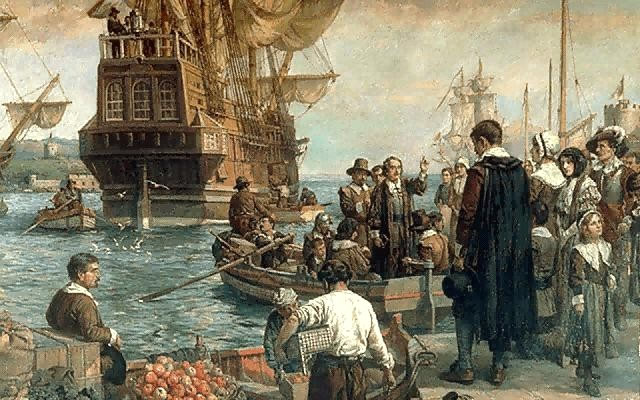
On April 26, 1607, the Sarah Constant, Godspeed, and Discovery arrived in Virginia carrying 105 passengers, who named their settlement Jamestown after the king. From the start, the colony was beset by troubles.

The Chesapeake Bay region was then controlled by a confederation of Algonquian Indian tribes led by the paramount chief Powhatan. Powhatan was instrumental in helping provision the colonists in the early years, but the two groups often came into conflict thereafter.

More immediately, the colonists died in large number of disease and starvation: Only 38 of the original passengers survived “seasoning,” or their first winter in America. Ultimately, the colonists proved unwilling to grow their own food, preferring instead to search for gold, leading to internal dissension.

A series of governors tried with varying degrees of success to salvage the colony, including most notably John Smith, who ordered that “he will not work, shall not eat.” Yet such attempts often proved fruitless such as in the winter of 1609–10, appropriately termed “the starving time,” when desperate colonists turned to cannibalism and ate the dead.

Only the constant infusion of new colonists kept Jamestown afloat. Relations with the Indians improved in 1614 when Powhatan’s daughter Pocahontas married John Rolfe, yet it was Rolfe’s introduction of tobacco (Nicotiana tabacum) two years later that finally made the colony profitable.

Because tobacco sold in London for five to 10 times as much as it cost to grow, soon “the marketplace and streets, and all other spare places were planted with tobacco.” Within a decade, Virginia became the wealthiest and most populous colony.

Despite Jamestown’s success, the Virginia Company teetered on the verge of bankruptcy. In the late 1610s, the company tried to make the settlement more profitable by giving more control to colonists.

It instituted the headright system, which gave land to settlers, and the House of Burgesses, the first representative assembly established in America. Yet when a violent Indian attack in 1622 wiped out a fifth of the colony’s population, the king revoked the company’s charter and, in 1624, he placed Virginia under the control of the English government.